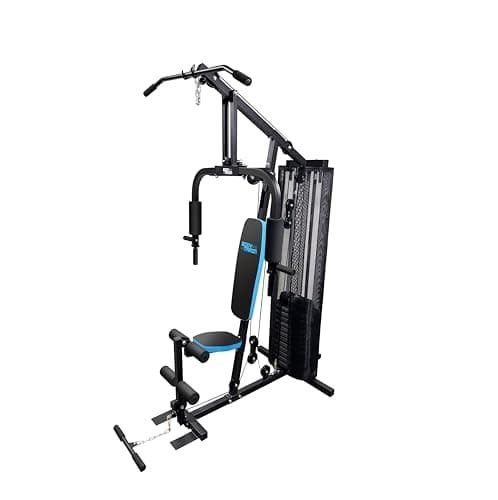
Home Gym
BodyTrain Advanced Single Station Multi Gym Review: 72kg for Under £300
Our BodyTrain multi gym review: the 72kg shrouded stack, 12.5lb jumps, stations, 213cm height, lifetime frame warranty and £283.99 price against rivals.

By Jack Atkins, Home Gym Equipment Specialist · Updated 3 November 2026
A cable crossover machine is two tall, separate towers, each with its own weight stack and a pulley you can set high or low, usually joined across the top by a pull up bar. You stand in the gap between them and pull the handles inwards, which is how the cable fly got its other name. At home it's the most versatile single piece of kit after a rack and a barbell, but the spec sheets mislead in two predictable ways: the stack weight isn't what you'll feel, and the height is often taller than the room you've got. This guide covers both, plus what to buy at each price.
Strip away the attachments and every crossover has the same parts. Two uprights carry a weight stack each, guided by steel rods. A cable runs from the stack over a set of pulleys to a handle, and on most modern home units that handle pulley slides up and down a column so you can set it anywhere from ankle to above head height. The cheapest designs fix one pulley at the top and one at the bottom of each tower instead.
The two towers are independent. That's the point. You can row with one arm, press with both, or set the left side at chest height and the right side at the floor for a woodchop, and neither stack cares what the other is doing.
These four get lumped together in Amazon listings, and they suit very different rooms.
Cable crossover. Two towers, wide apart, linked at the top. The GYM MASTER fixed-pulley model is about 251cm wide and its adjustable sibling stretches to 289cm, so you need a long wall. In return you get a big open working area for flies and lunging moves. Our GYM MASTER cable crossover review and RIP X cable crossover review cover the two best-known budget versions.
Functional trainer. Both stacks packed into one frame with pulley arms on the front. Far less floor, shorter cable path, and usually much more money; the Body-Solid functional trainer is around £1,658.
Single cable tower. One stack, one pulley. Cheaper and narrower, but you train one side at a time. The Bells of Steel cable tower is the premium example at around £1,100.
Wall-mounted. A single column bolted to masonry with two pulleys on it. The XS Sports cable pulley crossover takes up roughly 53cm by 52cm of floor and costs around £320, but the wall fixing is the whole job, and you'd better trust your brickwork.
There's a fifth hybrid now: a crossover built around a power rack. The Strongway 177kg crossover and the plate-loaded SPORTNOW crossover power cage both do this.
A selectorised stack means you move a pin and you're done. It's quick, which matters on supersets and drop sets, and it's what most people picture. The catch is a hard ceiling: once you can row the full stack, the machine has nothing more to give you.
Plate-loaded crossovers have carriages you load with Olympic plates. The SPORTNOW cage costs around £340 but ships with no weight at all, and our review reckons a usable plate set adds £150 to £300. You're never capped by a stack, though changing weight between sets is slower and you'll need somewhere to store the plates.
Stack quality varies too. GYM MASTER uses concrete-filled plates on both its crossovers, which is fine for function but bulkier per kilo than cast iron.
This is the single biggest source of disappointment, so here's the arithmetic.
The headline figure is the total plate weight across both towers. Strongway's 177kg is two 88.5kg stacks; GYM MASTER's 180kg is two 90kg stacks. So you start with roughly 90kg per side, not 180kg.
Then the pulley ratio cuts it again. On a 1:1 cable, a 10kg plate feels like 10kg at the handle. On a 2:1 cable, the extra pulley on the carriage halves the load and doubles the cable travel, so that same 10kg feels like 5kg. GYM MASTER lists its fixed-pulley crossover as 2:1, and our RIP X review puts effective resistance at around half the plate figure. A full 90kg stack on a 2:1 machine therefore gives you roughly 45kg per handle, a little less once friction takes its share.
Is 45kg per handle enough?
For flies, lateral raises, pushdowns, face pulls and curls, yes, by a long way. It's on heavy single-arm rows and two-handed lat pulldowns that strong lifters hit the top. If pulldowns matter most to you, look at a dedicated lat pulldown machine or a plate-loaded design.
Some listings don't publish a ratio at all. Neither JX FITNESS nor the adjustable GYM MASTER states one, so ask the seller before you buy if the number matters.
Measure before you fall in love with anything. Home crossovers cluster between 210cm and 225cm tall:
A typical modern UK ceiling is about 240cm, so most of these fit a spare room. Garages are where it goes wrong, because an up-and-over door track can sit 20cm or 30cm below the ceiling. Sloped lofts are mostly out. And if you want to hang from the pull up bar, you need clear space above the bar for your head, which on a 220cm frame means more than a standard ceiling gives you.
Width needs thinking about as well. Add a metre or so to each side of a cage-style machine so the cables have somewhere to go; our SPORTNOW review puts the real working width closer to three and a half metres than the 165cm on the box.
Floor loading is rarely a problem on a ground-floor slab. Upstairs on timber joists it's worth a thought: you're putting 180kg of plates plus a steel frame on two small footprints, then dropping the stack repeatedly. Put it near a load-bearing wall, spread it with rubber gym flooring, and don't let the stack crash down.
Almost everything above the waist, and a fair bit below it. For chest, the cable fly in high, mid and low versions is the classic crossover move, with the cable chest press for heavier pressing. Rows, single-arm pulldowns and face pulls cover the back. For arms there's the cable bicep curl and pushdowns; for shoulders, the cable lateral raise. Core and legs get the cable woodchop, pull-throughs and kickbacks.
Constant tension through the whole range is the selling point. The ACSM's position stand on resistance training progression recommends novices work in an 8 to 12 rep range and add 2% to 10% load once they can beat the target by a rep or two. That's where pin-selected stacks shine, provided the plate increments are small enough; on a 2:1 machine a 5kg plate becomes a 2.5kg jump, which is actually ideal for isolation work. The NHS asks adults to train all major muscle groups on at least two days a week, and a crossover makes that easy without a spotter. Our cable back exercises and cable shoulder exercises guides give you full sessions.
For most people with a spare room and a 240cm ceiling, the £380 GYM MASTER is the sensible default, and it's the top pick in our best cable machine UK roundup.
Check the GYM MASTER Cable Crossover Machine price on Amazonaround £379If you also want somewhere to squat and bench, skip a separate rack and look at the Strongway instead. It's more than double the price, but it replaces two machines.
Check the Strongway Cable Crossover 177kg price on Amazonaround £900It's two tall, independent towers, each with its own weight stack and pulleys at the top and bottom (often adjustable along the height), usually linked across the top by a pull up bar. You stand between them and pull handles towards the middle, which is where the 'crossover' name comes from. It lets you train chest flies, rows, pulldowns, curls, pushdowns and leg work on one frame.
A crossover has two towers spaced wide apart, so you get a big open working area between the stacks. A functional trainer puts both stacks in one compact frame with swinging pulley arms on the front. The trainer uses less floor; the crossover gives you a longer cable path and more room for wide flies and lunging moves.
Most home crossovers stand between 210cm and 225cm tall. Add at least 10cm for assembly, and realistically aim for 240cm if you want to use the pull up bar. Measure at the exact spot the machine will stand, because garage door tracks and sloped loft ceilings are the usual problem.
No. The figure is the total plate weight across both stacks, so each side typically carries about 90kg. Most home units also run a 2:1 pulley ratio or similar, which roughly halves what you feel at the handle. Expect something closer to 40kg to 45kg per handle at full stack on a 2:1 machine.
Wall-mounted single columns start around £320, plate-loaded cages around £340 before you buy plates, and freestanding dual-stack crossovers sit roughly between £380 and £480. A crossover with an integrated power rack is closer to £900, and commercial-grade functional trainers run well past £1,000.
Our BodyTrain multi gym review: the 72kg shrouded stack, 12.5lb jumps, stations, 213cm height, lifetime frame warranty and £283.99 price against rivals.
Every common cable machine attachment explained: D-handles, rope, straight and EZ bars, V-bar, ankle straps and more, with exercises, the 4 to buy first and prices.
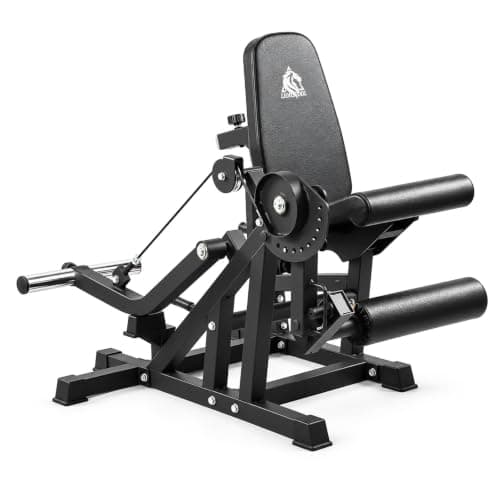
LIONSCOOL leg extension machine review: the V4.0's cable system, 400lb capacity, lying leg curl, 1.65m footprint and what the £429.99 price really buys you.
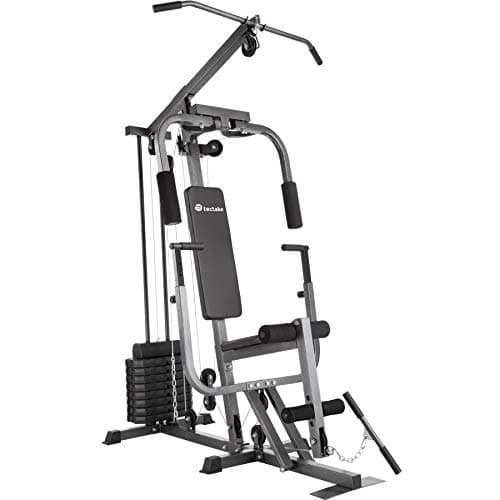
Our tectake multi gym review: chest press, fly, lat pulldown and leg extension, 4.5kg block steps, 150kg load limit, 203cm height and the missing stack weight.
Best Exercise is a participant in the Amazon EU Associates Programme, an affiliate advertising programme designed to provide a means for sites to earn advertising fees by advertising and linking to Amazon.co.uk. As an Amazon Associate we earn from qualifying purchases. This comes at no extra cost to you and never influences our independent reviews or rankings.