Home Gym
Cambered Bar Explained: Squat, Bench and Swiss Bar Types
What a cambered bar is, the three main types (cambered squat bar, bowed bench bar, cambered Swiss bar), what each one does, how much they weigh and how to buy one.

By Jack Atkins, Home Gym Equipment Specialist · Updated 25 July 2026
We may earn a commission from qualifying purchases made through links on this page, at no extra cost to you. This never affects our ratings.
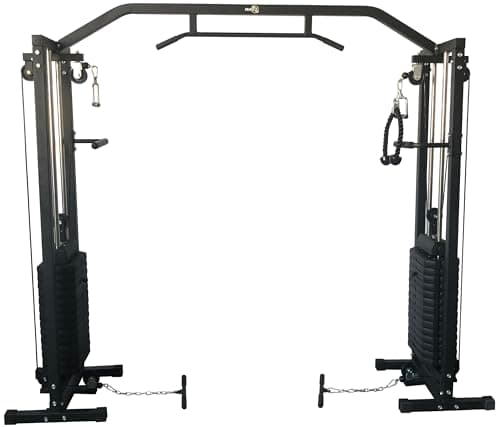
Cables are the thing most home gyms never quite sort out. A rack and a barbell handle your squats, presses and pulls, but flyes, lat pulldowns, face pulls, rows and triceps pushdowns all want a pulley, and buying those as separate stations costs a fortune and eats a room. The RIP X 180kg Cable Crossover tries to fix that in one frame: two adjustable pulleys, a 90kg stack behind each, and a pull up bar bolted across the top. My verdict after digging into the specs and what owners actually report is that it's a strong value pick for a home functional trainer, so long as you go in clear-eyed about two things, the real resistance and the ceiling it demands.
This sits in the mid-price bracket, around £379.99 at the time of writing, and that price tells you what it is. You're not getting commercial-gym tolerances or glass-smooth pulleys out of the box. What you're getting is the functional range of a proper cable area for roughly the cost of one decent commercial single station, in a footprint that lives in a garage.
How we review
This review draws on the manufacturer's published specs, verified owner reviews and expert write-ups of comparable home cable machines. We haven't run a months-long hands-on test of this exact unit, so we stick to the points that come up again and again, good and bad, rather than one-off opinions. Prices and specs are right at the time of writing and can shift.
This machine is for the lifter who already has the big lifts covered and wants the missing half of their training. If you own a power cage, a bar and some plates, adding two cable columns changes what you can do overnight, especially for the back, rear delts and arms, where free weights leave awkward gaps. It's also a smart pick if you're training around a niggle or coming back from injury, because cable tension is smooth and controlled with no bar to balance.
It's the wrong buy in three situations: a low ceiling, no appetite for a long build, or wanting a single machine to be your whole gym. This is a cable trainer, not a multi gym with a leg press hanging off it. If that's what you're after, start with our best multi gym UK guide.
The frame is where your money goes, and it's the right place for it to go. Two heavy uprights carry a 90kg selectorised stack each, the base is wide, and once the thing is squared and tightened it doesn't sway when you pull hard. RIP X have reworked the top and bottom swivel pulleys over earlier versions, and that swivel matters more than it sounds: it lets the cable follow your handle as you move through crossovers and single-arm work instead of dragging at an angle.
Now the part nobody prints on the box. That 180kg is the plate weight, not the resistance. It's two stacks of 90kg, and each pulley runs through a reduction, so the weight you feel in your hand is meaningfully lower than the pin you set. In practice it tends to land near half the plate value. This is completely normal for a cable crossover, every machine of this type does it, but people who expect a 90kg pin to feel like a 90kg dumbbell get a shock. The upside is that a big stack gives you plenty of usable range even after the reduction, and for flyes, pulldowns, rows and arm work you're highly unlikely to max it out. Don't buy this to move 180kg. Buy it for smooth, adjustable cable tension across a big range.
| Type | Dual column cable crossover and functional trainer |
|---|---|
| Total weight stack | 180kg, split as two 90kg selectorised stacks |
| Resistance at handle | Lower than plate weight due to pulley ratio, typically around half |
| Pulleys | Two, independently adjustable up and down the full upright |
| Pulley design | Improved top and bottom swivel for cleaner cable tracking |
| Pull up bar | Integrated across the top of the frame |
| Attachments | Handles supplied, standard fittings accept aftermarket bars and ropes |
| Ceiling height needed | Approx 2.2m minimum, more for the pull up bar |
| Assembly | Approx 3 to 6 hours, two people recommended |
| Mounting | Freestanding, floor fixing optional |
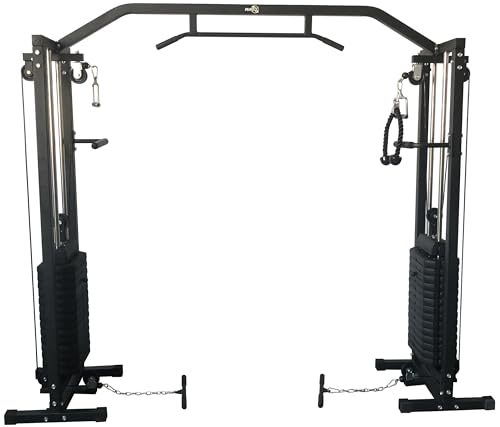
The case for a cable machine isn't that it beats free weights; it's that it does work free weights can't. Tension stays constant through the whole rep rather than dropping off at the top, and you can pull from lines a dumbbell simply won't give you. That constant loading through the full range is one of the genuine reasons to bother with cables (review of resistance training and muscular adaptations).
Crossovers are the obvious one, and with two columns you set both pulleys high and squeeze across the chest with a resistance curve that free weights fight you on. Set them high for lat pulldowns and you can drop the pin low enough for high-rep back work or load it up for heavy sets, then swap to a rope for face pulls in seconds. Rows come off the low position, and the constant tension makes them feel very different to a barbell row; your mid-back stays under load the whole way. Triceps pushdowns are a natural fit off the top pulley, and because each side is independent you can do single-arm pushdowns to even out a weaker arm. Face pulls deserve a specific mention, because they're one of the exercises almost nobody trains enough and almost everybody's shoulders need. A cable and a rope make them trivial; without a pulley they're a fiddly mess.
The dual adjustable pulleys are the reason to spend here rather than on a single-station machine. Both high gives you crossovers and pulldowns; both low gives you curls, upright rows and pull throughs; split them and you're into single-arm presses and chops. That range is what keeps the machine earning its floor space long after the novelty wears off, and it makes piling on volume for a lagging muscle easy without stacking on more heavy compound work. Volume matters, because it's one of the clearer levers for muscle growth even once your strength gains flatten out.
One honest note on smoothness. Home-grade cable machines often ship with guide rods and pulleys that feel a touch notchy at first. A wipe-down and a light lubricant before the first session makes a real difference, and it's worth doing before you write off how the stack moves.
Check price on AmazonAt around £379.99 the RIP X is a lot of functional trainer for the money. Put it next to a commercial crossover and the price gap is enormous; put it next to buying a separate pulldown, a low row and a crossover station, and it wins on both cost and space. The compromises are the ones you'd expect at this level and none of them is a surprise: a long build, a home-grade rather than commercial finish, and a real ceiling requirement that rules it out for some rooms entirely.
The one thing that isn't about build quality, and the thing to be honest with yourself about, is the resistance. If you walked in expecting 180kg of pulling power you'll feel short-changed. If you understand that the plate figure and the handle load are two different numbers, and you want smooth adjustable cable tension across a huge range of exercises, this delivers exactly that for a fair price. Cables are a supplement to a proper strength routine, not a replacement for one, and the NHS recommends strengthening work across all the major muscle groups on at least two days a week. A machine like this makes hitting the small, awkward groups far easier.
For a wider look at the options, our best cable machine UK guide sets out the alternatives, and if you want to nail the technique on the two exercises this machine is best at, we've got dedicated guides to the cable fly and the lat pulldown.
Check price on AmazonNo, and it's important to understand why before you buy. The 180kg is the total plate weight, split as two 90kg stacks, one per column. Because each pulley runs through a reduction, the weight you actually feel at the handle is lower than the plates you select, usually somewhere around half. So a 90kg stack does not fight you like a 90kg deadlift. For flyes, pulldowns, rows and arm work that reduced load is still plenty for most home lifters, but if you're expecting to pull a genuine 180kg you'll be let down.
A lot, which is the whole point of a dual pulley machine. Set the pulleys high and you get cable flyes, lat pulldowns, face pulls and triceps pushdowns. Drop them low and you get rows, biceps curls, upright rows and cable pull throughs. Put them at chest height for single arm presses and wood chops. The integrated pull up bar adds bodyweight pulling on top. Two independent columns mean you can train both sides at once or one arm at a time.
Yes. This is a tall frame with a pull up bar across the top, so plan on roughly 2.2m of clear height as a working minimum, and more if you want to hang and pull without tucking your knees. Measure to the lowest thing in the way, not the highest point of the room. Garage door tracks, strip lights and sloped ceilings catch people out constantly. Low ceiling height is the single most common reason these machines get returned.
It's a long afternoon, not a quick job. Expect three to six hours, and get a second person because the uprights and the loaded stacks are heavy and awkward to lift alone. The instructions are basic. Lay out and identify every part first, build the base square, and leave the bolts finger tight until the whole frame stands, then work round tightening in sequence. Rushed out of order, you'll be undoing things.
They do different jobs. A multi gym bolts on a fixed leg press, chest press and a few set movement paths, so it's a self-contained station. The RIP X is a pure cable trainer: two freely adjustable pulleys that cover far more angles, at the cost of not having a dedicated leg press. If you already own a rack, a bar and plates for your heavy lifts, the RIP X fills the cable gap better than a multi gym does. If you want one machine to be your entire gym, look at our best multi gym UK guide instead.
The frame itself is wide because the two columns sit either side of a crossover zone, and you need clear room in the middle to stand and press without clipping the cables. Budget for the width of the frame plus a metre or so of working space in front. It suits a single garage or a dedicated gym room. It is not a fold-away that tucks behind a door.
What a cambered bar is, the three main types (cambered squat bar, bowed bench bar, cambered Swiss bar), what each one does, how much they weigh and how to buy one.
What a landmine attachment is, the rack-mounted, plate-post and floor platform types, how to check bar and rack fit, safety tips, and the best exercises to do.
What a safety squat bar is, how much it weighs, how it changes your squat compared with a straight bar, who it suits and what to check before buying one in the UK.
What a Swiss bar (football or multi-grip bar) is, how much it weighs, why the neutral grip suits sore shoulders, the best exercises and what to check when buying.
Best Exercise is a participant in the Amazon EU Associates Programme, an affiliate advertising programme designed to provide a means for sites to earn advertising fees by advertising and linking to Amazon.co.uk. As an Amazon Associate we earn from qualifying purchases. This comes at no extra cost to you and never influences our independent reviews or rankings.