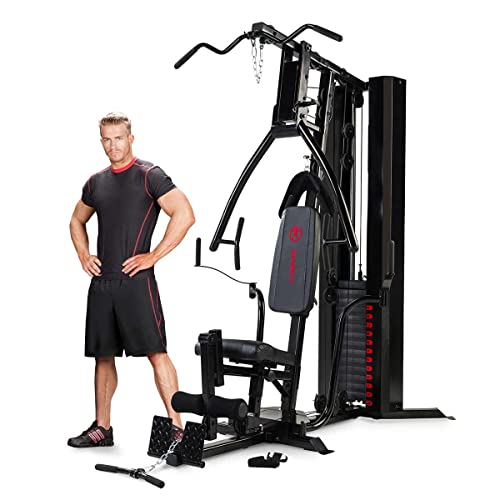
Home Gym
Marcy HG5000 Multi Gym Review: 90kg Stack, Separate Pec Dec and a Lifetime Frame Warranty
Our Marcy HG5000 review: the 90kg stack versus the 106kg claim, independent chest press and pec dec, 211cm height, 135kg user limit and £699 price.

By Jack Atkins, Home Gym Equipment Specialist · Updated 23 November 2026
A power tower is a tall, free-standing steel frame that combines a pull-up bar, dip handles, a vertical knee raise station and, usually, push-up handles in one footprint. It's the closest a home gym gets to a full upper-body and core station without drilling into a wall or buying a power cage, and it's why retailer pages sell them in their hundreds. What those pages rarely tell you is whether one will actually fit your room, what each station is good for, and where the cheaper frames fall down. That's what this guide covers.
Strip the marketing away and a power tower is two upright posts on a wide H-shaped or bracket-shaped base, joined at the top by a pull-up bar. Halfway up, a padded backrest and two horizontal arm pads form the knee raise station, and at the front of those arm pads you'll find angled dip handles. Most frames also have a pair of short handles near the floor for push-ups.
The uprights are telescopic on most models, so the bar height adjusts in steps of a few centimetres. That matters more than any other feature, as you'll see below.
Retailers also sell the same thing as a "pull up and dip station", "dip tower" or "free standing pull up bar". The naming overlaps almost completely; if you want the broader view of frames without the extra stations, our free-standing pull up bar guide covers those.
The top bar normally has several grip positions: a straight section for wide overhand pull-ups, angled ends, and on many towers a pair of neutral (palms-facing) handles. That gives you pull-ups, chin-ups and neutral-grip pulls without moving anything. Mayo Clinic EMG work found the lats working at well over 100% of maximal voluntary contraction across pull-up and chin-up variations (Youdas et al., 2010), which is why the bar is the station you'll use most.
Two handles about shoulder width apart, usually at chest to shoulder height. On a tower they're higher off the floor than on a stand-alone dip station, so taller users can go through a full range without their feet hitting the ground. The drawback is that the width is almost always fixed. If you're broad through the shoulders, they can feel tight.
This is the station people underrate. You rest your forearms on the pads, press your back into the backrest and lift your knees or straight legs. Because your arms are supported, grip stops being the limit, so you can train your abs and hip flexors to real fatigue instead of letting go of a bar because your hands gave out.
Low handles at the base that let you go deeper than a floor push-up and take some strain off the wrists. They're the least important station on the frame, and on some towers they're positioned so close to the uprights that your feet catch the base. Treat them as a bonus.
A tower makes most sense if pull-ups and dips are going to be the backbone of your upper-body training and you can't, or don't want to, drill into a wall. Renters, people with plasterboard walls that won't take a wall-mounted bar, and anyone setting up a garage gym on a budget fall into this group.
It's a poorer fit if your room has a standard ceiling and you're over about 185cm, because you'll be running the bar well below its top setting. It also overlaps heavily with a squat rack that already has a pull-up bar; in that case a set of floor dip bars does the missing job for far less money.
The training case is solid. The NHS advises adults to do strengthening activities that work all the major muscle groups on at least 2 days a week, and a tower covers the upper body and trunk side of that in one bit of kit.
Work out two numbers before anything else. First, the maximum bar height on the listing. Second, your ceiling height, measured where the tower will actually stand (garage ceilings often drop around beams and doors). At the top of a pull-up your head sits roughly 25 to 30cm above the bar, so a 235cm bar in a 240cm room is unusable at full height.
Then check the lowest setting. A low bar is handy for shorter users, for band-assisted work and for starting from a box, and it means you can still use the frame in a low-ceilinged room by dropping a notch or two.
Bigger base, less rock. The deep side of the base should run front to back, because that's the direction your body swings during a pull-up. A footprint under about 90 x 65cm on a full-height tower is a warning sign. Mark the footprint on the floor with masking tape, then add room in front for your legs on knee raises and behind for any swing.
Listings give one static figure, usually somewhere between 120kg and 230kg. Add your bodyweight to whatever you plan to hang from yourself later (a dip belt with a 20kg plate, a weight vest) and leave a generous margin on top, because a pull-up isn't a static load: the force through the bar spikes as you accelerate. If a listing quotes two different capacities, plan around the lower one.
Frame weight tells you more about stability than the capacity figure does. Many budget towers weigh 20 to 25kg, and the better-built ones are around 28 to 35kg. Thicker tubing and fewer telescopic joints generally mean less flex. If the listing doesn't publish the assembled weight, take that as a reason for caution rather than a neutral detail.
Some towers let you move the backrest and arm pads independently of the pull-up bar. That's worth having if more than one person will use it, since the knee raise station needs to suit your torso length, not just your reach.
A few frames include a bracket or strap to tie the top of the tower to a wall. It's not essential, but it's the single most effective fix for wobble, so a tower that offers it is a plus.
Is there a safety standard?
Indoor fitness equipment in the UK is covered by BS EN ISO 20957-1, the general safety and test-method standard for stationary training equipment (it replaced the older BS EN 957 series). Most budget power tower listings on Amazon don't state conformity with it, so you can't assume a frame has been tested to it. Where a manufacturer does cite it, that's a point in the product's favour.
Every tower moves if you swing on it. You're hanging 70kg or more from the highest, narrowest point of a 25kg structure, so physics is not on your side. Strict reps are fine. Kipping, fast negatives and anything with a swing push your centre of mass outside the base and the frame starts walking or lifting its back feet.
The fixes, in order of cost:
If you want to kip or do muscle-ups, don't buy a tower for it. A bar bolted to masonry, like the options in our wall-mounted pull up bar guide, is the right tool.
Expect an hour or more, and it's much easier with two people because the uprights are awkward to hold square while you start the bolts. Leave every bolt finger-tight until the whole frame is together, then tighten them in sequence. Powder-coated holes sometimes need a bit of persuasion to line up; that's normal and doesn't mean a part is faulty. A frame bolted tight while slightly out of square is the usual root cause of a tower that rocks from day one.
The backrest and arm pads on budget towers are thin and compress over months. It's cosmetic until your elbows start to feel the steel, at which point a folded towel or a cheap foam wrap sorts it.
Here's how the stations map to exercises, with our technique guides for each:
A simple twice-weekly session would be 3 sets each of pull-ups, dips, knee raises and push-ups, which fits within the NHS strength guidance above. When bodyweight gets easy, a dip belt lets you keep adding load to pull-ups and dips.
What a tower can't do is train your legs or load your lower body. Budget for squats and lunges elsewhere.
The three options do overlapping jobs at very different prices.
| Power tower | Free-standing pull-up frame | Doorway bar | |
|---|---|---|---|
| Pull-ups | Yes | Yes | Yes (strict only) |
| Dips | Yes | Usually no | No |
| Supported knee raises | Yes | No | No |
| Drilling | None | None | None for most |
| Floor space | Permanent, roughly 1m square | Permanent, a bit less | None |
| Stability for swinging | Poor to fair | Poor to fair | Poor |
| Typical cost | Highest of the three | Middle | Lowest |
A doorway bar wins on price and takes up no floor space, but it only does pull-ups and it can mark your door frame. A plain free-standing frame suits someone who only wants to hang and pull. The tower is the pick when dips and supported core work matter to you as much as pull-ups, and you're happy to give up a corner of the room. Our best pull up bar UK guide compares doorway, wall and free-standing options side by side, and if dips are your priority, a stand-alone unit from our best dip station UK round-up is cheaper and easier to store.
The Sportsroyals Power Tower is the one we've covered in depth. It's listed at around 235cm at full height on a roughly 107 x 81cm base, weighs about 28kg, and has a wide bracket-style base with adjustable foot caps. Its current listing gives a 204kg load capacity, though earlier versions of the same listing quoted 400 lb and 450 lb, so treat 181kg as the safe planning figure. The 235cm maximum is the catch: in a standard UK room you'll use it a notch or two down. Our Sportsroyals Power Tower review has the full breakdown.
Check the Sportsroyals Power Tower price on AmazonA power tower is a free-standing steel frame for bodyweight upper-body and core training. The usual stations are a pull-up bar at the top, dip handles at chest height, a padded back and arm rests for vertical knee raises, and low push-up handles at the base. Between them you can train your back, chest, shoulders, arms and abs without drilling into a wall.
Most adjustable towers run from somewhere around 150 to 165cm at their lowest bar setting up to 210 to 235cm at the highest. A typical UK room is about 240cm floor to ceiling, so check the maximum height on the listing and remember you need room above the bar for your head at the top of a pull-up.
They're safe for controlled bodyweight work when assembled correctly, used on a level floor and kept within the rated load. The risk comes from swinging: kipping pull-ups and explosive dips shift your weight outside the base and can make a light frame rock or walk. Re-tighten the bolts after the first couple of weeks and weight the base if it moves.
Yes. Pull-ups, chin-ups, dips, push-ups and knee raises train every major upper-body muscle group plus your trunk. Once bodyweight reps get easy, add load with a dip belt or weight vest, slow the lowering phase, or move to harder variations. It won't train your legs, so pair it with squats, lunges or a set of dumbbells.
The frame itself usually covers around 90 x 65cm up to 110 x 85cm. Allow extra space in front for your legs during knee raises and dips, and behind for any swing, so plan on roughly a 1.5m by 1.2m patch of floor with the tower's deep side running front to back.
Not for strict reps on a decent frame. Anchoring helps if your tower rocks even after you've levelled the feet, added a rubber mat and weighted the base, or if you're a heavier user near the rated limit. A strap or bracket from the top of the frame to a wall stud or masonry is a much smaller job than mounting a full pull-up bar.
Our Marcy HG5000 review: the 90kg stack versus the 106kg claim, independent chest press and pec dec, 211cm height, 135kg user limit and £699 price.
What a weight sled is, push vs drag sleds, why your floor matters more than the plates, Olympic posts, empty sled weight and what to check before you buy one.
How Apple Watch estimates VO2 max (Cardio Fitness), where to find it in the Health app, how accurate it is against lab tests, how to raise it and how it compares to Garmin.
Fitbit Charge 6 vs Inspire 3 compared: built-in GPS, ECG, Google Wallet, battery, size and price. Our clear verdict on which tracker suits you in the UK.
Best Exercise is a participant in the Amazon EU Associates Programme, an affiliate advertising programme designed to provide a means for sites to earn advertising fees by advertising and linking to Amazon.co.uk. As an Amazon Associate we earn from qualifying purchases. This comes at no extra cost to you and never influences our independent reviews or rankings.