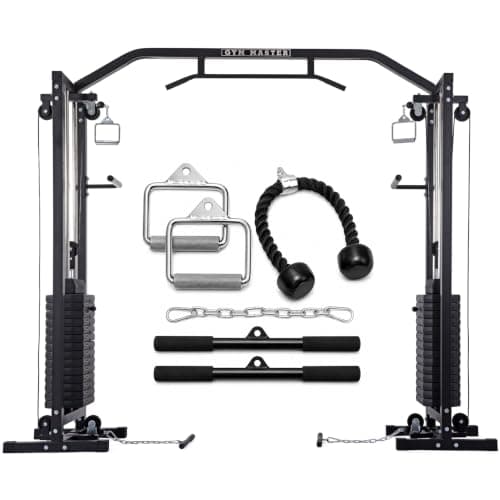
Cables are the one thing most home gyms are missing. You can cover squats, presses and deadlifts with a rack and a barbell, but chest flyes, lat pulldowns, face pulls, triceps pushdowns and cable rows all want a pulley, and buying those stations separately is neither cheap nor space-efficient. The GYM MASTER Cable Crossover is an attempt to solve that in one frame: two adjustable pulleys either side of a large weight stack, with a pull up bar across the top. The verdict is that it succeeds on value and versatility, and asks you to accept a long build and a genuine ceiling height requirement in return.
This is a home machine at a home price, and it is worth being clear about what that means. The tolerances are not commercial, the pulleys are not butter-smooth out of the box, and the guide rods want a wipe and a light lubricant before first use. What you get instead is the functional range of a commercial cable area for a fraction of the outlay, in a footprint that fits a single garage.
How we review
This review is based on close research of verified owner reviews, the manufacturer's published specifications and expert write-ups of comparable home cable machines. We have not run a months-long hands-on test of this exact unit, so we stick to the findings that come up repeatedly, both positive and negative, rather than isolated opinions. Prices and specs are correct at the time of writing and can change.
Who it is for
This machine suits the person who already has the basics and wants to fill the gap. If you own a power cage, a bar and some weight plates, adding cables transforms what you can train, particularly for the back, rear delts and arms, where free weights alone leave awkward holes. It also suits anyone rehabbing or training around an injury, because cable resistance is smooth and constant with no bar to control.
It is the wrong buy if your ceiling is low, if you cannot commit an afternoon to assembly, or if you want a single machine to be your entire gym. It is a cable station, not a multi gym with a leg press and a chest press bolted on. If that is what you are after, our best multi gym UK guide is the better starting point.
Pros
Dual adjustable pulleys cover high, mid and low positions on both sides
Large stack means you will not outgrow the resistance quickly
Pull up bar included, so it doubles as a pulling station
Genuinely good value against any comparable commercial-style cable machine
Wide, heavy base is stable freestanding for most training
Cable work gives constant tension through the full range, unlike free weights
Covers flyes, pulldowns, rows, face pulls, curls and pushdowns in one frame
Cons
Needs roughly 2.2m of ceiling height, more to use the pull up bar well
Assembly takes three to six hours and really wants two people
Instructions are basic and some hardware is poorly labelled
Pulleys benefit from cleaning and lubricating before first use
Weight at the handle is lower than the number on the stack
Finish and tolerances are home grade, not commercial grade
Build, assembly and the ceiling problem
The frame itself is reassuringly heavy. The uprights are substantial, the base is wide, and once it is together and square it does not shift or wobble during normal work. Owners who train hard on it consistently report that stability is not the weak point.
Assembly is the weak point. Budget an afternoon rather than an hour. The parts are heavy enough that lifting the uprights alone is unwise, the instruction booklet is sparse, and several people note that bolt bags are not always labelled clearly. The practical advice that comes up again and again is sound: lay every part out and identify it before you start, build the base square, and leave every bolt finger-tight until the whole frame is up, then tighten in sequence. Do it that way and it goes together fine. Do it out of order and you will be undoing work.
The ceiling height requirement deserves its own warning because it is the most common cause of regret. This is a tall machine. Around 2.2m of clear height is the practical minimum, and if you want to hang from the pull up bar without folding your legs you need more again. Measure before you buy, and measure to the lowest obstruction, not the highest point of the room. Garage door tracks, ceiling lights and sloping ceilings have all caught people out.
GYM MASTER Cable Crossover key specs
Type
Dual pulley cable crossover and functional trainer
Weight stack
180 kg selectorised, shared across the system
Pulleys
Two, independently adjustable through the full upright height
Pull up bar
Integrated across the top of the frame
Adjustment
Pin-selected weight, multiple pulley heights per side
Attachments
Handles supplied, standard fittings accept aftermarket bars
Ceiling height needed
Approx 2.2 m minimum
Assembly
Approx 3 to 6 hours, two people recommended
Mounting
Freestanding, floor fixing optional
In use
The reason to own a cable machine is not that it beats free weights. It is that it does different work. Resistance stays constant through the whole range rather than falling away at the top of a rep, and you can pull from angles a dumbbell simply cannot produce. Face pulls, cable rows, pulldowns and crossovers all become straightforward, and the rear delts and mid-back in particular are far easier to train properly with a pulley than without one.
The dual adjustable pulleys are what make it worth the money over a single-station machine. Set both high and you have crossovers and pulldowns. Set both low and you have curls, upright rows and pull throughs. Set them at different heights and you can work single-arm presses and chops. That range means the machine keeps earning its floor space long after the novelty has gone, and it makes it easy to add volume to a muscle group without adding more heavy compound lifts. That matters, because training volume is one of the clearer levers for muscle growth even when strength gains flatten out (study on resistance training volume and hypertrophy).
Two honest notes on the resistance. First, the number on the stack is not the weight you feel at the handle. Pulley ratios reduce it, which is completely normal for this type of machine but surprises people who expect 180kg to feel like 180kg. Second, the plates run in guide rods that ship dry. Cleaning them and applying a light lubricant before first use makes a noticeable difference to how smooth the stack feels, and several owners who initially complained about notchy movement report it resolved after doing exactly that.
Is the GYM MASTER Cable Crossover worth it for a home gym?
For the money it is one of the better ways to add cable work to a home gym. You get dual adjustable pulleys, a large stack and a pull up bar in one frame, which covers a big share of what a commercial gym cable area does. It is not a commercial machine and it does not pretend to be, but if you want chest flyes, lat pulldowns, rows, face pulls and triceps work at home without buying four separate machines, it earns its place.
What ceiling height do you need for the GYM MASTER Cable Crossover?
Plan on roughly 2.2m of usable height as a minimum, and more if you intend to use the pull up bar properly. This is the single most common reason people end up disappointed, so measure the height of the room, including any garage door track or light fitting in the way, before you order.
How hard is the GYM MASTER Cable Crossover to assemble?
It is a long job. Most owners report somewhere between three and six hours, and it is much easier with two people because of the weight of the uprights and the stack. The instructions are basic and some hardware is not clearly labelled, so allow an afternoon, lay the parts out first and do not fully tighten anything until the frame is square.
Is the 180kg weight stack per side or in total?
The stack is shared across the system rather than being 180kg of usable resistance on each individual handle. Because of the pulley ratio, the weight you actually feel at the handle is lower than the number on the plate, which is normal for cable machines. In practice most home users find the resistance range more than sufficient for flyes, rows, pulldowns and arm work.
Can you do lat pulldowns and rows on it?
Yes. The adjustable pulleys run the full height of the uprights, so setting them high gives you lat pulldowns, face pulls and triceps pushdowns, and setting them low gives you rows, curls, upright rows and cable pull throughs. That versatility is the main reason to buy a dual pulley machine rather than a single-station one.
Does it need to be bolted to the floor?
It is designed to be stable freestanding thanks to the weight of the stack and the width of the base, and most owners use it without bolting it down. If you train explosively, or the machine sits on an uneven garage floor, fixing it down or shimming the feet is a sensible precaution and makes the whole frame feel considerably more solid.
An honest Fitbit Inspire 3 review covering its AMOLED screen, 10-day battery, sleep and heart rate tracking, connected GPS, the Premium paywall and who should buy it.
Our Fitbit Versa 4 review covers built-in GPS, 6+ day battery, Google Maps and Wallet, the lost third-party apps and Wi-Fi, and who should buy it at £179.
An honest Garmin Lily 2 Active review: built-in GPS on a 38mm, 29g case, 9 day battery, Garmin Pay, and the greyscale screen and missing music storage to weigh against the price.
Garmin vivomove Trend review for UK buyers: analogue hands over a hidden touchscreen, Body Battery, Garmin Pay, Qi charging, and the 5 day battery and missing GPS to weigh up at £232.
Best Exercise is a participant in the Amazon EU Associates Programme, an affiliate advertising programme designed to provide a means for sites to earn advertising fees by advertising and linking to Amazon.co.uk. As an Amazon Associate we earn from qualifying purchases. This comes at no extra cost to you and never influences our independent reviews or rankings.