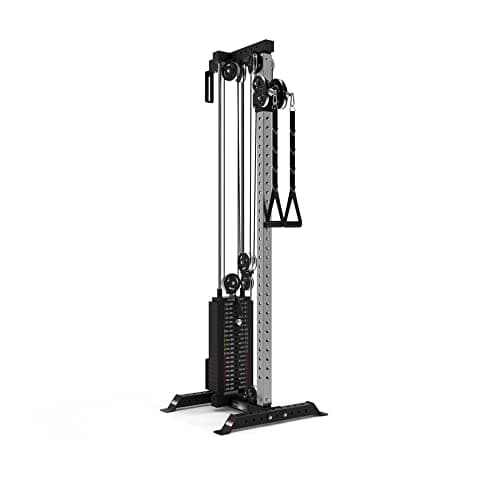
Most home gym owners hit the same wall eventually. The rack handles squats and presses, the bench covers what a bench covers, and then there is an entire category of training that simply cannot be done with free weights: constant-tension cable work, proper lat pulldowns, face pulls, cable flyes at a fixed angle. The usual answer is a functional trainer the size of a wardrobe. The Bells of Steel Cable Tower is the answer for people who do not have a wardrobe's worth of floor to give up.
It packs a 210lb selectorised stack into a footprint under 2.5 feet square, and at around £1,100 it undercuts most full functional trainers by a considerable margin. There's a catch, and it's a pulley ratio, so let's deal with that properly rather than burying it.
How we review
This review is based on Bells of Steel's published specifications, the current Amazon UK listing and recurring themes across verified owner feedback and independent home gym testing. We have not run a long-term teardown of this exact unit, so we report consistent findings and flag the areas where opinion genuinely splits.
The pulley ratio nobody reads about first
Out of the box the Cable Tower runs a 2:1 pulley ratio. The handle travels twice as far as the stack, and you feel roughly half the selected weight. Pin the full 210lb and you're pulling about 105lb, or 48kg, at the handle.
That's not a defect, it's a design decision, and for a lot of training it's the better setup. Cable movements built on speed and range benefit from a light, fast-moving handle with a long travel, and 48kg is more than enough for flyes, lateral raises, curls, triceps pushdowns and face pulls. The trouble comes on heavy pulling. If you can lat pulldown 70kg, the default configuration will not challenge you.
Bells of Steel's fix is a 2-to-1 cable adapter, supplied in the box, which joins the dual cables into a single line for a genuine 1:1 pull. Fit it and you have the full 95kg with 230cm of cable travel. Swapping between configurations takes a minute or two, which is fine if you set up once per session and irritating if you want to superset a heavy row with light flyes. Know this before you buy and you'll be happy. Discover it after, and it feels like a bait and switch.
Pros
Full 210lb selectorised stack in a footprint under 2.5ft square
Over 30 height settings with numbered markings every five holes
Switchable between 2:1 speed and 1:1 full-load configurations
Smooth, quiet pulleys with no noticeable cable judder
Limited lifetime frame warranty and spare parts held in stock
Wall brackets, handles, carabiners and adapter all included
Roughly half the price of a comparable full functional trainer
Cons
Default 2:1 ratio halves the load, which catches buyers out
Only 90 days of warranty on cables and pulleys
Wall mounting is strongly recommended, which rules out renters
Two nylon handles only, so budget for a lat bar and a rope
Single pulley column, so no dual-cable crossover movements
Assembly is a long job and better done with two people
Build and adjustability
The tower stands 205cm tall on a base of roughly 72cm by 53cm, which is the whole point of the thing. Bells of Steel's own figure is that most cable towers need three to four times the space to deliver the same training, and having looked at the footprints of the alternatives, that's not an exaggeration.
Adjustability is the quiet strength here. There are over 30 pulley height positions with the uprights numbered every five holes, so once you know that face pulls are hole 22 you never hunt for the setting again. Most competing towers offer half that granularity, and the difference shows up on movements where a few centimetres changes the angle of the resistance completely.
The pulleys run smoothly and quietly. Cable travel is 230cm in the single-cable configuration and around 116cm with the dual cable, which is enough for a full pulldown or a long woodchop. The frame carries a limited lifetime warranty, cables and pulleys get 90 days, and Bells of Steel keeps spare parts in stock. That last point is worth more than the warranty terms suggest, because cables are a consumable on every cable machine ever made and the real question is whether you can buy a replacement in three years.
Limited lifetime frame, 90 days cables and pulleys
Price
Around £1,100 at the time of writing
What you can actually train
Everything the constant-tension category is good for. Lat pulldowns and straight-arm pulldowns from the top position, seated and standing rows from the bottom, cable flyes and face pulls from the middle, plus curls, triceps pushdowns, cable crunches, woodchops and Pallof presses. Our guides to the lat pulldown, the cable fly and the Pallof press cover the technique for each.
What you cannot do is a true crossover, because this is a single column rather than a dual-tower setup. If crossovers are the reason you want a cable machine, you need a wider unit, and our best cable machine UK guide covers those.
The training case for adding cables to a rack-based home gym is straightforward. The ACSM's position stand on resistance training progression makes the point that varied loading patterns and progressive overload across multiple exercises drive continued adaptation, and cables give you angles and constant tension that a barbell simply cannot produce. For a home setup, that's the gap this fills.
Bells of Steel publishes the full specification list on its Cable Tower product page if you want to check dimensions against your ceiling height before ordering.
Who should buy it
Someone with a rack, a bench and a bar who has run out of things free weights can teach them, and who has a wall they're allowed to drill. That's the sweet spot. At around £1,100 it costs roughly half what a comparable weight-stack functional trainer does, and it gives up dual-cable crossovers and a bit of convenience in exchange.
Renters should think carefully, because wall mounting is the recommended setup and the small footprint that makes this appealing is exactly what makes anchoring worthwhile. Anyone who pulls seriously heavy should factor in the adapter swap as part of their routine rather than an afterthought. And if you're still building the basics, a power cage and a weight bench will do more for you first. You'll find the rest of our strength kit coverage in the home gym hub.
Frequently asked questions
What does the 2:1 pulley ratio mean on the Cable Tower?
It means the handle moves twice as far as the weight stack, so you feel roughly half the load you selected. A 210lb stack gives you about 105lb, or 48kg, at the handle in the default configuration. That is plenty for flyes, face pulls, curls and triceps work, but it will run out on heavy lat pulldowns and rows. Bells of Steel includes a 2-to-1 adapter that joins the cables for a true 1:1 pull when you want the full stack.
Is 210lb enough for a home cable machine?
For isolation and accessory work, comfortably. For heavy compound pulling it depends on how you configure it. Run the adapter for a 1:1 pull and you have the full 95kg, which covers lat pulldowns and seated rows for most people who are not competitive lifters. Run it at 2:1 and you have a fast, smooth 48kg that suits higher-rep work.
Do you have to bolt the Cable Tower to a wall?
Bells of Steel supplies two L-brackets for wall mounting and it is the recommended setup. The tower is tall and the footprint is deliberately small, so anchoring it removes any question about stability during hard pulls. If you cannot drill, position it against a rack upright or a solid wall and be sensible about how aggressively you pull.
How much space does the Cable Tower need?
The base measures roughly 72cm by 53cm and the unit stands about 205cm tall, so the machine itself fits into well under a square metre. What you actually need is working room in front of it, ideally two to three metres for rows, pulldowns and cable woodchops.
What attachments come with the Bells of Steel Cable Tower?
Two adjustable nylon handles, two carabiners, the 2-to-1 cable adapter and two wall mounting L-brackets. That is enough to train the day it arrives, but most owners add a lat bar, a rope and an ankle strap fairly quickly, which is another £60 to £100 to factor in.
What warranty does Bells of Steel offer?
A limited lifetime warranty on the frame and 90 days on the cables and pulleys, with spare parts kept in stock. The short cable warranty looks mean next to the lifetime frame cover, though cables are a wear item on any machine and being able to buy replacements matters more than the warranty length.
Are adjustable dumbbells worth it? We run the UK numbers on cost and floor space against a fixed hex set, then cover dial, twist and spin-lock types, drop risk and who should skip them.
Our Relife vertical climber review covers its 4 guide rails, 150kg limit, 5 step levels and folding frame, and asks whether £516 is fair when rivals cost far less.
Our Xiser mini stepper review covers the cast alloy build, hydraulic resistance, sprint use and warranty, and explains who should save £500 and buy a cheap stepper instead.
An honest Fitbit Inspire 3 review covering its AMOLED screen, 10-day battery, sleep and heart rate tracking, connected GPS, the Premium paywall and who should buy it.
Best Exercise is a participant in the Amazon EU Associates Programme, an affiliate advertising programme designed to provide a means for sites to earn advertising fees by advertising and linking to Amazon.co.uk. As an Amazon Associate we earn from qualifying purchases. This comes at no extra cost to you and never influences our independent reviews or rankings.