Home Gym
Fitbit vs Apple Watch: Which Should You Buy in 2026?
Fitbit vs Apple Watch for UK buyers: battery, price, Google Health Premium, GPS, accuracy research and apps compared, with a straight answer on which to buy.

By Jacob Chambers, Founder & Lead Reviewer · Updated 8 August 2026
We may earn a commission from qualifying purchases made through links on this page, at no extra cost to you. This never affects our ratings.
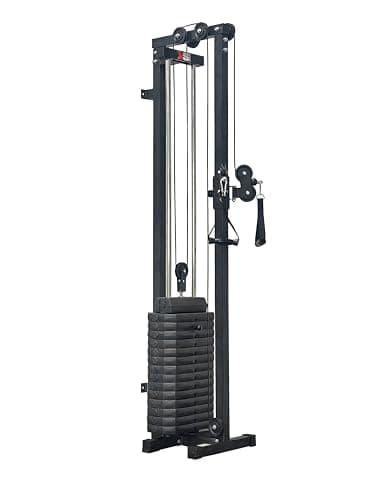
Most home cable machines have the same problem: they are enormous. A proper functional trainer eats two square metres of floor before you have loaded a plate, which rules it out of the spare bedrooms and single garages where most UK home gyms actually live. The XS Sports Cable Pulley Crossover takes the obvious way out and bolts the whole thing to the wall. At roughly 53cm deep it occupies about as much floor as a bookshelf, and it comes with 68kg of plates in the box for around £320.
That is an unusually good deal on paper. The catch is not the machine. It is your wall.
How we review
This review is based on XS Sports' published specifications, the recurring themes in verified owner reviews of wall-mounted trainers, and the research on cable and machine-based training. We have not run a long-term hands-on test of this exact unit, so we stick to consistent, repeated findings rather than one-off opinions, and we flag the installation requirements plainly because they are the part people underestimate.
A single upright column, 212cm tall, carrying two independently adjustable pulleys that slide the full height of the frame. Fifteen weight plates totalling 68kg come with it, along with two handles that clip on to the cable ends. The pulleys can be worked one at a time, both together, or clipped into a single point for a straight-bar-style pull.
That adjustability is the whole argument for a cable machine over a rack of dumbbells. Set the pulleys high and you have lat pulldowns, tricep pushdowns, face pulls and cable crossovers. Drop them to the floor and you have cable rows, bicep curls, upright rows and glute kickbacks. Set them at mid height and you have chest presses, wood chops and pallof presses. One column covers the majority of the isolation and accessory work most people drive to a gym for.
Read this bit before you order anything. The unit is 212 x 53 x 52cm and it carries 68kg of static plate weight, plus whatever force you generate pulling against it. Every bit of that load goes into the wall. XS Sports is explicit that it must be mounted on a sturdy wall with fixings correct for that wall type, and that instruction is not boilerplate.
In practice that means brick, block or concrete, with resin or expansion anchors sized properly. Plasterboard with a timber stud behind it is not adequate for this load, whatever a forum post says. Garage walls, converted outbuildings and older solid-wall houses are the natural home for this machine. Modern timber-frame builds usually are not, and that alone will make the decision for a lot of buyers.
Budget an afternoon and a second pair of hands. Getting a 212cm column plumb and level while someone holds it is not a solo job, and neither is loading plates onto a carriage at head height.
| Type | Wall mounted dual adjustable pulley (functional trainer) |
|---|---|
| Dimensions | 212 x 53 x 52 cm |
| Weight included | 68 kg, supplied as 15 plates |
| Pulleys | 2, independently adjustable through full height |
| Handles included | 2, clip-on |
| Attachment compatibility | Standard functional trainer accessories |
| Usage modes | Single arm, dual arm, or both cables clipped together |
| Mounting | Solid masonry wall required, fixings not universal |
| Storage | None built in |
Cables are best at the things barbells are worst at. Constant tension through the whole range, no dead spot at the top, resistance from any angle you can set a pulley to, and no chance of dropping anything on yourself when training alone. For rear delts, triceps, lats, chest flies and rotational core work, a cable column beats a dumbbell every time.
Where it runs out is heavy bilateral loading. Because both pulleys draw from the same 68kg system, a two-handed lat pulldown or a seated row shares that load rather than doubling it. Most people will find the ceiling on rows and pulldowns well before they find it on curls or pushdowns. If you are already pulling heavy, this is not the machine to replace a lat pulldown station in a commercial gym; it is the machine that means you do not have to drive to one for accessory work.
The trade-off between cables and free weights is less dramatic than either camp claims. A 2023 systematic review and meta-analysis of 13 studies covering 1,016 participants found no difference between free-weight and machine-based training for hypertrophy or jump performance, and found that strength gains were simply specific to whichever modality had been trained (BMC Sports Sci Med Rehabil, 2023). In other words, pick the equipment you will use consistently. The NHS asks for muscle-strengthening work covering all the major muscle groups on at least two days a week, and a machine in the garage gets used far more often than a gym membership across town.
Two handles is not enough. A rope for triceps and face pulls, a straight or lat bar for pulldowns, and an ankle strap for glute work cover almost everything else the column can do, and the whole set costs a small fraction of the machine. A weight bench turns it into a chest press and seated row station, which roughly doubles the exercise list. Beyond that, a pair of adjustable dumbbells fills the compound gap the cables leave.
If your wall will not take it, the freestanding alternatives are worth a look. Our best cable machine UK guide covers floor-standing options, and the Gym Master cable crossover is the obvious comparison at a similar price with a much larger footprint.
For the money it is a lot of machine. Around £320 buys a dual adjustable pulley system with 68kg of plates included, in a footprint of roughly 53cm deep. The compromises are real though: it needs a genuinely solid wall, the plate-loaded stack is slower to change than a pin stack, and only two handles come in the box. As a first cable machine in a spare room or garage it makes a lot of sense.
Solid masonry, brick or block, with the correct fixings for your wall type. This is not a plasterboard job under any circumstances. The unit stands 212cm tall and carries 68kg of plates plus whatever force you pull with, so the fixing is the single most important part of the whole install. If you are unsure about your wall, pay a builder for an hour rather than guessing.
68kg in total, supplied as 15 plates. Because both pulleys draw from the same loading system, that is 68kg for a single-arm movement and split across the two when you use both handles at once. For most people the ceiling here is lat pulldowns and rows rather than isolation work, and 68kg gets you a long way before that matters.
Yes. Two handles are included and they clip on to the existing cable, so any standard functional trainer accessory works. A rope, a straight bar, a lat bar and an ankle strap between them cover almost every exercise the machine can do, and they cost far less than the machine itself.
The unit is 212cm tall, 53cm wide and 52cm deep, so it takes up less floor space than a chest of drawers. What it really needs is clearance in front: allow around two metres for the cables to travel and for you to stand or kneel at the working position. A garage wall or the end of a spare room works well.
Neither is better, they are different. A 2023 meta-analysis of 13 studies found no difference between free weights and machines for hypertrophy or jump performance, with strength gains simply being specific to whatever modality you trained. Cables win on constant tension, joint-friendly angles and safety when training alone. Free weights win on loading heavy compound lifts.
Fitbit vs Apple Watch for UK buyers: battery, price, Google Health Premium, GPS, accuracy research and apps compared, with a straight answer on which to buy.
Every common leg machine at the gym named and explained: what each one trains, a beginner leg machine workout, and which leg machines make sense for a home gym.
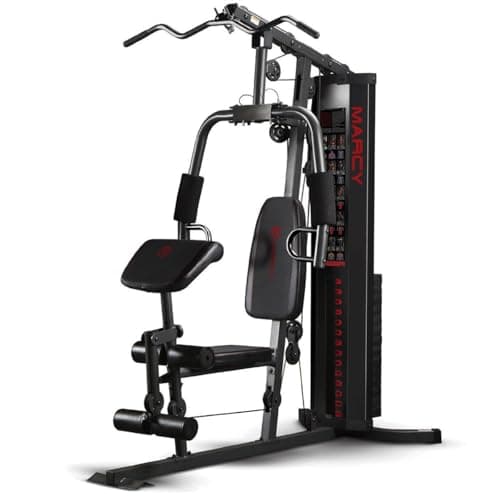
Our Marcy HG3000 multi gym review: the 68kg stack versus the 90kg claim, pec dec, preacher pad, leg extension, 210cm height, £599 price and who it suits.
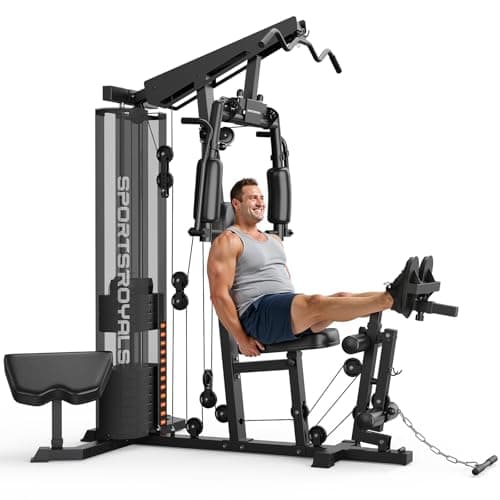
SPORTSROYALS home gym review: the 68kg stack, leg press and chest fly stations, 191 x 131cm footprint, 142kg build, £759.99 price and who it suits in the UK.
Best Exercise is a participant in the Amazon EU Associates Programme, an affiliate advertising programme designed to provide a means for sites to earn advertising fees by advertising and linking to Amazon.co.uk. As an Amazon Associate we earn from qualifying purchases. This comes at no extra cost to you and never influences our independent reviews or rankings.