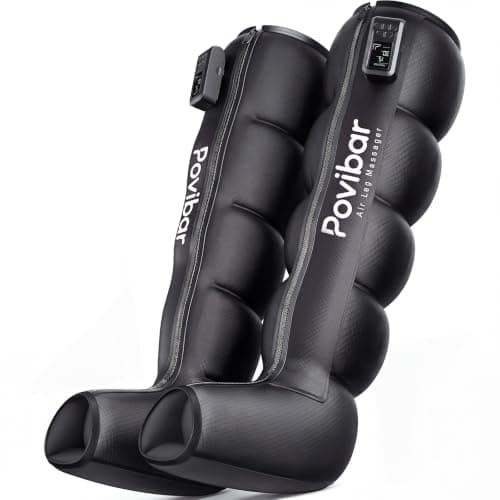
Recovery
Povibar Cordless Compression Boots Review: Hose-Free for £200
Our Povibar cordless compression boots review: 5 air chambers, 3 modes, 5 intensities and 180 minutes of battery for £200, but no published pressure figure.

By Mike Shilling, Recovery & Training Editor · Updated 29 October 2026
We may earn a commission from qualifying purchases made through links on this page, at no extra cost to you. This never affects our ratings.
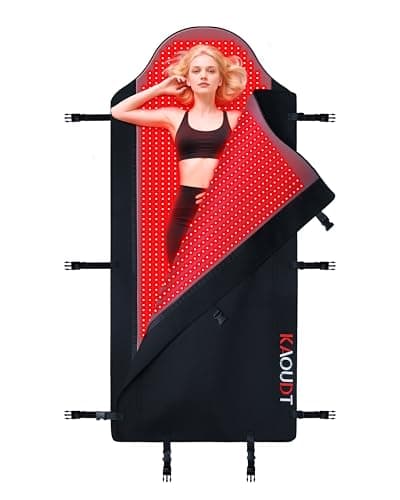
The Kaoudt red light therapy mat is a full body LED wrap that costs around £720, and our view is that it's a competent piece of hardware with one serious hole: there's no published irradiance, so you can't know what dose you're getting. It pairs 2,600 LEDs at 660nm red and 850nm near infrared with a medical grade TPU surface and a two piece design that lies flat or closes into a cocoon. For people who want front and back coverage without standing in front of a panel, that design has real appeal. For anyone buying primarily for muscle recovery, the price and the evidence both argue for a cheaper, better documented panel.
That's the short version. The longer one comes down to what a mat can and can't do compared with a panel, what the research on whole body light actually shows (less than you'd hope), and whether Kaoudt's warranty is enough to cover the risk of buying from a brand with no website we could reach.
How we review
We haven't used this mat ourselves. This review is built from the manufacturer's listing, published research on photobiomodulation and owner feedback where we could find it, and we compare it against the red light panels we've already reviewed. Where Kaoudt hasn't published a figure, we say so rather than guess.
This suits someone who already likes red light therapy, finds standing in front of a panel for 10 to 20 minutes tedious, and has the budget to pay for convenience. Lying inside a wrap is easier to fit into an evening than holding a position, and you treat your whole posterior chain and the front of your body at once. People with a lot of floor space and nowhere to mount a panel get another tick in the box.
It's a poor fit if you want a precise, repeatable dose for a specific area such as a knee, an Achilles or your quads after a long run. A panel with a published irradiance figure lets you calculate that; this mat doesn't. If you're new to the whole idea, our guide to using red light therapy explains distance, time and dose before you spend anything.
You can check the current price and stock here if the wrap design is what you're after.
Check Kaoudt mat price on AmazonThe listing describes 2,600 "3 in 1" LEDs, which reads as multi chip LEDs carrying both wavelengths, spread across a surface of 72 by 33 inches (about 183 by 84 cm). That's roughly 15,400 square centimetres, so you get one LED for every 6 square centimetres or so. Density matters on a mat more than on a panel because you lie close to the surface, and there's little distance for the light from neighbouring LEDs to spread and overlap.
The two piece construction is the clever part. Lay both halves flat and you have a large mat to lie on; snap them together and you have a sleeping bag style cocoon with light above and below. Most cheaper mats are single sheets, so you treat one side, then turn over. Kaoudt's approach halves the session time for full coverage, assuming the output is useful in the first place.
| LEDs | 2,600 (listed as 3 in 1) |
|---|---|
| Wavelengths | 660nm red, 850nm near infrared |
| Size | 72 x 33 in (approx 183 x 84 cm) |
| Construction | Detachable top and bottom mats, flat or wrap |
| Surface | Medical grade TPU, wipe clean |
| Modes | Constant, 10Hz pulse, 40Hz pulse |
| Brightness | 5 levels (P1 to P5) |
| Timer | Yes |
| Irradiance | Not published |
| Warranty | 365 days, plus 3 years free parts replacement |
| Price at time of writing | £721.96 |
The TPU surface is a sensible choice for something that's going to sit against bare skin, often after training. It wipes down, it shouldn't absorb sweat, and Kaoudt says it's odour free, which matters more than you'd think; some cheap mats arrive smelling of plastic for weeks. We couldn't find a surface temperature figure, so if you run warm, start on a low brightness setting and see how it feels.
Here's the problem that drags the rating down. Irradiance, measured in milliwatts per square centimetre, tells you how much light energy actually reaches your skin. Multiply it by the time in seconds, divide by 1,000, and you get the dose in joules per square centimetre, which is the unit nearly every study reports.
To show why this matters, take two hypothetical mats. One delivers 20 mW/cm2 at the surface; ten minutes on it gives you 12 J/cm2. The other delivers 5 mW/cm2; the same ten minutes gives you 3 J/cm2, a quarter of the dose. Both could carry the same LED count and the same wavelengths on the box. Without Kaoudt's number, you don't know which of those (or neither) you're buying.
And more isn't automatically better. Photobiomodulation follows what researchers call a biphasic dose response, where too little light does nothing and too much can cancel the effect. You need the figure in both directions, to avoid wasting your time and to avoid overdoing it.
The panels we've reviewed show how differently brands handle this. The Nebula 1020W publishes 95 mW/cm2 at six inches and 76 mW/cm2 at twelve; the Hooga ULTRA360 publishes 132 mW/cm2. Even the STASUN 1050W, which we marked down for an unverified figure, at least gives you a claim to work with. Kaoudt gives you nothing, and on a £720 product that's hard to excuse.
The research on photobiomodulation and muscles is real but uneven, and most of it isn't about mats. A 2025 meta-analysis on delayed onset muscle soreness pooled controlled trials using wavelengths from 660 to 950nm and found a moderate reduction in soreness at 72 and 96 hours, plus better strength at 24 and 48 hours. That's encouraging, though only four of the 14 included studies had data good enough to pool, and the light was applied to between one and six points on the affected muscle. Targeted, in other words.
Whole body devices are a different story. A 2025 systematic review of whole body photobiomodulation found just five human studies with 105 participants in total. None showed a benefit for exercise performance or fatigue markers; two reported better sleep quality. The authors were blunt that whole body light shows no evidence of benefit for recovery yet, and that more research is needed to explain why it doesn't match the local results.
One of those studies is worth a closer look. In a randomised crossover trial of 48 active adults, 20 minutes of whole body light before repeated sprint cycling didn't change power, lactate or perceived recovery compared with placebo. Heart rate variability the next morning was a little higher after the light session, which the authors read as a possible recovery signal, but it's one measure in one small trial.
So where does that leave a mat? It uses the right wavelengths, and if its output is decent, there's a plausible case for sleep and general wellbeing. For muscle recovery specifically, the stronger evidence sits with targeted treatment at a known dose, which is exactly what a panel with published irradiance lets you do. Our red light therapy for recovery guide goes through the studies in more detail.
None of this is medical advice, and the mat isn't a treatment for any condition. If you've got an injury or ongoing pain, see a GP or physio first.
Constant mode is the one the recovery research mostly uses, and it's where we'd spend nearly all our time. The five brightness levels (P1 to P5) are useful for comfort, but without irradiance at each level they're relative steps rather than doses you can plan around.
The 10Hz and 40Hz pulse modes flash the LEDs at those rates. Some listings in this category tie 40Hz to brain health, and we're sceptical. The 40Hz research that gets quoted mainly involves flickering light or sound perceived through the eyes and ears, much of it in mice, not near infrared shone onto your back while you lie in a bag. We'd also note that pulsing reduces the average light delivered over a session unless the session runs longer. Kaoudt doesn't claim specific brain benefits on the listing we read, and we'd ignore anyone who does.
At £721.96 at the time of writing, the Kaoudt mat costs about what you'd pay for two of the panels we rate well. The FliKEZE panel was £249.99 when we reviewed it, the STASUN 1050W £269.99 and the Nebula 1020W £379.99. All of them carry 660nm and 850nm, and the Nebula covers a tall treatment area from head to thigh in one go.
| Kaoudt mat | Nebula 1020W | STASUN 1050W | FliKEZE panel | |
|---|---|---|---|---|
| Format | Full body wrap | Tall panel | Large panel | Panel |
| Wavelengths | 660nm, 850nm | 660nm, 850nm | 660nm, 850nm | 630, 660, 830, 850nm |
| Published irradiance | None | 95 mW/cm2 at 6 in | 167 mW/cm2 at 3 in (claimed) | 134 mW/cm2 (claimed) |
| Front and back at once | Yes | No | No | No |
| Price when reviewed | £721.96 | £379.99 | £269.99 | £249.99 |
What the extra money buys is format. You lie down, you close the wrap, the timer runs, and you've treated everything. With a panel you stand, treat the front, turn round and treat the back, which doubles the time. If that convenience is the difference between using red light four times a week and giving up after a fortnight, the mat might earn its premium. If you're disciplined enough to stand in front of a panel, it won't.
Kaoudt is an unfamiliar name, and we couldn't reach a brand website to find manuals, a support contact or any independent test data. That puts more weight on Amazon's own returns process and on the warranty, which is better than we expected: 365 days, plus three years of free parts replacement. Read that second part carefully. Free parts implies they'll send a replacement component, such as a controller or cable, rather than swap the whole mat, so it's worth keeping your order details and asking the seller before buying how a claim works.
We'd also test the mat properly within the Amazon return window. Check every section lights on all settings, that the snaps hold when the two halves are joined, and that the controller and timer behave. Faults on cheap LED products tend to show up early.
Start at a low brightness setting in constant mode for 10 minutes, a few times a week, and build from there if your skin is comfortable. Wear eye protection or keep your eyes closed when your face is inside the wrap, since near infrared isn't fully visible and you won't always notice how bright it is. Don't fall asleep in it with the timer off. And because you can't calculate a dose, keep a simple log of sessions and how you feel, so you're judging the mat on your own results rather than the listing.
If what you really want is lower soreness after hard sessions, red light is one tool among several. Sleep matters more than any device, as our sleep and muscle recovery guide explains, and a good massage gun costs a fraction of this mat.
For those set on full body coverage and happy to accept the unknowns, this is where to check today's price.
See the Kaoudt red light mat on AmazonOnly if full body coverage in one session is the thing you want most and you accept that you can't calculate a dose. For pure recovery value, a well documented panel at £250 to £400 gives you published irradiance and the same 660nm and 850nm wavelengths. The mat wins on convenience and coverage, not on evidence.
Kaoudt doesn't publish one. The listing gives LED count, wavelengths, modes and size but no mW/cm2 figure at any distance, and we couldn't find a brand website to check. Without that number you can't work out how many joules per square centimetre a session delivers, which is the figure the research is built on.
The evidence is thinner than the marketing suggests. Localised photobiomodulation, where light is aimed at specific muscles at a known dose, has some positive meta-analyses for soreness and fatigue. A 2025 systematic review of whole body devices found five studies and no benefit for performance or fatigue markers, though two reported better sleep.
They flash the LEDs on and off at those rates instead of running them constantly. Some sellers link 40Hz to brain benefits, but that research mostly involves flickering light seen through the eyes, largely in animal studies, not light shone onto your back. We'd treat the pulse modes as optional extras and stick with constant mode for recovery use.
Yes. It comes as a detachable top and bottom mat that you can lay flat or snap together into a cocoon you lie inside. That's the main practical difference from a panel, because it treats front and back at the same time without you having to turn round.
Our Povibar cordless compression boots review: 5 air chambers, 3 modes, 5 intensities and 180 minutes of battery for £200, but no published pressure figure.
How to use a massage chair properly: first session settings, how long to sit in one, how often, zero gravity, airbags, heat, after training and who to avoid.
Is a vibrating foam roller worth the extra money? What the research shows on range of motion, pain and DOMS, who should pay more, and what to look for.
How to use a portable steam sauna tent at home: setup, which water to use, pre-heat time, how long to sit in it, cleaning to stop mould, and who should check with a GP first.
Best Exercise is a participant in the Amazon EU Associates Programme, an affiliate advertising programme designed to provide a means for sites to earn advertising fees by advertising and linking to Amazon.co.uk. As an Amazon Associate we earn from qualifying purchases. This comes at no extra cost to you and never influences our independent reviews or rankings.