Recovery
Can Red Light Therapy Cause Cancer? What the Research Says
Can red light therapy cause cancer? Why red and near infrared LEDs aren't UV, what studies say about existing tumours, who should check with a GP first.

By Mike Shilling, Recovery & Training Editor · Updated 5 November 2026
An indoor sauna is a heated cabin, tent or blanket that you use inside the house, and for most UK homes the realistic choice is between a plug-in far-infrared cabin and a hard-wired traditional Finnish cabin. Infrared models run at roughly 45°C to 60°C, plug into a 13A socket and cost around 50p an hour to run. Traditional cabins get to 80°C and beyond with proper steam, but their 4.5kW to 9kW heaters need their own circuit, an electrician and some thought about ventilation. Tents and blankets sit underneath both as the cheap way in.
If you're planning a building at the bottom of the garden instead, our garden sauna guide covers bases, planning rules and outdoor heaters. This page is about the sauna that lives in your spare room, garage or loft.
These are the most common indoor saunas sold in the UK. A timber box, usually hemlock or spruce, holds ceramic or carbon panels that warm your body directly rather than heating all the air first. The air stays cooler, around 45°C to 60°C, and most one and two person cabins plug into a normal socket. Warm-up takes minutes rather than the best part of an hour.
The catch is the feel. You won't get a blast of steam, you can't ladle water on anything, and people raised on hotel saunas sometimes find it underwhelming. Our infrared sauna vs traditional sauna comparison goes through the differences in detail, and sauna temperature explains what each range actually feels like.
A traditional cabin is an insulated timber room with an electric stove topped with stones. It heats the air to 80°C to 100°C, and throwing water on the stones gives you the hit of humid heat Finns call löyly. Nothing else on this list matches it.
You pay for that in wiring. Even a compact 4.5kW heater draws close to 20 amps, far beyond what a 13A plug can supply, and larger 6kW to 9kW stoves need heavy cable and a large fuse at the consumer unit. Preheating takes 30 to 45 minutes too, so it's a planned session rather than a spur-of-the-moment one.
Pop-up tents are fabric shells on a folding frame, heated either by a small steam generator (often about 1kW) or by infrared panels. You sit on a chair inside with your head poking out of the top. They plug in, fold away into a cupboard and cost a couple of hundred pounds. They're a perfectly sensible way to find out whether you'll use a sauna twice a week before spending four figures. Our portable sauna guide and how to use a portable steam sauna cover them properly.
An infrared sauna blanket is a heated sleeping bag that you zip yourself into while lying down. It draws a few hundred watts and stores flat. Of the four, it's the furthest from a real sauna, as you can't move or sit up, but it takes up no floor space at all. See our best sauna blanket UK roundup if that's the route you want.
Floor area is only half the question. Height matters as much, because cabins stand around 1.9m to 2m tall and you need clearance above for ventilation and, with a traditional stove, the gap the heater manual specifies.
| Size | Typical footprint | What it suits |
|---|---|---|
| 1 person | About 90cm x 90cm | Corner of a spare room or bedroom |
| 2 person | Roughly 120cm wide, 100cm to 110cm deep | Spare room, garage, large landing |
| 3 person | Roughly 150cm wide | Dedicated room or garage bay |
| 4 person | Roughly 180cm wide or an L-shaped corner unit | Basement, large garage, converted outbuilding |
These are typical sizes, not standards, so measure your room and check the exact dimensions on the spec sheet. The SaunaMed one person cabin, for example, lists a footprint of about 90cm x 90cm x 190cm. Add space to open the door fully and room to get behind the cabin for assembly, since many kits slot together panel by panel and you can't build them flat against a wall.
One trap catches people out: carrying the panels upstairs. Measure the stairwell turn and every doorway on the route, not just the room it's going into.
This is the single biggest decision, and it splits indoor saunas into two camps.
A UK 13A socket supplies about 3kW at most. Small infrared cabins, steam tents and blankets are designed to stay well under that. Plug them straight into a wall socket, never into an extension lead or a multi-way adaptor, because a heater pulling a steady current for an hour is exactly the load that cooks a cheap lead. If you're buying a larger three or four person infrared cabin, check its rated wattage before you buy. Some of the bigger ones need their own circuit even though they're infrared.
Traditional sauna stoves are wired directly into a dedicated circuit from the consumer unit, with the cable size and fuse rating set by the heater manufacturer. A 9kW stove is a serious load, roughly in electric shower territory, and some older consumer units or main fuses won't take it alongside everything else in the house.
In England, putting in a new circuit is notifiable work under Approved Document P, the building regulation covering electrical safety in dwellings. The practical answer is to use an electrician registered with a competent person scheme, who can self-certify the job and register it with building control for you. The same applies if you're tempted to put a sauna in or next to a bathroom, because work near a bath or shower falls under the rules too. Wales, Scotland and Northern Ireland have their own regimes, so check locally there.
Get the electrician round before you order the sauna. If your supply can't take a 9kW stove, you'd rather know that before the cabin arrives, and a smaller room with a 4.5kW or 6kW heater is often the sensible compromise. Our home sauna cost guide has more on what the electrician is actually doing.
A traditional sauna needs fresh air moving through it, both for comfort and so the heater works as designed. Manufacturers typically specify an inlet low down near the stove and an exhaust vent higher up or on the opposite side, and the exact positions are in the heater manual. Follow it, because a stove that can't breathe heats unevenly and leaves the air feeling stale.
Moisture is the other half. Every ladle of water on the stones turns to steam, and once you open the door that humid air spills into the house. In a spare room with a window, that's easy: open it and leave the cabin door ajar for half an hour afterwards so the timber dries. In a windowless box room or basement, plan for an extractor fan, or you'll be fighting condensation on cold walls and mould behind the cabin.
Infrared cabins are much easier to live with. The heat is dry, there's no water involved, and most have a small vent in the roof. Normal room airflow is enough. Steam tents are the exception among plug-in options: they put a surprising amount of water into the air, so treat them like a long shower and ventilate the room.
What the sauna sits on matters more than people expect, because sweat drips, water splashes and timber benches leak a little resin over the years.
Duckboards or a removable slatted floor inside a traditional cabin keep your feet off a hot, wet surface and can be lifted out to dry.
The easiest spot for an infrared cabin. You'll have a socket, a window for airflow and usually a carpet or laminate floor that a mat can protect. For a traditional cabin, a spare room works if the electrician can reach it without ripping up half the house.
Garages are popular because they often have a concrete floor, space to spare and a short cable run to the consumer unit. The downside is cold. An uninsulated garage in January drags heat out of the cabin, so warm-up takes longer and running costs climb. Check the walls and door for damp, too, because timber cabins don't like it.
Think carefully here. A sauna full of people, plus benches, a stove and a box of stones, concentrates a lot of weight in a small area, and many loft floors were never built to carry that kind of load. Unless the loft has already been properly converted with a habitable floor, ask a structural engineer to look at the joists before you carry anything up. Headroom under a sloping roof also rules out a lot of cabins.
A dry basement suits a traditional cabin well: solid floor, little noise transfer and space for a shower nearby. Ventilation is the issue, so budget for mechanical extraction if there's no window.
These ranges come from our home sauna cost guide, which we keep up to date with Amazon UK and specialist retailer prices.
| Type | Rough price | Electrician? |
|---|---|---|
| Sauna blanket | About £100 to £400 | No |
| Steam or infrared tent | About £100 to £300 | No |
| 1 to 2 person infrared cabin | About £1,300 to £2,200 | Usually not |
| 3 to 4 person infrared cabin | Up to about £4,000 | Sometimes |
| 2 person traditional cabin | From about £1,800 | Yes |
| 3 to 4 person traditional cabin | About £3,000 to £6,000 | Yes |
On top of a traditional cabin, budget for the electrician, any ventilation work and possibly new flooring. We won't give you a single number for the wiring, because a cabin beside the consumer unit and one in a loft at the far end of the house are completely different jobs. Get two quotes.
We've assumed 26.32p per kWh, the Ofgem price cap GB average for Direct Debit customers from 1 October to 31 December 2026. Your own rate will differ by region and tariff, so swap in the figure from your latest bill. The sum is heater power in kW, multiplied by hours on, multiplied by the unit rate.
| Setup | Time on | Energy used | Cost |
|---|---|---|---|
| 500W sauna blanket | 45 minutes | 0.375kWh | about 10p |
| 1kW steam tent | 1 hour | 1kWh | about 26p |
| 2kW infrared cabin | 1 hour, including warm-up | 2kWh | about 53p |
| 4.5kW traditional heater | 1.5 hours (warm-up plus session) | 6.75kWh | about £1.78 |
| 6kW traditional heater | 1.5 hours | 9kWh | about £2.37 |
| 9kW traditional heater | 1.5 hours | 13.5kWh | about £3.55 |
Every figure there is a ceiling. Once a cabin hits temperature, the thermostat switches the elements on and off, so the heater spends part of the session drawing nothing. A cold garage pushes the real number back up towards the ceiling. Used twice a week, an infrared cabin costs roughly £55 a year at the upper bound (104 sessions x 53p), while a 6kW traditional heater comes to about £246.
Infrared cabin listings lean hard on "low EMF" and "EMR neutral" labels. Here's the honest picture. Any electric heater, cable or appliance produces low-frequency electric and magnetic fields, and a sauna's heater panels sit close to your body for a long time, which is why some makers try to reduce them. The World Health Organization's EMF guidance says current evidence doesn't confirm any health consequences from low-level exposure, though it notes gaps in the research.
There's no UK standard that defines "low EMF" for a sauna, so the phrase means whatever the seller wants it to. If it matters to you, ask the manufacturer for measured readings at the seat, at a stated distance, and compare like with like. If they can't supply numbers, treat the label as marketing. We wouldn't pay hundreds of pounds extra for it, and we wouldn't rule out a well-made cabin because it doesn't carry the badge.
Regular sauna use looks safe for most healthy adults, but the research is thinner than enthusiasts suggest. A systematic review of 40 dry sauna studies found mostly beneficial effects, yet only 13 were randomised trials and most had fewer than 40 participants. The one adverse outcome it found was a temporary drop in sperm production in a small study of men, which reversed once they stopped. The authors called for better data on side effects, which is a fair summary of where things stand.
The practical rules for a home sauna:
If you want something that plugs in, warms up quickly and costs pennies to run, start with a one or two person far-infrared cabin. If you've tried saunas at the gym and it's the heavy, steamy heat you love, nothing but a traditional cabin will do, and the electrician's quote should come before anything else. If you're not sure you'll stick with it, a tent or blanket for under £300 answers that question cheaply.
For a compact plug-in cabin, the SaunaMed 1 Person Hemlock FAR Infrared Cabin is the one we'd look at first. It fits a roughly 90cm square footprint, uses four ceramic heaters and runs from a standard UK plug, and it was £1,649 on Amazon UK when we checked in November 2026. Our SaunaMed 1 person infrared sauna review covers its strengths and the compromises in detail.
Check the SaunaMed 1 Person infrared cabin price on AmazonIf you'd like to compare it against tents, blankets and larger cabins, our best home sauna UK guide ranks the lot, and the sauna pod guide covers the rounded, stand-up style cabins that work indoors and out. For the wider picture on heat and cold for recovery, browse our recovery hub.
Yes. Infrared cabins, portable tents and sauna blankets are designed for indoor use, and most small infrared cabins plug into a normal 13A socket. A traditional Finnish cabin also works indoors, but its 4.5kW to 9kW heater needs a dedicated circuit fitted by a registered electrician, plus sensible ventilation and a floor that copes with sweat and splashes.
Traditional saunas do. Heater makers specify an air inlet low down near the stove and an outlet higher up or on the opposite wall, so fresh air moves through the hot room. Infrared cabins usually have a small built-in vent and produce dry heat, so the room they sit in only needs normal airflow. Steam tents release moisture into the room, so open a window or run an extractor afterwards.
Plug-in infrared cabins, steam tents and blankets are built for a standard UK 13A socket, which tops out at about 3kW. Plug them straight into the wall, not an extension lead. Any traditional electric sauna heater of 4.5kW or more draws too much current for a plug and must be hard-wired on its own circuit.
Assuming 26.32p per kWh, the Ofgem price cap average for October to December 2026, a 2kW infrared cabin costs about 53p for an hour including warm-up. A 6kW traditional heater on for 90 minutes uses 9kWh, about £2.37. Those are ceilings, because the thermostat cycles the heater once the room is hot.
The cabin itself is furniture, so a plug-in model needs nothing. A new electrical circuit for a traditional heater is notifiable under Approved Document P in England, which is why you should use an electrician registered with a competent person scheme who can self-certify the work. Electrical changes near a bath or shower are also covered.
Only if the maker publishes measured readings. Infrared heaters give off the same low-frequency fields as other household electrics, and the WHO says current evidence does not confirm health effects from low-level exposure. Terms like low EMF or EMR neutral aren't regulated, so treat them as a nice-to-have rather than a reason to buy.
Can red light therapy cause cancer? Why red and near infrared LEDs aren't UV, what studies say about existing tumours, who should check with a GP first.
Regular saunas may mean fewer colds, but a sauna won't cure one. When a gentle session can ease a blocked nose, and when fever or flu means staying out.
Should your eyes be open or closed during red light therapy? Keep them shut and wear goggles. Why, what the eye research shows, and who should check first.
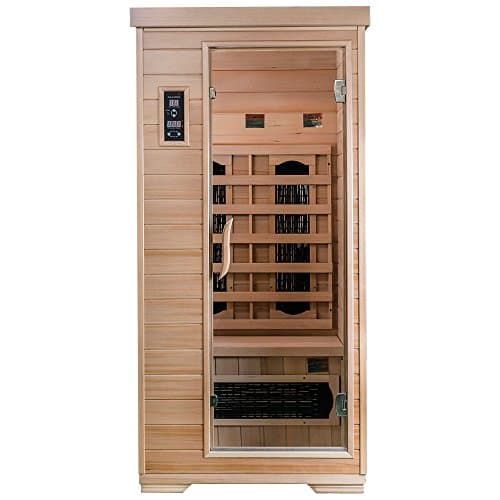
SaunaMed 1 person hemlock infrared sauna review: 1.4kW on a 13A plug, 65°C max, 90cm footprint, real running costs and how it compares with cheaper options.
Best Exercise is a participant in the Amazon EU Associates Programme, an affiliate advertising programme designed to provide a means for sites to earn advertising fees by advertising and linking to Amazon.co.uk. As an Amazon Associate we earn from qualifying purchases. This comes at no extra cost to you and never influences our independent reviews or rankings.