Recovery
Can Red Light Therapy Cause Cancer? What the Research Says
Can red light therapy cause cancer? Why red and near infrared LEDs aren't UV, what studies say about existing tumours, who should check with a GP first.

By Mike Shilling, Recovery & Training Editor · Updated 5 November 2026
We may earn a commission from qualifying purchases made through links on this page, at no extra cost to you. This never affects our ratings.
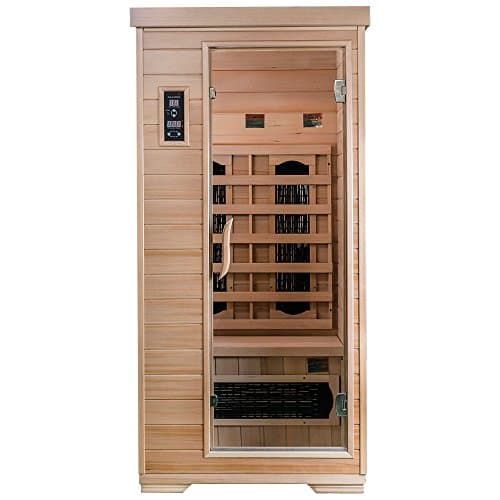
SaunaMed
SaunaMed is the in-house sauna brand of Aqualine, a UK hot tub and sauna retailer, and this is the smallest cabin in its Classic Hemlock range. You get a proper timber box rather than a fabric tent: 90cm square, 1.9m tall, four ceramic far infrared heaters, a glass-fronted door and a bench for one. It costs £1,649 on Amazon, the same as Aqualine charges direct, and it runs off an ordinary 13A plug.
The appeal is that it's the sort of sauna you can put in a spare bedroom or a dry garage corner without calling an electrician. The question is whether it's worth nearly double what the Home Deluxe Redsun S costs, the wooden cabin we rate highest in our best home sauna UK guide. For some people it is. Most should think hard first.
How we review
This review is research-based. We haven't installed or used the SaunaMed cabin ourselves. We've worked from Aqualine's published specification, the Amazon UK listing, owner feedback and the peer-reviewed research on infrared sauna use, and we flag where those sources disagree or where a spec simply isn't published.
Inside the hemlock shell sit four 350W DuraWave ceramic heaters, lava sand filled according to Aqualine: two on the back wall, one on the left and one at the front of the bench, aimed at your calves. That last one matters more than it sounds, because cheaper cabins and tents often leave your lower legs barely warm. Total draw is 1,400W.
The walls are double-skinned with an insulating cavity, which helps a 1.4kW cabin hold heat. There are digital control panels inside and out, with a thermostat and a session timer, so you can set the temperature from the bench rather than climbing out halfway through. Aqualine also lists Bluetooth audio, FM radio, built-in speakers, RGB mood lighting, a reading light, a drinks holder and an adjustable air vent. The Amazon listing mentions an ioniser and MP3/FM stereo instead of Bluetooth, so the spec sheet and the listing don't quite match; if Bluetooth audio matters to you, confirm with the seller before ordering.
Assembly uses interlocking panels that Aqualine says go together in under 30 minutes. Owners of flat-pack cabins generally find "under 30 minutes" optimistic for a first build, and you'll want a second person regardless, since the finished cabin weighs 90kg and arrives in three boxes. Two-person delivery to the UK mainland is included when you buy direct.
Check price on Amazon£1,649| Heaters | 4 x 350W DuraWave ceramic far infrared |
|---|---|
| Total power | 1,400W |
| Power supply | Standard 13A plug, single phase, 3m cable |
| Temperature range | 20°C to 65°C |
| External size | 900 x 900 x 1,900mm (W x D x H) |
| Minimum ceiling height | 2,050mm |
| Weight | Approx 90kg assembled, 3 boxes |
| Wood | Canadian hemlock, double wall |
| Warranty (home use) | 5 years cabin, 2 years electrics |
| Warm-up time | Not listed |
Figures come from Aqualine's SaunaMed 1 Person Classic Hemlock product page. Aqualine doesn't quote a warm-up time, which is the one number we'd most like to see.
At 65°C, a far infrared cabin is much cooler than a Finnish sauna, but that doesn't mean it's gentle on your body. In a small 2026 study, 12 healthy adults sat in a far infrared sauna set to 65°C for 45 minutes; their core temperature rose by about 1.4°C, heart rate climbed from 74 to 153 bpm and they sweated roughly 1.4 litres an hour (far infrared sauna at 65°C, Experimental Physiology). Two participants quit early, most rated it extremely uncomfortable, and the sauna's supplier part-funded the work. Treat 45 minutes at full temperature as a ceiling rather than a target; 15 to 30 minutes is plenty for most people, and our guide on how long to stay in a sauna goes into the detail.
For recovery after training, the evidence is mixed. A 2015 Finnish study had 10 active men sit in a far infrared sauna at 35°C to 50°C for 30 minutes after either a strength session or a maximal treadmill run (far infrared sauna and recovery, SpringerPlus). After strength work it made no measurable difference. After the endurance run, jump height 30 minutes later was slightly better than with no sauna (0.34m against 0.32m), which is a small effect in a small sample.
The heart health headlines you'll see on sauna marketing mostly come from somewhere else entirely. The Kuopio cohort led by Jari Laukkanen followed 1,688 Finnish adults for a median of 15 years and found that people using a sauna four to seven times a week had a much lower risk of cardiovascular death than once-a-week users (sauna bathing and cardiovascular mortality, BMC Medicine). Those were traditional Finnish saunas averaging about 76°C, though, and it's an observational study. Nobody has shown the same thing for infrared cabins. Our infrared vs traditional sauna comparison covers that gap properly, and the infrared sauna benefits guide rounds up what the infrared-specific trials do show.
So buy this because sitting in dry heat for 20 minutes after a run feels good and helps you wind down, not because it'll add years to your life.
Here's the sum, with our assumptions stated. The cabin draws 1.4kW. Aqualine doesn't publish a warm-up time, so we've allowed 20 minutes at full power before a 30 minute session, which treats the heaters as running flat out for 50 minutes. That's about 1.17kWh.
| Unit rate | Cost per session | Three sessions a week, per year |
|---|---|---|
| 25p per kWh | about 29p | about £46 |
| 26p per kWh | about 30p | about £47 |
| 28p per kWh | about 33p | about £51 |
That's a worst case, because the thermostat cuts the heaters back once the cabin reaches temperature. Compared with a traditional 6kW electric sauna, which costs well over £1 an hour to run, it's cheap. Our home sauna cost guide has the same working for every sauna type.
Home Deluxe Redsun S (around £900). This is the obvious rival: another hemlock infrared cabin with ceramic radiators, a glass door and a plug-in supply, and it's roomy enough for two at a squeeze. It costs roughly £750 less. What the SaunaMed gives you for the extra money is a fuller published spec (exact wattage, clearances and warranty terms are all on the product page), a UK-based seller with a showroom operation behind it, double-wall insulation and a bench-level heater for your legs. If you're comfortable with a European import and slightly vaguer documentation, the Redsun S is the better value.
SereneLife infrared sauna box (about £130 to £160). A different category altogether: a fabric box you sit in with your head poking out the top, pack away afterwards and replace when the zip goes. It gets you sweating for a tenth of the price and is the sensible way to find out whether you'll actually use a sauna three times a week before spending four figures. It won't feel like a room, though, and taller users find it cramped.
Buy it if you've already got the sauna habit, maybe from a gym or a tent you've worn out, and you want a permanent one-person cabin in a spare room or dry outbuilding without rewiring anything. It's also a sound pick if you'd rather pay more to buy from a UK seller who publishes everything and offers delivery and support at home.
Skip it if you want heat for two, or the 80°C plus of a Finnish sauna; a traditional cabin with a proper heater (and the electrician that comes with it) is the only real answer there. Skip it too if you're not sure you'll use it, because a £150 tent will settle that question for very little money.
Check price on Amazon£1,649It draws 1.4kW at full power. Assuming a 20 minute warm-up plus a 30 minute session at a unit rate of 26p per kWh, that's about 1.17kWh, or roughly 30p a session. At 28p per kWh it's about 33p. The thermostat cycles the heaters once the cabin is up to temperature, so real bills should come in a little lower.
No. Aqualine, the UK company behind SaunaMed, says it plugs into a standard 13A socket on a single-phase supply, with a 3m cable coming from the roof. Plug it straight into a wall socket rather than an extension lead, since 1.4kW running for most of an hour is a sustained load.
The manufacturer lists a range of 20°C to 65°C. That's normal for a far infrared cabin and well below the 80°C to 100°C of a traditional Finnish sauna. Infrared heats you mostly by radiation, so you still sweat hard at 55°C to 65°C, but if you want that scorching Finnish blast this isn't it.
It measures 900 x 900 x 1,900mm externally. Aqualine asks for 150mm clearance above the roof, 15mm at the sides and a ceiling of at least 2,050mm. It arrives flat-packed in three boxes and weighs about 90kg built, so check your floor and your stairs as well as the corner itself.
For home use, Aqualine lists 5 years on the cabin and 2 years on the electrics. Light commercial use drops to 1 year. Two years on the heaters and control panel is the part to weigh up on a £1,649 purchase, because those are the components that actually fail.
Can red light therapy cause cancer? Why red and near infrared LEDs aren't UV, what studies say about existing tumours, who should check with a GP first.
A UK guide to indoor saunas: infrared vs traditional cabins, how much space you need, 13A plug vs hard-wired heaters, ventilation, flooring and running costs.
Regular saunas may mean fewer colds, but a sauna won't cure one. When a gentle session can ease a blocked nose, and when fever or flu means staying out.
Should your eyes be open or closed during red light therapy? Keep them shut and wear goggles. Why, what the eye research shows, and who should check first.
Best Exercise is a participant in the Amazon EU Associates Programme, an affiliate advertising programme designed to provide a means for sites to earn advertising fees by advertising and linking to Amazon.co.uk. As an Amazon Associate we earn from qualifying purchases. This comes at no extra cost to you and never influences our independent reviews or rankings.