Home Gym
How Do Adjustable Dumbbells Work? Every Mechanism Explained
How do adjustable dumbbells work? Spin-lock, dial, twist-handle, selector-pin and quick-lock systems explained, with UK examples, increments and weak points.

By Jack Atkins, Home Gym Equipment Specialist · Updated 4 November 2026
We may earn a commission from qualifying purchases made through links on this page, at no extra cost to you. This never affects our ratings.
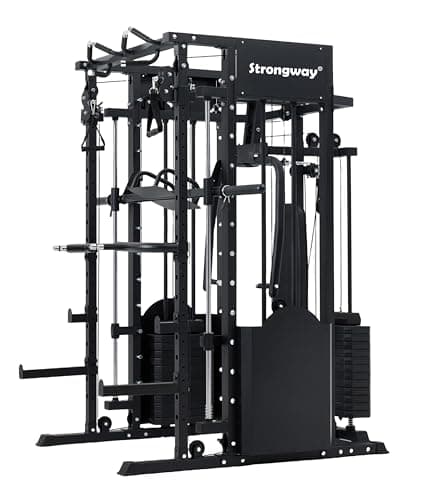
Strongway
The Strongway 265.5kg Smith Machine is the biggest, most loaded version of Strongway's all-in-one station, and for the right buyer it's the best value way to put a commercial-style cable and Smith setup in a garage for about £1,400. It adds a third 88.5kg stack, a rear high and low pulley and a plate-loaded butterfly chest press to the formula we liked on the cheaper 177kg Strongway Smith machine. What it doesn't add is a bench or any plates, and its 215cm width and 222.5cm height will rule it out of a lot of houses before price even comes into it.
How we review
We haven't physically tested this unit. This review is based on Strongway's listing specifications for this exact model (ASIN B0FM474VR4), verified owner feedback on Strongway's Smith machine range, and comparison with the smaller Strongway stations we've already covered. Where the listing is vague, we say so. Stock and price were checked on the day of publishing and change often.
Strongway sells two Smith machine stations that look similar in photos, so it's worth being precise. The 177kg model has two 88.5kg stacks driving the front dual pulley, and costs around £1,000. This 265.5kg model lists three 88.5kg stacks for 265.5kg in total, a rear dual cable pulley with high and low anchor points, and a butterfly chest station that loads with Olympic plates. The frame grows to match: 170cm deep, 215cm wide and 222.5cm tall, against 156 by 196 by 209cm on the smaller one.
The practical gain is more cable stations and more total weight. Strongway's listing doesn't spell out exactly which stack feeds which pulley, so check the cable diagram in the manual before you plan supersets around it; but a rear high and low pulley means face pulls, low rows and pulldowns get their own anchor point instead of crowding the front cables, and the extra 88.5kg gives you more headroom on heavy rows and pulldowns.
The butterfly station is the more interesting addition, and also the more limited one. Because it's plate-loaded rather than stack-driven, you'll need Olympic plates on hand to use it, and the loading is in whatever increments your plates allow. It gives you a proper fixed-arc pec fly and chest press without tying up the cables, which a lot of people will enjoy, but if you already run cable flyes well, it's a nice-to-have rather than a reason to upgrade.
At roughly 170kg before any plates go on, the frame is heavy enough that owners of Strongway's larger stations rarely mention rocking or walking, which is the usual failure of cheap multi gyms. The 350kg weight capacity is a structural rating for the whole frame; it's far beyond anything a home lifter will load onto the bar, so treat it as headroom rather than a target.
The attached black Smith bar runs on guided rails with hook-in catches at multiple heights. That's the whole point of a Smith machine for someone training alone in a garage at 9pm: you can grind out a last rep on the bench press and rack the bar with a flick of the wrists instead of hoping you've set the safeties right. One thing Strongway doesn't state clearly is the starting weight of the bar, and Smith bars vary a lot depending on the bearings and any counterbalance. Our Smith machine bar weight guide explains how to measure yours with a luggage scale so your logbook numbers mean something.
Pulleys and cables are where value stations wear first. Three stacks means more cable, more pulleys and more places for a bearing to start squeaking, so check the cable sheathing every few months and don't let the stack slam into the top plate on every rep.
| Weight stacks | 3 x 88.5 kg, 265.5 kg total |
|---|---|
| Cable system | Dual front pulleys plus rear dual pulley (high and low) |
| Chest station | Butterfly press, plate-loaded (Olympic plates) |
| Frame capacity | 350 kg |
| Dimensions | 170 cm deep x 215 cm wide x 222.5 cm high |
| Machine weight | Approx 170 kg |
| Smith bar | Attached black Smith bar with safety catches |
| Not included | Weight bench, Olympic barbell, plates |
| Price at publication | £1,399.95 |
The size. People tend to check the height and forget the width. At 215cm across, this is wider than a standard double bed is long, and the butterfly arms and plate loading need room on top of that. Plan for around 2.8m by 2.5m of clear floor. The 222.5cm height is the other trap: a typical 240cm UK ceiling clears it, but you need some slack to tip the uprights into place during the build, and a garage door rail or a light fitting can take that slack away. Measure the lowest point in the room. Then put down proper gym flooring, because 170kg of steel plus plates sitting on bare concrete or laminate is asking for scratches, dents and a frame that creeps.
The real price is higher than £1,400. You'll want an adjustable bench for pressing and seated cable work, and the butterfly station needs Olympic plates before it does anything. A sound bench from our weight bench guide and a basic set of weight plates can add £300 to £600, which pushes the total towards £2,000. That changes the comparison with buying a rack, bar, plates and a cable tower separately; it's still competitive, but not by the margin the headline price suggests.
Assembly. This is a pallet delivery. With three stacks to route and a frame that's taller and wider than the 177kg model, two people should set aside a weekend, not an afternoon. Don't open boxes in the hallway: the assembled machine won't come back through a door.
The fixed bar path. A Smith machine guides the bar in one line, which changes how your muscles share the work. A small study of six lifters comparing an 8-rep max on each found average muscle activity across the legs and trunk was 43% higher in the free-weight squat than the Smith squat, with the biggest gaps in the calves, hamstrings and vastus medialis (Schwanbeck et al., 2009). That doesn't make the Smith squat useless. A later meta-analysis found free-weight and machine training produced similar strength and muscle gains when each group was tested on the kit it trained with, though strength stayed specific to the modality (free weights versus machines meta-analysis). So you'll get stronger and bigger on this machine; you just won't automatically get a better barbell back squat. Our Smith machine squat guide covers foot position to make the most of the fixed path.
Buy the 265.5kg version if you're kitting out a garage from scratch, you train alone, and you know you'll use a lot of cable work. The third stack and rear pulley earn their keep for people who do a lot of rows, face pulls and pulldowns, or who train with a partner and want more than one cable station.
Check price on AmazonSkip it if the room measures under about 2.8m wide, if you rent, or if you mainly want a Smith bar and a pair of cables. In that case the 177kg Strongway Smith machine gives you the same core idea for about £400 less in a frame that's 19cm narrower and 13.5cm lower. And if barbell strength is the goal, the Strongway MultiGym Power Cage is a far cheaper rack with a cable attachment, though you'll need to buy a barbell and plates and set the safety pins properly.
Whichever you pick, the target is muscle-strengthening work on at least two days a week, covering the major muscle groups, according to NHS guidance. A machine this size in the garage makes that easy to hit; it's just a lot of steel to justify if it ends up as a clothes horse.
Against its smaller sibling, the decision is simple: pay the extra £400 for the rear stack and the butterfly press only if you'll use both. Against the wider market, it's fairly priced for a stack-loaded Smith station, and many of the premium machines we track are out of stock on Amazon for months at a time. For the full field, including cheaper frames without stacks, see our best Smith machine UK guide, and if you want the multi gym idea without a Smith bar at all, our best multi gym UK picks cover the cheaper end.
See the Strongway 265.5kg Smith machine on AmazonOnly if you'll use what the extra £400 buys: a third 88.5kg stack, a rear high and low pulley and a butterfly chest station. If you mostly squat, press and do pulldowns on the Smith bar and front cables, the 177kg model at around £1,000 covers that in a smaller frame. The 265kg version makes sense when you want to run cable work and Smith work without constantly re-pinning one pair of stacks.
The frame stands 222.5cm tall, so a 230cm ceiling is the practical minimum just to stand it up and leave room to tilt it during assembly. Most UK homes have ceilings of about 240cm, which works, but older garages with low beams or a garage door track can catch you out. Measure the lowest point, not the middle of the room.
The listing gives 170cm deep by 215cm wide. Add space to sit on a bench, step back from the cables and load plates on the butterfly station, and you should plan for roughly 2.8m wide by 2.5m deep of clear floor. That rules out most spare bedrooms.
No. You get the frame, the three weight stacks and the black Smith bar. There's no weight bench, no separate Olympic barbell and no plates. The butterfly chest station is plate-loaded, so you'll need Olympic plates to use it at all. Budget roughly £150 to £300 for a decent adjustable bench and the same again for a starter set of plates.
Expect a full weekend with two people. The machine weighs around 170kg, arrives across several heavy boxes, and the cable routing on three stacks is the fiddly part. Carry every box into the final room before you open anything, because the built frame won't fit through a domestic doorway.
How do adjustable dumbbells work? Spin-lock, dial, twist-handle, selector-pin and quick-lock systems explained, with UK examples, increments and weak points.
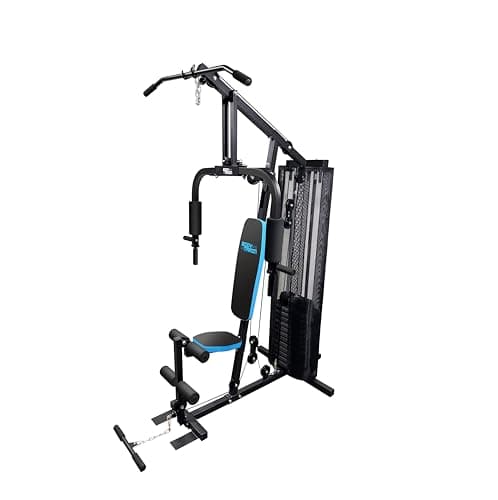
Our BodyTrain multi gym review: the 72kg shrouded stack, 12.5lb jumps, stations, 213cm height, lifetime frame warranty and £283.99 price against rivals.
What a cable crossover machine is, how it differs from a functional trainer, what 177kg stacks really mean, the ceiling height you need and UK price bands.
Every common cable machine attachment explained: D-handles, rope, straight and EZ bars, V-bar, ankle straps and more, with exercises, the 4 to buy first and prices.
Best Exercise is a participant in the Amazon EU Associates Programme, an affiliate advertising programme designed to provide a means for sites to earn advertising fees by advertising and linking to Amazon.co.uk. As an Amazon Associate we earn from qualifying purchases. This comes at no extra cost to you and never influences our independent reviews or rankings.