Polar's Pacer Pro is now several years old, it has a memory-in-pixel screen in a market that moved to AMOLED, and it still deserves your attention at £269. The reason is weight and software. At 41 grams with the strap on, and 23 grams without, this is one of the lightest serious running watches you can buy, and Polar's recovery analysis remains sharper than anything Garmin or Coros ships at the same price.
What you're trading away is obvious the moment you look at it. The 1.2 inch MIP display is sharp in sunlight and dull indoors, there's no onboard music, and there are no maps. Polar's answer is that none of those things make you a faster runner, which is annoying mostly because it's true.
How we review
This review is based on Polar's published technical specifications for the Pacer Pro, repeated findings across verified owner reviews and independent testing outlets, and our experience with the wider Polar Vantage and Grit X range. We have not personally run a multi-month endurance test on this specific unit, so we report consistent patterns rather than isolated opinions.
Who it is for
This suits the runner who reads their data. If you check your recovery status before deciding whether to do the intervals, if you care about training load balance across weeks, and if you'd rather have accurate overnight measurements than a flashy watch face, Polar has built the watch for you. Triathletes and gym-based trainers get 150 sport profiles thrown in, though swimming metrics are basic next to a dedicated multisport watch.
It's the wrong watch if you want a smartwatch. Notifications arrive and that's roughly the extent of the smart features; there are no apps, no payments and no music. Anyone after that mix should read our Garmin Forerunner 70 review instead.
41g with the strap, so light you forget it exists on long runs and overnight
139 hours of eco-mode GPS, which covers an ultra without a charger
Nightly Recharge measures your autonomic nervous system overnight, not just sleep duration
Wrist-based running power with no foot pod or chest strap needed
Hill Splitter automatically breaks a run into climbs and descents with pace and power for each
Barometer, compass, MIL-STD-810G testing and WR50 water resistance
Five physical buttons that work in rain and gloves
Cons
MIP display looks dated indoors compared with any AMOLED rival
No maps, no onboard music, no contactless payments
Plastic case with an aluminium bezel feels cheaper than the price suggests
No SpO2, ECG or skin temperature sensors
Polar Flow is powerful but slower and clunkier than Garmin Connect
Hardware and the display question
The case is 45mm across and 11.5mm thick, which sounds chunky until you pick it up and realise how little it weighs. Polar used plastic for the body and aerospace aluminium for the bezel, with Gorilla Glass over the screen. It doesn't feel premium in the hand. It does feel invisible on the wrist, and for a watch you'll wear through a 20 mile long run and then sleep in, that trade is the right one.
The display is the sticking point for most buyers. A 1.2 inch, 240 by 240 MIP panel is always-on by default and genuinely excellent in bright sun, where AMOLED screens wash out and need the backlight. Indoors, or at 6am in December, it's flat and grey and you'll be reaching for the backlight button constantly. Four years ago this was standard. Now it's the single thing most likely to put someone off.
Polar Pacer Pro key specs
Dimensions
45 x 45 x 11.5 mm
Weight
41 g with strap, 23 g without
Display
1.2 inch MIP, 240 x 240, always-on
Screen material
Gorilla Glass, aerospace aluminium bezel
Battery, performance training
30 hours full GPS
Battery, eco training
139 hours
Battery, smartwatch mode
6.5 days
Satellites
GPS, GLONASS, Galileo, QZSS, all with assisted modes
Heart rate sensor
Polar Precision Prime, gen 3.5 optical
Other sensors
Barometer, compass, accelerometer. No SpO2, ECG or skin temperature
Durability
WR50 water resistance, tested to MIL-STD-810G
Sports
150 profiles
Key running tools
Wrist running power, Hill Splitter, Running Performance Test, FuelWise
Recovery
Nightly Recharge, Sleep Plus Stages, Training Load Pro
Price at review
Around £269
Running power and Hill Splitter
Wrist running power is the feature Polar got to first and still does well. Instead of estimating your effort from heart rate, which lags behind reality by several seconds, the watch calculates the mechanical work of each stride in watts and shows it instantly. On a steep climb, where heart rate tells you what you were doing half a minute ago, power tells you what you're doing now. It takes a few weeks to learn your own numbers before the zones mean anything, and after that it's a better pacing tool than heart rate for anything hilly.
Hill Splitter is the quieter highlight. It automatically detects every climb and descent in a run using the barometer, then hands you distance, ascent, pace and power for each one. Nobody needs this. Anyone who runs hilly routes will use it every single time, because comparing this week's climb up the same hill against last month's is the most direct feedback on fitness you can get without a lab.
Recovery data, where Polar still leads
Nightly Recharge is the reason experienced runners keep buying Polar. It splits overnight recovery into two parts: Sleep Charge, which reads how you slept, and ANS Charge, which measures how far your autonomic nervous system calmed down in the first few hours after you fell asleep. Heart rate variability sits underneath the second figure, and wearable HRV measurement is accurate enough at rest to be worth acting on (evaluation of measurement accuracy of wearable devices for heart rate variability, 2023).
In practice, the ANS reading is the one that catches things you'd otherwise miss. A late meal, a stressful week or the start of a cold shows up there a day before you feel it. Train through a string of poor ANS readings and you'll usually regret it.
Training Load Pro then splits your load into cardio load, muscle load and perceived load, and tells you whether you're straining, maintaining or detraining. That three-way split is more honest than a single load number, particularly if you lift as well as run, and our deload week guide covers what to do when the numbers say back off.
Heart rate accuracy
Precision Prime is Polar's multi-sensor optical array, and it's among the better wrist units for steady-state running. The usual caveats apply during hard intervals, where wrist optical readings drift and occasionally lock onto cadence; validation work consistently finds agreement is strongest at rest and in light activity and weakens as intensity climbs (wrist and arm-worn wearable heart rate validation study, 2025). The Pacer Pro pairs with any Bluetooth chest strap, and if you're doing structured interval work you should use one. Our best heart rate monitor UK guide lists the options.
One Polar-specific point worth knowing: Recovery Pro, the company's most detailed recovery feature, requires an H10 chest strap and orthostatic testing. It isn't available on the Pacer Pro from the wrist alone.
Value and the alternatives
At £269 the Pacer Pro is caught between two better-looking watches. Garmin's Forerunner 265 is around £297 with an AMOLED screen and music, and Coros sells the Pace Pro at £299 with a brighter display and a bigger battery. Both beat the Polar on hardware. Neither matches Nightly Recharge or Hill Splitter, and neither is as light.
Buy the Pacer Pro if the software is the point. Polar's own Pacer Pro specification page lists the full feature set, and if you want the newer Polar hardware with an AMOLED screen and dual-frequency GPS, our Polar Vantage V3 review covers the step up. The mid-range option sits in our Polar Vantage M3 review.
Yes, if you value recovery data and battery life over screen quality. It launched in 2022 and the hardware shows its age next to AMOLED rivals, but Nightly Recharge, Training Load Pro and wrist running power are still among the best training tools you can get for £269. Anyone who wants a bright colour screen should look elsewhere.
How long does the Polar Pacer Pro battery last?
Polar quotes 30 hours in performance training mode with full GPS, 139 hours in eco training mode, and 6.5 days in smartwatch mode. Real-world use with daily wear and four or five hours of running a week usually lands around five days between charges.
Does the Polar Pacer Pro have maps?
No maps. You get route guidance via Komoot and breadcrumb-style navigation back to your start, plus Hill Splitter for automatic climb detection, but there is no street or topographic map on the watch. The Polar Grit X2 Pro is the model to look at if maps matter.
What is wrist running power on the Pacer Pro?
It estimates the mechanical work you are doing while running, in watts, straight from the wrist without a foot pod or chest strap. It responds faster than heart rate on hills and during intervals, which makes it a useful pacing tool once you have run a few sessions to learn your own numbers.
Polar Pacer Pro or Garmin Forerunner 265?
The Garmin wins on screen, sensor quality and ecosystem. The Polar wins on weight (41g versus 47g), battery life in eco mode and recovery analysis, and it costs around £30 less. Pick Polar if you train by recovery data and sleep metrics, pick Garmin if you want the better all-round smartwatch.
Does the Polar Pacer Pro track sleep properly?
It does more with sleep than most watches at this price. Sleep Plus Stages breaks the night into light, deep and REM, and Nightly Recharge combines that with an overnight autonomic nervous system measurement to produce a single recovery status each morning. Stage-level accuracy on any wrist device is approximate, so read the trend rather than the individual minutes.
How the assisted dip machine works (more weight means more help), how to set it up, form cues, common mistakes, and a simple plan to reduce the assistance until you can do unassisted dips.
The best back extension alternative is a floor prone extension for the lower back, or a Romanian deadlift if you want load. 9 swaps, sorted by erector or glute focus.
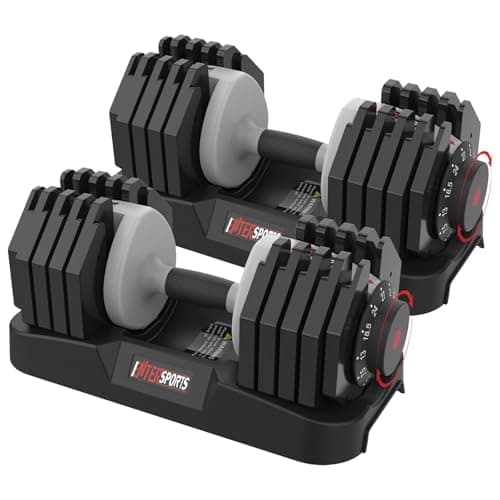
EnterSports 27kg adjustable dumbbells review: 10 settings from 2 to 27kg, uneven 2.5 to 3kg jumps, dial lock, wobble and who should pick it over the 20kg pair.
What a glute ham developer is, how a GHD machine differs from a Roman chair, the exercises it's built for, how to set it up, UK price bands and cheaper substitutes.
Best Exercise is a participant in the Amazon EU Associates Programme, an affiliate advertising programme designed to provide a means for sites to earn advertising fees by advertising and linking to Amazon.co.uk. As an Amazon Associate we earn from qualifying purchases. This comes at no extra cost to you and never influences our independent reviews or rankings.