Garmin's entry-level runners used to feel like punishment. You saved money and you lost the screen, the training metrics, and anything that made the watch interesting to look at. The Forerunner 70 stops that. It's a 43mm AMOLED running watch with built-in GPS, training readiness, Garmin Coach and around 13 days of battery, and at roughly £214 it undercuts the Forerunner 265 by about £80 while keeping most of what actually changes how you train.
The compromises haven't vanished; they've just moved to places most beginners will never look. There's no offline map, no onboard music, and the optical heart rate sensor is the same mid-tier unit that struggles when you hit a hard interval. None of that matters much if you're training for a 10K and want a watch that tells you whether today should be hard or easy.
How we review
This review draws on Garmin's published specifications for the Forerunner 70, the consistent findings from verified owner reviews and expert testing outlets, and our own long-running experience with the wider Forerunner line. We have not run a six-month endurance test on this exact unit, so we report only the patterns that show up repeatedly rather than one-off complaints.
Who it is for
Buy this if you're new to structured running and you want the watch to do the thinking. Garmin Coach will build you a 5K, 10K or half marathon plan that shifts when you miss a session, daily suggested workouts fill in the gaps on unstructured weeks, and training readiness gives you a single number each morning that folds in sleep, recovery time, training load and HRV status.
Skip it if you run trails where a map matters, if you want music without your phone, or if you already own a Forerunner 165 or 265. Runners chasing lab-grade heart rate data should also read the Garmin Forerunner 265 review, which sits a tier up in sensor quality and screen size.
Bright 43mm AMOLED touchscreen with physical buttons, so sweaty hands still work
Training readiness on an entry-level Garmin, which used to start two tiers higher
Around 13 days of smartwatch battery and 23 hours of GPS
Garmin Coach plans genuinely adapt when you miss a run
80+ activity profiles, including strength, HIIT and cycling
Light enough at 43mm to sleep in without noticing it
Incident detection and LiveTrack for solo evening runs
Cons
No offline maps, only breadcrumb return-to-start navigation
No onboard music storage, so your phone comes with you
Optical heart rate lags at the start of hard intervals
Always-on display roughly halves the quoted battery life
Text replies work on Android only, not iPhone
Screen, build and everyday wear
The AMOLED panel is the reason this watch exists. Garmin's older budget Forerunners used dim memory-in-pixel screens that saved power and looked a decade old, and moving to AMOLED at this price finally closes that gap with the Coros and Suunto competition. Colours are saturated, the display is readable in direct sun at full brightness, and the touchscreen is responsive enough for scrolling through data screens without feeling laggy.
Garmin kept physical buttons, which matters more than the spec sheet suggests. Touchscreens turn unreliable the moment your fingers are wet, and in a January downpour the buttons are the only thing that works. The 43mm case is small by modern standards and sits comfortably on slimmer wrists, and at this weight most people forget they're wearing it overnight, which is the practical requirement for sleep tracking to be worth anything.
Garmin Forerunner 70 key specs
Case size
43 mm
Display
AMOLED touchscreen with button controls
Battery, smartwatch mode
Up to 13 days
Battery, GPS mode
Up to 23 hours
GPS
Built-in, multi-GNSS
Heart rate
Wrist-based optical sensor
Activity profiles
80+, including running, cycling, HIIT and strength
Training metrics
Training readiness, training status, training effect, recovery time, HRV status
Incident detection and live location sharing via phone
Music
Phone control only, no onboard storage
Maps
None, breadcrumb navigation only
Price at review
Around £214
Training features that actually earn their place
Training readiness is the headline, and it deserves to be. Each morning the watch combines your sleep quality, recent training load, recovery time and overnight HRV into a score from 1 to 100, and the score is honest enough to be useful: it will tell you that your planned tempo run is a bad idea after four hours of broken sleep. Garmin is careful to describe these as close estimations rather than measurements, and that caveat is fair, but the trend over a fortnight is what you should read anyway.
Garmin Coach is the other feature that changes behaviour. Pick a target race and a date, answer a few questions about your current mileage, and it builds a plan that adjusts week by week based on what you actually did. Miss a Tuesday session and it reshuffles rather than sulking. The beginner plans include run/walk workouts, which is the right call for a watch aimed at people who haven't raced before.
Everything else is the familiar Garmin toolkit. Training status tells you whether your load is productive, unproductive or simply maintaining. Training effect splits each run into aerobic and anaerobic benefit. Recovery time counts down the hours until you're fresh, and daily suggested workouts hand you a session when you can't be bothered planning one.
Heart rate and GPS accuracy
The optical sensor is competent rather than excellent. On steady runs and everyday wear it tracks closely enough that the resulting zone distribution is meaningful. Push into a short hard interval and you get the familiar wrist-optical delay, where the reading climbs several seconds behind your actual effort and occasionally locks onto your cadence instead. Device validation work across wrist-worn wearables has found the same pattern repeatedly: agreement is strongest during sedentary and light activity and degrades as intensity climbs (wrist and arm-worn wearable heart rate validation study, 2025).
The fix is cheap and it's a chest strap. If you run by feel or by pace, ignore all of this and the wrist sensor is fine. If your training plan is built on precise zone time, budget another £40 and read our best heart rate monitor guide.
GPS tracking is multi-band Garmin, which means it settles quickly and holds a sensible line on open roads. Tight city blocks with tall buildings still produce the occasional wobble, as they do on every watch at this price.
Sleep and recovery tracking
Sleep score and sleep stages feed the training readiness number, so their accuracy matters more here than on a watch that treats sleep as a novelty. Consumer sleep trackers do a decent job of detecting total sleep time and a much rougher job of splitting that into stages, with multi-device validation studies putting stage-level agreement well below the headline figures (accuracy of commercial wearables for sleep tracking, 2024). Read your total hours and the week-to-week direction; treat the deep-sleep minutes as a rough guide rather than gospel.
Daily energy tracking, Garmin's drain-and-recharge battery metaphor for your body, is more useful than it sounds. It responds to naps, stress and hard sessions, and after a fortnight of wear the pattern lines up well with how you actually feel. Pair it with something that helps you recover properly and it stops being a novelty: our guides to how long DOMS lasts and foam rolling before or after a workout cover the practical side.
Value against the competition
At around £214 the Forerunner 70 sits awkwardly close to the £219 Forerunner 165 Music and roughly £80 below the Forerunner 265. Against the 165, the 70 wins on training readiness and loses on offline music. Against the 265, you're giving up screen size, a better heart rate sensor and music storage to save real money, and for a new runner that's a sensible trade.
The outside competition is tougher than it used to be. Coros sells the Pace 4 at £229 with longer battery life, and Polar's Pacer Pro undercuts the Garmin ecosystem on price while losing to it on software. Garmin's advantage remains Connect, which is still the most useful training platform of the three. Full details of the alternatives sit in our Coros Pace 4 review and the best Garmin watch UK guide.
For a first proper running watch, yes. You get an AMOLED screen, built-in GPS, training readiness, Garmin Coach plans and roughly 13 days of everyday battery for around £214, which is about £80 less than a Forerunner 265. If you already own a Forerunner 165 or 265, the upgrade is not worth the money.
What is the battery life of the Forerunner 70?
Garmin quotes up to 13 days in smartwatch mode and up to 23 hours with GPS running. In practice, if you run four or five hours a week and leave the screen on gesture wake, expect to charge it every week to ten days. Leaving the always-on display enabled cuts that roughly in half.
Does the Forerunner 70 have offline maps?
No. It gives you breadcrumb-style navigation back to your start point but there is no full topographic or street map on the watch. If you need proper maps on your wrist, you are looking at a Forerunner 965, a Fenix or a Suunto Race 2 instead.
Does the Forerunner 70 have music storage?
No onboard music storage. It controls whatever is playing on your phone, which means the phone has to come with you on runs if you want audio. The Forerunner 165 Music is the cheapest Garmin that stores playlists offline.
Is the Forerunner 70 accurate for heart rate?
It is good for steady running and everyday tracking, and it is the usual wrist-optical story for intervals: lag of several seconds at the start of a hard effort, and the occasional cadence lock. Validation work on wrist devices shows accuracy drops as intensity rises, so pair a chest strap if you train by heart rate zones.
Forerunner 70 or Forerunner 165?
The 70 is the newer and cheaper of the two, and it carries training readiness, which the 165 does not. The 165 Music wins if offline playlists matter to you. For most new runners the 70 is the better buy, and the gap is around £5 to £30 depending on the week.
How the assisted dip machine works (more weight means more help), how to set it up, form cues, common mistakes, and a simple plan to reduce the assistance until you can do unassisted dips.
The best back extension alternative is a floor prone extension for the lower back, or a Romanian deadlift if you want load. 9 swaps, sorted by erector or glute focus.
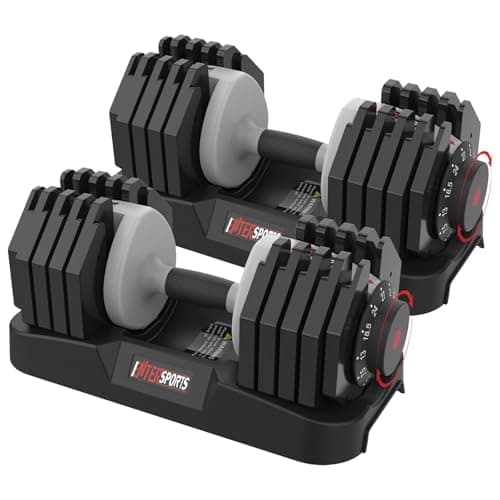
EnterSports 27kg adjustable dumbbells review: 10 settings from 2 to 27kg, uneven 2.5 to 3kg jumps, dial lock, wobble and who should pick it over the 20kg pair.
What a glute ham developer is, how a GHD machine differs from a Roman chair, the exercises it's built for, how to set it up, UK price bands and cheaper substitutes.
Best Exercise is a participant in the Amazon EU Associates Programme, an affiliate advertising programme designed to provide a means for sites to earn advertising fees by advertising and linking to Amazon.co.uk. As an Amazon Associate we earn from qualifying purchases. This comes at no extra cost to you and never influences our independent reviews or rankings.