Workouts
Bayesian Curl: How to Do the Bayesian Cable Curl Properly
How to do the Bayesian curl: setup, form cues, what the research says about the stretched position, common mistakes, home band version and a simple plan.

By Paul Kendrick, Cardio & Endurance Editor · Updated 4 October 2026
We may earn a commission from qualifying purchases made through links on this page, at no extra cost to you. This never affects our ratings.
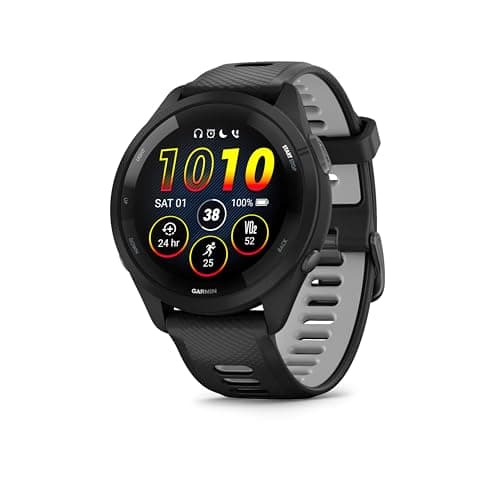
Garmin's Forerunner 265 landed as the moment AMOLED arrived in a mid-range running watch, and two years on it is still the one most runners should buy. The screen is the headline: bright, sharp and readable in low winter light without hunting for a backlight button, which sounds trivial until you have squinted at a memory-in-pixel display at 6am in November. Underneath sits Garmin's training software, the actual reason people stay in this ecosystem. At £299 it isn't cheap, though it's priced well below the 965 while doing nearly everything that watch does. If you've been searching for the Garmin 265 and wondering whether it's been overtaken by the newer Forerunner 570, the short answer for most people is no: it still has the full training suite, and the price gap is the bigger story.
How we review
This review is built on Garmin's published specifications, the current Amazon UK listing, and the consistent themes in verified owner reviews and independent expert testing. We have not run our own multi-month test of this specific unit, so we report what comes up repeatedly rather than isolated experiences, and we separate Garmin's quoted numbers from what owners actually see.
Runners who train with some structure. If you follow a plan, care whether today should be hard or easy, and want to see whether your fitness is moving, the 265 gives you tools that genuinely change decisions. Triathletes are covered too, with open water swimming and cycling profiles among the 30-plus activity profiles Garmin lists.
It is overkill for walkers and casual gym-goers. If your interest is heart rate zones during a spin class or a treadmill session, our best heart rate monitor guide covers chest straps that do that job more accurately for under fifty quid.
The 1.3in AMOLED at 46mm is the thing you notice in the first ten seconds and keep appreciating for months. Colours are strong, text is crisp, and a wrist flick wakes it instantly. You can run it always-on if you prefer a traditional watch face, at a real cost to battery.
Physically it stays sensible. Forty-seven grams means you forget it overnight, which matters because sleep tracking feeds the recovery numbers. Garmin kept five physical buttons alongside the touchscreen, and anyone who has tried to stop a lap on a touchscreen in the rain with numb fingers will understand why that decision is worth a paragraph. The case is polymer with a plastic bezel, and at £299 it looks it, particularly beside the titanium 965.
| Case size | 46 mm (265S is 42 mm) |
|---|---|
| Display | 1.3 in AMOLED touchscreen, plus five buttons |
| Weight | Approx 47 g |
| Battery, smartwatch mode | Up to 13 days |
| Battery, GPS mode | Up to 20 hours |
| Positioning | Multi-band GNSS with SatIQ |
| Water rating | 5 ATM |
| Activity profiles | 30+ including running, cycling, triathlon, open water swim |
| Music | Offline storage, Spotify, Amazon Music and Deezer support |
| Key metrics | Training readiness, HRV status, training status, race widget |
Training readiness is the one that changes behaviour. Each morning the watch combines your sleep, recent training load, recovery time and HRV status into a single score, and after a fortnight of calibration it is uncannily good at telling you the session you had planned is a bad idea. The morning report puts that in front of you before you have made a decision you regret.
HRV status needs about three weeks of consistent overnight wear before it gives you a baseline, so do not judge it in week one. Once established, it flags the run of poor nights or the incoming cold before you consciously notice either.
Daily suggested workouts adapt to what you actually did rather than what a plan said you should have done, and the race widget builds toward a date you enter, adjusting as your fitness moves. None of it replaces a coach. All of it is better than guessing.
GPS is excellent. Multi-band reception with SatIQ switching means city routes between tall buildings and runs under heavy tree cover track far more cleanly than single-band watches manage, and SatIQ only burns the extra battery when conditions call for it.
Wrist heart rate is a different story, and it is worth being straight about it. Optical sensors read blood flow through the skin and get confused by wrist flexion, cold and sudden intensity changes, which is why validation work comparing wrist-worn devices with chest straps against ECG consistently places straps closer to the reference, and why a study of wearable heart rate accuracy in cardiac rehabilitation found accuracy varied by both device and activity. For easy and steady running the 265 is fine. For 400m repeats, pair a chest strap; the watch takes an external sensor in seconds.
Garmin's 13 days assumes gesture-based backlight and light use. Turn on always-on display, take notifications from a busy phone, and run four times a week, and most owners report something in the five to seven day range. That is still a week between charges on a bright AMOLED watch, which two years ago would have sounded optimistic. GPS runtime of up to 20 hours covers a marathon several times over, though music playback while running drags it down sharply.
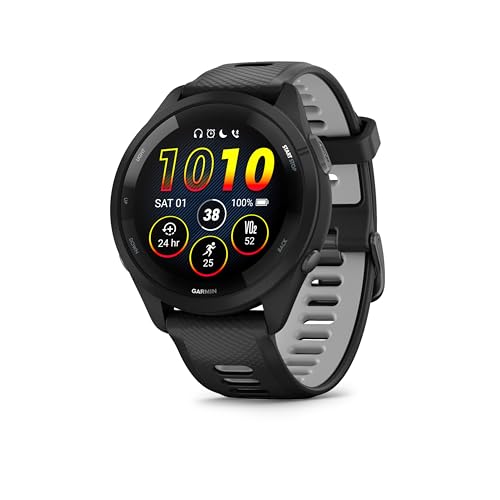
The 265 and the Forerunner 265S are the same watch inside. The 265 has a 46mm case with a 1.3 inch screen and 22mm straps; the 265S drops to 42mm, a 1.1 inch screen and 18mm straps. Garmin quotes 13 days in smartwatch mode for the 265 and 15 for the 265S, because the smaller screen has less to light. Pick by wrist size, not features: if a 46mm watch overhangs your wrist bone, the S is the one you'll actually wear to bed, and sleep data is half of what makes training readiness useful.
Against the Forerunner 965, you lose maps, screen size and the titanium bezel, and you keep essentially the whole training suite. Unless you navigate unfamiliar trails, the 265 is the better value by a distance. Against the older 255, the AMOLED screen is the upgrade, and the 255 remains a bargain when it is discounted.
For treadmill work the 265 tracks distance from wrist movement, and it improves as you calibrate it against known distances, though it will never match a foot pod for accuracy on a belt. If most of your mileage happens indoors, spending less on the watch and more on the machine is the smarter allocation; our treadmill reviews and the best incline treadmill guide are the place to start. Whatever you use it for, the target worth hitting remains the NHS guidance of 150 minutes of moderate activity a week, and a watch that nags you gently toward it earns its keep.
Check price on AmazonFor anyone who runs a few times a week and wants training guidance rather than just a stopwatch, yes. Around £299 buys an AMOLED screen, multi-band GPS, offline music and Garmin's training readiness and HRV tools, which is a lot of watch. If you only jog occasionally, the older Forerunner 255 or a cheap chest strap paired to your phone will cover you for a fraction of the money.
Maps and materials, mostly. The 965 adds full colour topographic and street maps, a titanium bezel, a larger screen and longer battery life, for a meaningful jump in price. Training features are near identical, so unless you run trails or travel somewhere you need on-wrist navigation, the 265 gives you almost the same watch for a lot less.
Good for steady running and less reliable during hard intervals, which is true of every wrist optical sensor rather than a Garmin failing. Validation studies consistently rank chest straps closer to ECG than wrist sensors during vigorous exercise. Pair a chest strap for interval sessions and use the wrist for everything else.
Garmin quotes up to 13 days in smartwatch mode and up to 20 hours with GPS. Real world with the always-on display enabled, notifications flowing and a few runs a week, most people land somewhere around five to seven days. Turning off always-on display is the single biggest battery saving you can make.
No. It gives you a breadcrumb trail and turn prompts for a course you load, but there is no base map on the watch, so you cannot pan around and find a road. That is the main reason to pay more for the Forerunner 965.
Yes. It holds offline playlists from Spotify, Amazon Music and Deezer with a subscription, or your own MP3 files, and pairs to Bluetooth headphones so you can leave your phone at home. Downloading playlists over Wi-Fi is slow, so start it before you make dinner rather than before you head out.
How to do the Bayesian curl: setup, form cues, what the research says about the stretched position, common mistakes, home band version and a simple plan.
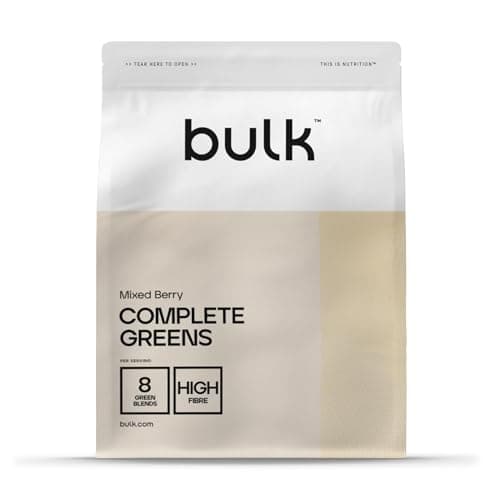
The best greens powders in the UK for 2026, from budget super greens to premium all-in-one vegetable powders, plus an honest look at whether they actually work.
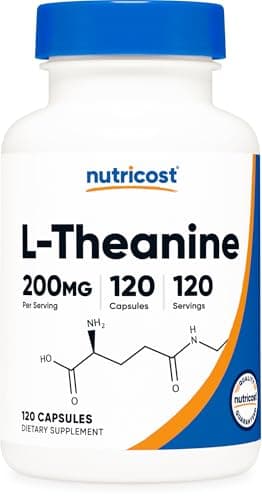
The best L-theanine supplement for UK buyers in 2026: five capsules ranked on dose and cost per day, what the research shows about sleep and caffeine, and the dose worth taking.
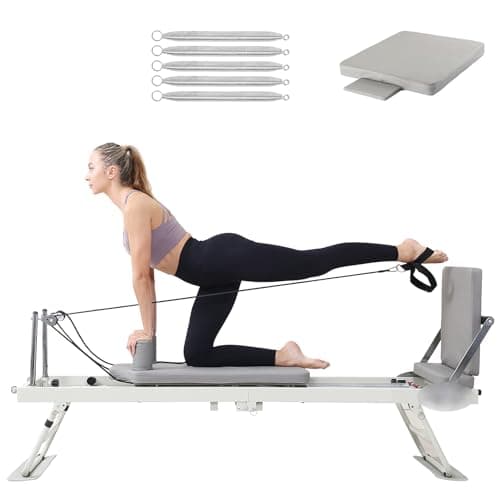
The best reformer pilates machines for home use in the UK in 2026, from a £259 foldable to a £788 wooden frame. Honest picks, real specs and how to choose a pilates machine.
Best Exercise is a participant in the Amazon EU Associates Programme, an affiliate advertising programme designed to provide a means for sites to earn advertising fees by advertising and linking to Amazon.co.uk. As an Amazon Associate we earn from qualifying purchases. This comes at no extra cost to you and never influences our independent reviews or rankings.