Home Gym
Adjustable Kettlebell: Is One Worth Buying? Types, Pros and Cons
Is an adjustable kettlebell worth it? The main designs, weight jumps, how they cope with swings and snatches, cost per kg versus fixed bells, and what to buy.

By Jack Atkins, Home Gym Equipment Specialist · Updated 13 November 2026
We may earn a commission from qualifying purchases made through links on this page, at no extra cost to you. This never affects our ratings.
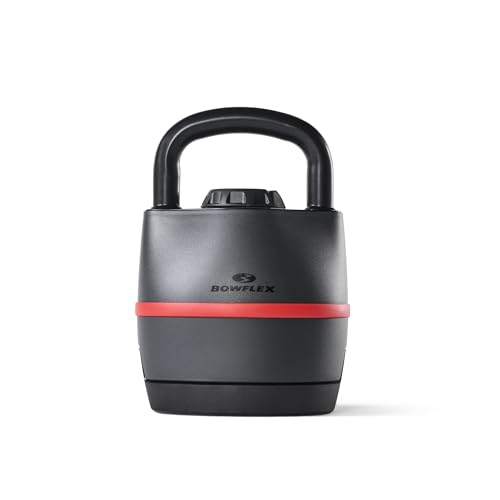
The BowFlex SelectTech 840 is a dial-adjustable kettlebell that replaces six fixed bells, from 3.5kg up to 18kg. It's a good buy if you want fast weight changes and a small footprint for swings, goblet squats and presses at home, and a poor one if you want a bell that feels and handles like cast iron. At £141.99 on Amazon UK at the time of writing, it costs about what two or three mid-weight fixed bells do.
The idea is simple. You sit the bell in its base, turn a dial to the weight you want, and lift out the handle with only those plates attached. No tools, no spanners. BowFlex's own spec page lists six weights (3.5, 5.5, 9, 11, 16 and 18kg), a 2 year parts warranty and a bell body that measures 22.4 x 17.8 x 31.8cm.
The trade-offs are just as clear. The shape is bulkier than a cast-iron bell because the plates and selector live inside a plastic-shelled body. It isn't built for juggling or high-rep snatches. And without the base, you can't change weight at all.
How we review
This review is research-based. We've worked from BowFlex's published specifications, the live Amazon UK listing and consistent owner feedback, and we haven't run a long-term hands-on test of this bell. Where a detail isn't published, we say so rather than guess.
The 840 makes sense for a few kinds of buyer.
It's a poor fit if you already swing 20kg or more, since the top setting is 18kg. It's also awkward for anyone who wants fine jumps for progressive overload, and for anyone who'll be dropping, throwing or juggling the bell. Not sure what weight you need? Our what weight kettlebell should I use guide gives starting weights by exercise.
Six settings sound flexible. Look at the actual numbers though: 3.5, 5.5, 9, 11, 16 and 18kg. The gaps are 2, 3.5, 2, 5 and 2kg.
That 5kg leap from 11kg to 16kg is the one that matters. Plenty of people find 11kg too light for swings and 16kg a reasonable target, and the BowFlex gives you no middle. Presses, windmills and get-ups suffer most, because a jump that size can mean going from comfortable to unmanageable in one step. For swings and deadlifts it's less of a problem, since you can use more reps or slower tempos to bridge it.
Compare that with the Bells of Steel adjustable kettlebell, which runs 12 to 32kg in 0.5kg steps. It's a different animal: a steel competition shell, around £300, tools needed. If you expect to progress past 18kg, it's the better long-term pick. If you want quick changes and light weights, the BowFlex wins.
| Weight settings | 6: 3.5, 5.5, 9, 11, 16 and 18kg |
|---|---|
| Imperial equivalent | 8, 12, 20, 25, 35 and 40 lb |
| Dimensions | 22.4 x 17.8 x 31.8cm (L x W x H) |
| Adjustment method | Selection dial, bell sits in base |
| Warranty | 2 years (parts) |
| Amazon UK price | £141.99 at time of writing |
A cast-iron kettlebell is a solid ball with a handle. The BowFlex is a plastic-shelled body wrapped around the plates and selector, and that changes how it sits and moves. It's wider and chunkier than a fixed bell of the same weight, so the rack position, where the bell rests against your forearm and chest, feels different. People with smaller frames report the bulk sits awkwardly, which is a common complaint with dial-style bells.
The 22.4 x 17.8 x 31.8cm footprint is BowFlex's own figure. We haven't seen a published handle diameter, so we won't guess one. Check the owner photos on the Amazon listing and compare against what you're used to before you buy.
What we're confident about is the design limit. The plates sit loose inside a plastic shell. That's fine for swings, squats, deadlifts and presses done with control. It's the wrong choice for juggling, throwing or high-rep snatches, where the bell lands or rotates fast. And you shouldn't drop it. A cast-iron bell shrugs off a floor slap, but an adjustable selector mechanism is more likely to take damage.
Kettlebell work itself is well supported by research, though no study used this bell. In a 6-week trial, twice-weekly kettlebell swing training improved half-squat strength by 9.8% and vertical jump by 19.8% in 21 healthy men, with no significant difference from jump squat training. Another randomised trial found that 8 weeks of ballistic kettlebell training reduced musculoskeletal pain in workers with high pain levels. The first used 12kg or 16kg bells depending on body mass, both inside the BowFlex's range. If swings are your main goal, see our kettlebell swing guide.
The dial is the selling point, so it's worth saying where it pays off. Picture a 20 minute circuit: goblet squats at 16kg, halos at 5.5kg, then a few presses at 9kg. With fixed bells you'd have three on the floor. With the BowFlex you return the bell to its base, turn the dial and lift out the new weight. It takes a few seconds, and nothing sits around to trip over.
Where it frustrates is anything that needs a precise load. If your last set of presses at 9kg was easy and 11kg is too hard, you're stuck. Many lifters get round this with extra reps, slower lowering or a pause at the bottom, which works but isn't the same as adding 1kg. Swings forgive the gaps better than presses do, and for general fitness that's often enough. Anyone chasing a specific press target, such as a strict 16kg overhead, will want a bell with finer steps.
Storage is simple: the bell lives in its base, and the pair fit on a shelf or in a corner. Keep the dial set to your lightest weight between sessions so the next person doesn't lift an unexpected 18kg.
It's bulkier than it looks in photos. Because the selector mechanism lives in the body, the bell is bigger than a cast-iron bell of the same weight. Expect a wider footprint on the floor and a clunkier feel in the rack.
Not for juggling or high-rep snatches. If your plan includes snatch ladders, bell flips or anything that sends the bell spinning around your hand, buy a fixed cast-iron or competition bell. The BowFlex is a swing-squat-press tool.
Rough drops are out. Set it down, don't let it fall. Once weight is dialled in and the handle is lifted out, it's a sealed unit, but it isn't a bell you slam to the floor.
The base is non-negotiable. Every weight change needs the base. That's no hassle in a home gym, but it's one more object to store, and it makes the bell awkward to take to a garden or a friend's house.
The 5kg jump. Already covered, but it's worth repeating because it's the most common reason people outgrow this bell early.
Ceiling of 18kg. Many men and a fair number of women will want 20 to 24kg for swings within a year of consistent training. At that point you're buying a second bell.
£141.99 isn't cheap for six weights. Three fixed bells in the mid weights will often cost less than that, but you'd get three weights, not six. You're paying for six weights in one footprint and a dial that changes in seconds.
If you'll use three or four of those weights regularly and space is tight, the maths works. If you'll only ever use one or two, buy fixed bells.
Check today's price on the BowFlex SelectTech 840 kettlebell£141.99It has six dial settings: 3.5kg, 5.5kg, 9kg, 11kg, 16kg and 18kg. BowFlex lists these as 8, 12, 20, 25, 35 and 40 lb. There's nothing in between, so you can't dial up to 13kg or 14kg.
Yes. The bell sits in its base while you turn the dial, then you lift the handle out with only the chosen weight attached. If the base is in another room, you're not changing weight. Keep it near where you train.
Yes, for swings, goblet squats, deadlifts, rows and presses. Most adults will find 16kg or 18kg plenty for swings to start. It's the wrong tool for fast snatches, juggling or anything where the bell might hit the floor hard.
The BowFlex changes weight in seconds with a dial but tops out at 18kg and moves in six steps. The Bells of Steel runs 12 to 32kg in 0.5kg steps with a competition-shape steel shell, but needs tools and about a minute per change. BowFlex suits circuits and light weights. Bells of Steel suits heavy, progressive lifting.
We haven't found anything linking this kettlebell to the 2025 recall of SelectTech dumbbells, which covered the 552 and 1090 models. Check the Product Recalls page on BowFlex's own site with your serial number if you're unsure.
BowFlex's product page lists a 2 year parts warranty. Check the terms that apply to the UK seller you buy from.
Is an adjustable kettlebell worth it? The main designs, weight jumps, how they cope with swings and snatches, cost per kg versus fixed bells, and what to buy.
Google Pixel Watch 5 review: dual-frequency GPS, 40 hour battery, readiness, sleep score and Gemini coaching for £329. Where it still loses to a Garmin.
How much is a reformer pilates machine? UK prices run from about £220 for a folding cord model to £3,500 for studio kit. Real prices by tier, Nov 2026.
Why is reformer pilates so expensive? Classes cap at about 10 machines costing £2,450 each. UK class prices, the studio maths and four cheaper routes.
Best Exercise is a participant in the Amazon EU Associates Programme, an affiliate advertising programme designed to provide a means for sites to earn advertising fees by advertising and linking to Amazon.co.uk. As an Amazon Associate we earn from qualifying purchases. This comes at no extra cost to you and never influences our independent reviews or rankings.