Home Gym
Adjustable Kettlebell: Is One Worth Buying? Types, Pros and Cons
Is an adjustable kettlebell worth it? The main designs, weight jumps, how they cope with swings and snatches, cost per kg versus fixed bells, and what to buy.

By Paul Kendrick, Cardio & Endurance Editor · Updated 8 October 2026
We may earn a commission from qualifying purchases made through links on this page, at no extra cost to you. This never affects our ratings.
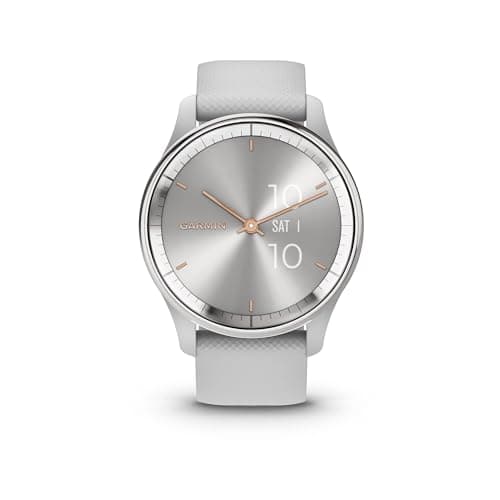
The vívomove Trend is a Garmin that doesn't look like one. From across a table it reads as a smart 40mm analogue watch with a stainless steel bezel, and only when you tap or raise your wrist do the hands swing aside to reveal a colour touchscreen underneath. At £232 on Amazon UK, it's the best-looking way to get Garmin's health tracking, Body Battery and Garmin Pay on your wrist. It's also a poor choice if you want a training watch, because there is no GPS inside and the battery only runs for around five days.
That split is the whole story here. Judge it as jewellery that counts your steps, scores your sleep and pays for your coffee, and it's very good. Judge it against a Forerunner and it falls apart, and Garmin never pretended otherwise.
How we review
This review is research-based. We compile Garmin's published specifications from its UK product page, the Amazon UK listing, and recurring patterns in verified owner feedback. We have not tested this watch hands-on, so we report what shows up consistently, good and bad, rather than one person's impression. Price and stock were checked on Amazon UK at the time of writing.
Garmin launched the Trend in February 2023 at £279.99, so today's Amazon price is a fair discount for a watch whose hardware hasn't been replaced yet. The figures below come from Garmin's own vívomove Trend page and the Amazon UK listing.
| Case size | 40mm, stainless steel bezel |
|---|---|
| Display | Hidden colour touchscreen beneath analogue hands |
| Battery (smartwatch mode) | Up to 5 days |
| Battery (watch mode) | Up to 1 additional day |
| Charging | Qi wireless or supplied Garmin cable |
| GPS | Connected GPS only (uses your phone) |
| Water rating | 5 ATM |
| Sensors | Optical heart rate, Pulse Ox, barometric altimeter, accelerometer |
| Payments | Garmin Pay (NFC) |
| Safety | Incident detection and assistance (via phone) |
| Compatibility | iPhone and Android, Garmin Connect app |
| Amazon UK price | £232.00 at the time of writing |
This is the reason to buy it. Garmin's earlier hybrids, including the vívomove Sport that a lot of people search for, hid a small monochrome strip in the lower half of the dial and asked you to read your data through a letterbox. On the Trend, the hidden display covers most of the face and shows colour, so heart rate graphs, notifications and the Body Battery gauge are legible without squinting. When the screen lights up, the hands move out of the way; when it times out, they sweep back to the correct time.
The 40mm case suits slim and average wrists well, and the steel bezel lifts it above the plastic Sport. Owners consistently mention that it passes for a normal dress watch at work, which is exactly the brief.
There's a catch, though. Even on the Trend, the display window is small next to a full smartwatch, so longer messages need scrolling and the touch interface asks for a few more swipes than a Venu. It's fine for glances, which is the point, but you won't be reading emails on it.
Underneath, the Trend runs the same wellness software as Garmin's mainstream watches. You get continuous heart rate, stress, sleep score, Pulse Ox, respiration, women's health tracking and Body Battery, which rolls sleep, stress and activity into a single 0 to 100 energy figure. Steps, floors climbed (from the barometric altimeter), calories and intensity minutes are all logged, and Garmin Connect lays the trends out clearly over weeks and months.
Intensity minutes are quietly the most useful number for most buyers. The NHS physical activity guidelines ask adults for at least 150 minutes of moderate activity a week, and the Trend tracks your progress towards that target without you having to start a workout.
For workouts themselves, there are profiles for walking, running, cycling, yoga, strength, cardio, HIIT, pilates and more. Optical heart rate is reasonable for steady sessions but, like every wrist sensor, it struggles with sharp intervals and heavy gripping. A 2019 study of wrist-worn monitors in cardiac rehabilitation found that none of the four wrist devices tested matched an electrode chest strap, and the gap widened during exercise. If accurate interval heart rate matters to you, a chest strap paired to your phone or gym kit is the better tool, and our heart rate zone training guide explains why the numbers matter.
This is the biggest functional gap. The Trend relies on connected GPS, so outdoor runs and walks only get a route map, accurate distance and pace if your phone is with you. Without the phone, it falls back on the accelerometer to estimate distance, which drifts.
For dog walks and commutes with your phone in a pocket, connected GPS works well enough. For anyone who wants to run phone-free, it's a dealbreaker, and the cheaper Fitbit Charge 6 has GPS built in for well under half the price.
Garmin quotes up to 5 days in smartwatch mode and one more day in watch mode once the battery runs low. That's short by Garmin standards; the vívoactive 6 manages up to 11. Turning on overnight Pulse Ox cuts it further, and owners commonly report charging every four days or so with notifications and sleep tracking switched on.
Qi wireless charging softens the blow considerably. The Trend was Garmin's first watch to support it, and it works on most standard Qi pads, so you can drop it on the same charger as your phone. A proprietary clip cable comes in the box as backup.
Garmin Connect is free with no subscription, which still counts for a lot when Fitbit locks its deeper insights behind Premium. Garmin Pay works with a range of UK banks, though not all of them, so check yours first. Incident detection can send your location to emergency contacts during outdoor walks, runs and rides if it senses a fall, but it needs your paired phone nearby to do so.
Notifications arrive reliably on both iPhone and Android. Android users can send preset quick replies; iPhone users can only read and dismiss.
The Trend makes sense for someone who:
Skip it if you train seriously, run without a phone, swim laps or hate charging more than once a week.
No onboard GPS is the main one, and it rules out phone-free running entirely. Second, the 5 day battery is short for a Garmin and noticeably shorter than cheaper bands. The display window, while far better than the Sport's, is still small for reading anything longer than a text. And at £232 you're paying a clear premium for the hybrid design; similar money buys a vívoactive 6 with built-in GPS, music storage and twice the battery.
Garmin Lily 2 Active: the closest rival for people who want a small, stylish Garmin. It has a digital hidden display rather than analogue hands, and it adds built-in GPS, so it's the better choice if you run or walk without your phone.
Garmin Venu 3S: around £284 buys a full AMOLED smartwatch with built-in GPS, up to 10 days of battery, ECG and sleep coaching. It looks like a smartwatch, though, and that's exactly what Trend buyers are trying to avoid.
Fitbit Charge 6: much cheaper at around £85, with built-in GPS and a longer battery, but it's a plastic fitness band, and the best insights sit behind a Fitbit Premium subscription.
Garmin vívoactive 6: the sensible all-rounder at about £252, with up to 11 days of battery, 8GB of music and built-in GPS. If looks don't matter, it's the better watch.
If the hybrid design is what you're after, Amazon UK's current price sits well below the £279.99 launch RRP.
Check price on Amazon£232.00Not built in. It uses connected GPS, which borrows your phone's GPS signal to map walks, runs and rides. If you leave your phone at home, you still get time, heart rate and an estimated distance from the accelerometer, but no route map or accurate pace.
Garmin quotes up to 5 days in smartwatch mode, plus up to 1 extra day in watch mode where only the hands keep running. Turning on the Pulse Ox sensor overnight shortens it. Most owners settle into a twice-weekly charge, which wireless charging makes less of a chore.
The Sport is the cheaper option, with a smaller monochrome display hidden in the lower half of the dial and a plastic bezel. The Trend has a much larger hidden colour touchscreen that fills most of the dial, a stainless steel bezel, Garmin Pay and Qi wireless charging. If payments or the bigger screen matter, the Trend is the one to buy.
Yes. It has NFC and supports Garmin Pay, so you can tap to pay with a supported UK bank card. Check that your bank appears on Garmin's list before buying, because support varies between banks.
It is rated to 5 ATM, which covers showering, swimming in a pool and getting caught in the rain. It isn't a dive watch, and there is no dedicated pool swim profile with lap counting.
Yes. It pairs with both iPhone and Android through the Garmin Connect app. Android users can reply to texts with preset responses from the watch; iPhone users can read notifications but not reply.
Is an adjustable kettlebell worth it? The main designs, weight jumps, how they cope with swings and snatches, cost per kg versus fixed bells, and what to buy.
Bumper plates explained: why each is 450 mm wide, crumb vs virgin vs urethane rubber, IWF colours, thickness, bounce, price per kg and the set to start with.
Calibrated plates are machined to within 10g or 0.25% of their stated weight and are much slimmer than cast iron. What they cost in the UK and who needs them.
How to choose a dumbbell rack for a home gym: A-frame vs 2 and 3-tier racks, saddles vs shelves for hex dumbbells, load ratings, footprint and floor protection.
Best Exercise is a participant in the Amazon EU Associates Programme, an affiliate advertising programme designed to provide a means for sites to earn advertising fees by advertising and linking to Amazon.co.uk. As an Amazon Associate we earn from qualifying purchases. This comes at no extra cost to you and never influences our independent reviews or rankings.