Best Garmin Watch UK 2026: Which Model Should You Actually Buy?
By Paul Kendrick, Cardio & Endurance Editor · Updated 9 August 2026
We may earn a commission from qualifying purchases made through links on this page, at no extra cost to you. This never affects our ratings.
Garmin's range is genuinely confusing. There are five families, several of them overlap in price, and the differences between a £162 watch and a £602 one are not obvious from a spec sheet. Having spent a lot of time with the data these watches produce, the honest summary is that most people buy too much watch: the mid-range Forerunner does 90% of what the flagship does, and the remaining 10% is mapping and multisport features that a lot of owners never touch.
This guide covers the five Garmin models worth buying in the UK right now, what each one is genuinely best at, and where the money stops buying anything useful.
How we chose
We researched Garmin's published specifications, owner feedback on Amazon UK and independent expert testing rather than running our own long-term test of every model. Prices quoted were correct when this was written and Garmin discounts heavily around sale periods, so check before you buy. Every watch here was in stock on Amazon UK at the time of writing.
1. Garmin Forerunner 265: Best Overall
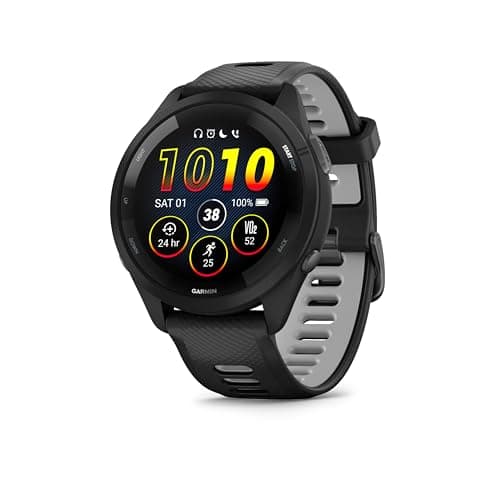
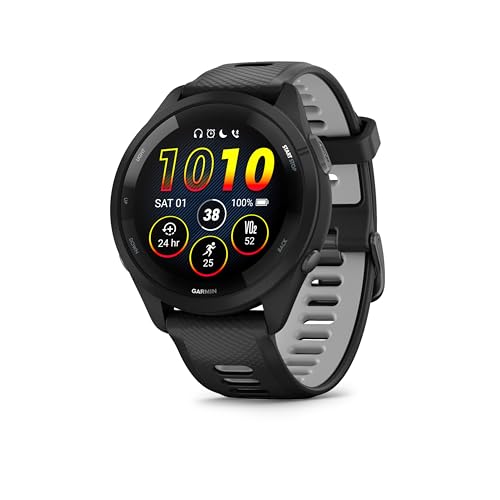
The Forerunner 265 is the one we'd point most people towards, and it isn't close. It took the training features that used to live only in Garmin's expensive watches, put them behind a bright AMOLED touchscreen, and priced it at around £294. Training readiness, HRV status, daily suggested workouts and full running dynamics all appear here.
Multi-band GPS is the upgrade that matters most in daily use. Running through a city centre or under tree cover, the 265 holds a far more believable track than single-band watches, which means your pace readings stop jumping around mid-mile. Battery life lands around 13 days in smartwatch mode and roughly 20 hours with GPS running, which comfortably covers a marathon with plenty spare.
The complaints are fair enough. It's a chunky watch on a small wrist, the touchscreen occasionally does something you didn't intend during a sweaty run, and there's no offline mapping. Neither of the first two is a reason to spend more, and the third only matters if you run somewhere unfamiliar without a phone.
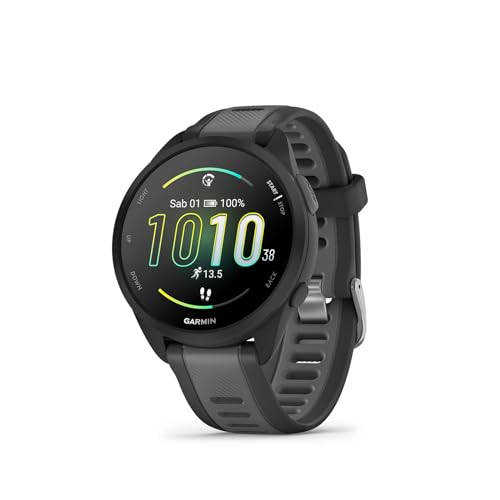
At around £162, the Forerunner 165 is the cheapest Garmin we'd recommend without reservation. It shares the same AMOLED screen technology as the 265, covers up to 11 days of battery in smartwatch mode, has built-in GPS, and runs Garmin Coach training plans if you're working towards a 5K or a half marathon.
What you give up is worth understanding before you save the money. There's no multi-band GPS, so accuracy in built-up areas is a step down. Training readiness and HRV status are missing, and so are the deeper running dynamics like ground contact time. For someone running three times a week who mainly wants distance, pace and a sensible training plan, none of that will be missed.
The 43mm case also suits smaller wrists better than most of the range, which is a practical advantage that spec sheets never mention.
3. Garmin Instinct 3 Solar 45mm: Best Battery Life
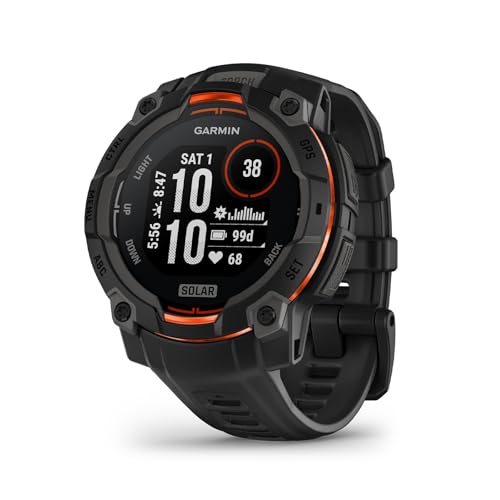
The Instinct 3 Solar takes a different approach: a monochrome memory-in-pixel display instead of AMOLED, which looks dated indoors and is brilliantly readable in direct sun. That screen choice, combined with the solar lens, is why Garmin quotes up to 28 days in smartwatch mode without any sun at all, and effectively unlimited battery under optimal solar conditions of around 50,000 lux for three hours a day (Garmin Instinct 3 Solar specifications).
Read that solar claim carefully. Fifty thousand lux is bright summer daylight, not a British November, so treat the unlimited figure as a best case rather than a promise. Even ignoring solar entirely, four weeks between charges is transformative if you hate charging things.
It's built to a military durability standard, rated to 100m of water, and includes a genuinely useful LED torch with a red mode. Multi-band GPS is standard across both sizes. At about £234 it undercuts the Forerunner 265, and the trade is simple: better battery and toughness, worse screen and fewer running-specific metrics.
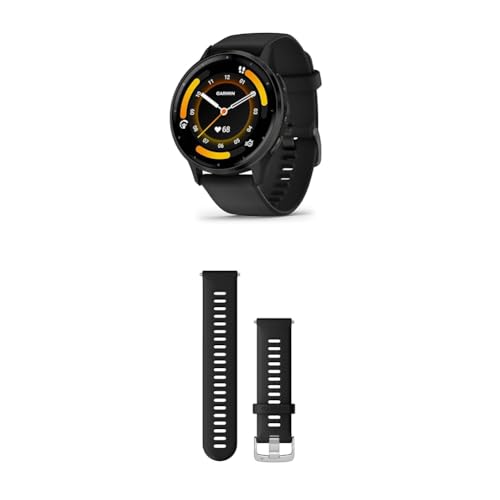
The Venu 3 is Garmin's answer to the question "what if I want a health watch that happens to track workouts, rather than the other way round?" It has the nicest screen in the range, Bluetooth calling, a voice assistant, and Garmin's most developed sleep tracking including a sleep coach and a nap detection feature that works surprisingly well.
Around £406 buys roughly 14 days of battery, which is the number that makes sleep tracking practical in a way an Apple Watch never quite manages. There's a wheelchair mode, meditation tracking, and enough workout profiles to cover a gym routine properly.
Runners should still buy a Forerunner. The Venu 3 has GPS and it works, but training readiness, running dynamics and the deeper analysis aren't the focus here. Buy it for sleep, stress, steps and general health with workouts alongside.
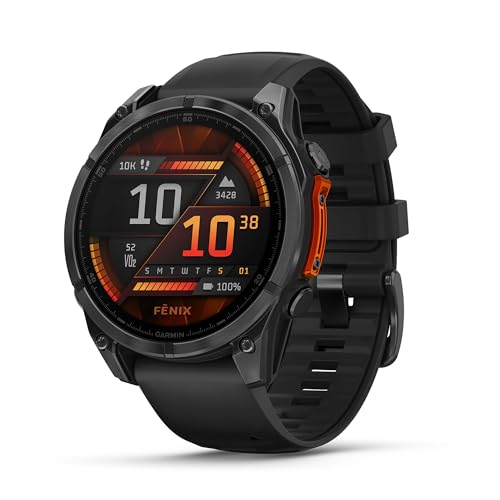
At roughly £602 the fēnix 8 is difficult to justify on features alone, and it's still the best watch Garmin makes. Full offline topographic mapping, a titanium and sapphire build, dive-rated water resistance, a built-in speaker and microphone, and battery life that stretches into weeks despite the AMOLED panel.
The people who genuinely need it are hikers, trail runners, triathletes and anyone who spends real time away from a phone signal. Mapping is the feature that separates it from everything below: being able to see the trail on your wrist and route back to your start point is worth the money if you use it, and worth nothing if you don't.
If you're buying it because it's the top of the range rather than because you'll use maps offline, buy the Forerunner 265 and spend the difference on running shoes.
Start with battery life, because it dictates how you'll use the watch more than any single feature. Anything over ten days means you can wear it to bed indefinitely and charge it whenever you remember; anything under two days means you'll take it off at night and lose the sleep data entirely.
Then decide whether you need multi-band GPS. If you run in a city, through woodland, or between tall buildings, yes. If you run on open roads or mostly train indoors, single-band is fine and saves you over a hundred pounds.
Mapping is the last question and the easiest one. Either you've been lost somewhere without phone signal and wished you had a map, or you haven't. If you answered yes and the fenix price stings, the Garmin epix Pro (Gen 2) is the cheap route into full offline mapping: it's a fenix 7 Pro underneath with an AMOLED panel on top, and it sells for roughly £350.
A word on heart rate accuracy
Wrist-based optical sensors have improved a lot, and Garmin's are among the better ones, with research finding their optical sensor performs comparably to a Polar chest strap for general use (wrist-worn optical and chest strap heart rate comparison). The weakness is consistent across brands: accuracy drops during rapid changes in heart rate, so interval sessions and sprint starts are where wrist readings drift (wearable heart rate device validation study).
The Forerunner 265. It has the bright AMOLED screen, the full training suite including training readiness and daily suggested workouts, dual-band GPS and around 13 days of battery in smartwatch mode, for roughly £294 at the time of writing. Almost everything above it in the range adds features that most runners never open.
What is the difference between the Forerunner 165 and the 265?
Both have AMOLED screens and cover the essentials well. The 265 adds multi-band GPS for better accuracy in cities and under trees, training readiness and HRV status, running dynamics, and a slightly better heart rate sensor. The 165 costs around £132 less and is more than enough for anyone running a few times a week.
Is a Garmin better than an Apple Watch for running?
For running specifically, yes. Battery life is the deciding factor: a Garmin runs for one to two weeks between charges while an Apple Watch needs charging daily or nightly, which makes sleep tracking and long events awkward. Apple wins on apps, calls and general smartwatch behaviour.
Do I need the solar version of the Instinct?
Only if you're outdoors a lot. Solar charging on the Instinct 3 extends battery meaningfully in genuinely bright conditions, and in the UK for much of the year those conditions are scarce. The non-solar model still runs for weeks, so buy solar for hiking, cycling and outdoor work rather than for a commute.
Are Garmin wrist heart rate readings accurate?
Good enough for steady efforts, unreliable for intervals. Wrist optical sensors track well at a stable heart rate but lag behind during rapid changes, which is exactly what intervals produce. If you train by heart rate zones, pair a chest strap for those sessions and use the wrist sensor the rest of the time.
How long do Garmin watches last?
Four to six years of normal use is typical before the battery holds noticeably less charge, and Garmin supports models with software updates for a long time. Straps and screens are the usual failure points rather than the electronics.
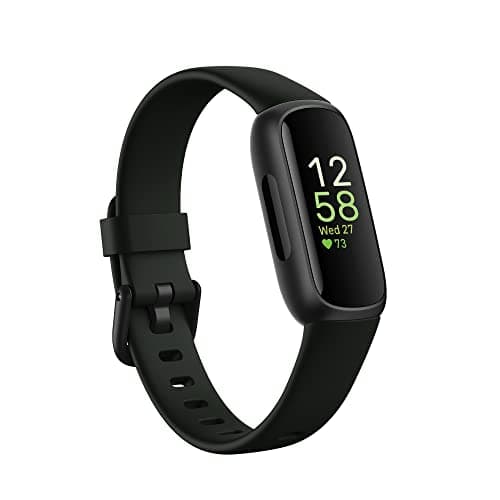
An honest Fitbit Inspire 3 review covering its AMOLED screen, 10-day battery, sleep and heart rate tracking, connected GPS, the Premium paywall and who should buy it.
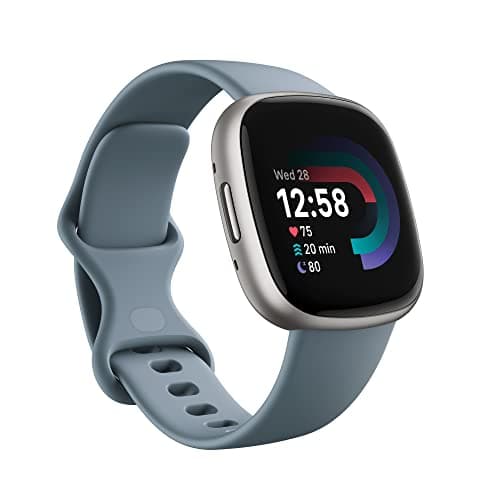
Our Fitbit Versa 4 review covers built-in GPS, 6+ day battery, Google Maps and Wallet, the lost third-party apps and Wi-Fi, and who should buy it at £179.
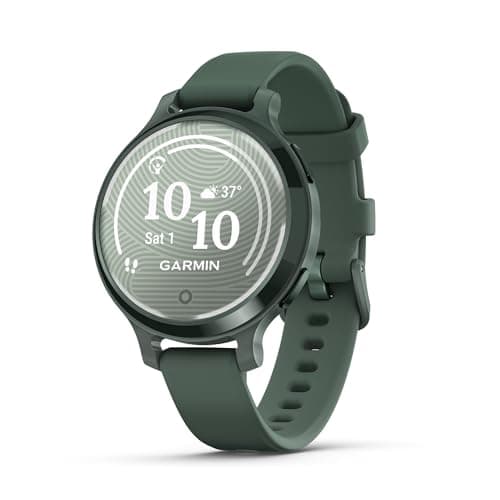
An honest Garmin Lily 2 Active review: built-in GPS on a 38mm, 29g case, 9 day battery, Garmin Pay, and the greyscale screen and missing music storage to weigh against the price.
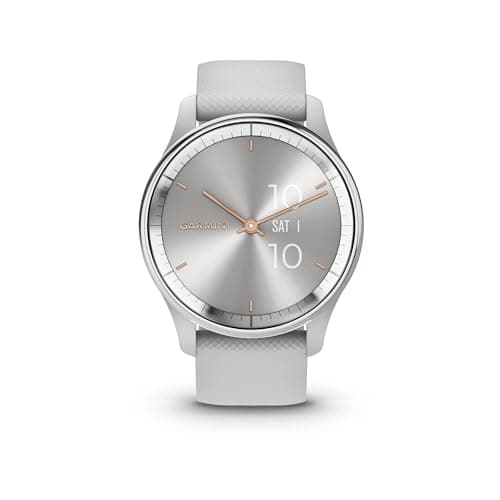
Garmin vivomove Trend review for UK buyers: analogue hands over a hidden touchscreen, Body Battery, Garmin Pay, Qi charging, and the 5 day battery and missing GPS to weigh up at £232.
Best Exercise is a participant in the Amazon EU Associates Programme, an affiliate advertising programme designed to provide a means for sites to earn advertising fees by advertising and linking to Amazon.co.uk. As an Amazon Associate we earn from qualifying purchases. This comes at no extra cost to you and never influences our independent reviews or rankings.