Home Gym
Forerunner 165 vs 265: Is the Garmin 265 Worth the Extra?
Garmin Forerunner 165 vs 265 compared on multi-band GPS, Training Readiness, Training Status, battery, screen size, triathlon mode and UK price, with a clear verdict.

By Paul Kendrick, Cardio & Endurance Editor · Updated 19 November 2026
We may earn a commission from qualifying purchases made through links on this page, at no extra cost to you. This never affects our ratings.
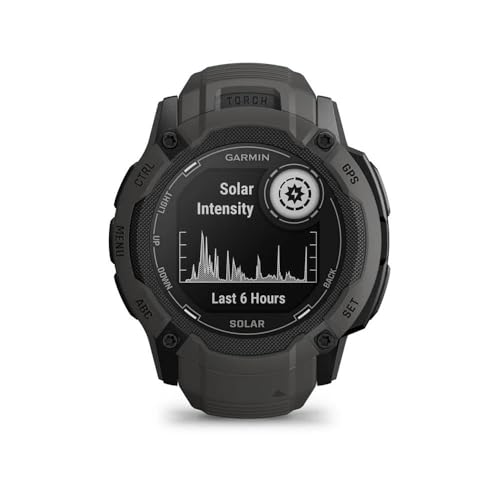
The Instinct 2X Solar arrived in April 2023 as the big brother of the Instinct 2: a 50mm case, a stronger solar lens, a longer battery and, the bit everyone noticed, an LED torch built into the top of the case. It was a very good outdoor watch then. The problem now is simple. Garmin has since released the Instinct 3, and at around £269.99 at the time of writing the 2X costs more on Amazon UK than the newer Instinct 3 Solar.
So this review has two jobs: explain what the 2X does well, and say plainly who should still pick it over its replacement. Spoiler: not many people at this price, though there's a real case for one group.
How we review
This review draws on Garmin's published specifications and owner's manual, the pattern of verified owner feedback on Amazon UK, and published independent testing. We haven't run our own long-term test of this exact unit, so we've reported only findings that turn up consistently rather than one-off impressions. Prices were correct at the time of writing and change often.
Hikers, cyclists, outdoor workers and anyone who wants a big, readable, nearly indestructible watch they charge once a month. It suits wide wrists, and it suits people who care more about runtime than about how the screen looks on a desk.
If you have slim wrists, want the most current Garmin training features, or simply want the best value in this family right now, look at the Instinct 3 Solar instead.
Check the Instinct 2X Solar price on Amazon UKGarmin's owner's manual lists up to 40 days in smartwatch mode with 24/7 heart rate, up to 60 hours of GPS, 150 hours in max battery GPS mode and 100 days in battery saver (Instinct 2X Solar battery life table). With solar, smartwatch mode becomes "unlimited" and GPS stretches to 145 hours.
Read the footnote, though. The unlimited figure assumes all-day wear plus three hours a day outdoors at 50,000 lux, which is bright, direct sunshine. A grey November afternoon in Manchester doesn't come close, and a watch under a coat sleeve gets nothing. In Britain, solar is a handy extension in summer and close to irrelevant from October to March.
That doesn't sink the watch. Forty days with no sun at all is already better than the 28 days Garmin quotes for the 45mm Instinct 3 Solar, and it's the single concrete reason to choose the 2X. Multi-band GPS is the big drain: owner reports and published testing put it at roughly 27 hours of tracking, which is still plenty for a weekend of hiking.
| Case | 50mm fibre-reinforced polymer, approx 14.5mm thick |
|---|---|
| Weight | Approx 67g |
| Display | Monochrome MIP, 176 x 176 pixels, Power Glass lens |
| Battery, smartwatch | Up to 40 days, unlimited with solar |
| Battery, GPS | Up to 60 hours, 145 hours with solar |
| Water rating | 10 ATM (100m pressure equivalent) |
| Durability | MIL-STD-810 thermal, shock and water |
| Sensors | Wrist HR, Pulse Ox, barometric altimeter, 3-axis compass |
| GPS | Multi-band GNSS |
| Torch | LED, variable white, red and strobe |
The LED on the top edge was the 2X's headline feature, and it remains the thing owners mention most. It has adjustable white light, a red mode, and a running strobe that alternates white and red in time with your cadence (Garmin's Instinct 2X Solar announcement). Lighting up a tent, a car footwell or a dark lane on an evening run turns out to be a daily habit once you have it. The Instinct 3 has a torch too, so this is no longer an exclusive.
The polymer case feels tough rather than premium. It's light for its size, which matters if you sleep in it, but 50mm across and roughly 14.5mm thick is a lot of watch on a small wrist. Garmin rates it to 10 ATM and runs it between -20 and 60°C (Instinct 2 Series specifications).
The 176 by 176 pixel memory-in-pixel display reads brilliantly in sunlight and poorly indoors, where you'll lean on the backlight. Garmin roughly doubled display contrast on the Instinct 3, and side by side the difference is obvious. If you're not used to monochrome watches, the 2X screen will feel dated from day one.
Training features cover the useful basics: VO2 max, recovery time, training load, overnight HRV status, sleep tracking and sport profiles including running, cycling, pool swimming and strength. It was also the first Garmin to add obstacle course racing as an activity. What it lacks is polish next to the Instinct 3, which carries Garmin's newer training suite and gets software attention first. Runners who want running dynamics and an easy-to-read pace screen should skip both and look at the Forerunner 265.
Wrist heart rate is fine for steady efforts and laggy in intervals, as with every optical sensor. A chest strap from our best heart rate monitor UK guide fixes that.
This is the decision that matters. The Instinct 3 Solar 45mm sells for around £251 at the time of writing, so it's cheaper, with a sharper display, newer software, a torch of its own and a size that suits more wrists. For most buyers that ends the argument.
The 2X still makes sense in two cases. First, if you want a 50mm watch with 40 days of battery and the 2X costs less than a 50mm Instinct 3; that's the combination that holds up. Second, if it drops into a sale well under the Instinct 3 Solar, where it becomes very good value for a watch whose core hardware hasn't aged much. If you'd rather have colour and don't mind charging every couple of weeks, the Instinct 3 AMOLED is the other route.
See today's Instinct 2X Solar price on Amazon UKOnly at the right price. It's a capable rugged watch with a 40 day smartwatch battery, multi-band GPS and a built-in LED torch, but the Instinct 3 Solar 45mm sells for around £251 and has a sharper screen and newer software. If the 2X drops well below the Instinct 3, it becomes a good buy; at around £269.99 it isn't.
Garmin quotes up to 40 days in smartwatch mode without solar, and unlimited with solar if you wear it all day and spend three hours a day outdoors in 50,000 lux light. GPS mode is rated at up to 60 hours, or 145 hours with solar. In the UK, treat the 40 day figure as the realistic baseline and solar as a top-up.
The Instinct 3 Solar has a higher contrast display, newer training software and comes in a smaller 45mm size, and it's currently cheaper. The 2X is a 50mm watch only and quotes a longer battery than the 45mm Instinct 3 (40 days against 28). Both have a torch, multi-band GPS and a 10 ATM rating.
It's rated to 10 ATM, which Garmin defines as pressure equivalent to 100 metres depth. Swimming, showering and rain are fine. It's built to MIL-STD-810 for thermal, shock and water resistance, but it isn't a dive computer.
No. You get breadcrumb navigation, TracBack to retrace your route, a compass and a barometric altimeter, but no topographic maps on the watch. For offline mapping you need a fenix or similar.
Possibly. The case is 50mm across and around 14.5mm thick, although it weighs only about 67g thanks to the polymer case. If you have slim wrists, the 45mm Instinct 3 Solar is the better fit.
Garmin Forerunner 165 vs 265 compared on multi-band GPS, Training Readiness, Training Status, battery, screen size, triathlon mode and UK price, with a clear verdict.
What Garmin Body Battery actually measures, how it charges and drains, what a good number is, why yours stays low, how far to trust it and which Garmin watches have it.
Garmin Venu vs vivoactive explained: what separates the two lines, how the Venu 4 and vivoactive 6 compare on battery, sensors and price, and when the older Venu 3 or vivoactive 5 is the smarter buy.
How Garmin estimates VO2 max, how accurate it really is against lab tests, what counts as a good score for your age and sex, why it drops or won't update, and how to raise it.
Best Exercise is a participant in the Amazon EU Associates Programme, an affiliate advertising programme designed to provide a means for sites to earn advertising fees by advertising and linking to Amazon.co.uk. As an Amazon Associate we earn from qualifying purchases. This comes at no extra cost to you and never influences our independent reviews or rankings.