Home Gym
Cambered Bar Explained: Squat, Bench and Swiss Bar Types
What a cambered bar is, the three main types (cambered squat bar, bowed bench bar, cambered Swiss bar), what each one does, how much they weigh and how to buy one.

By Paul Kendrick, Cardio & Endurance Editor · Updated 15 August 2026
We may earn a commission from qualifying purchases made through links on this page, at no extra cost to you. This never affects our ratings.
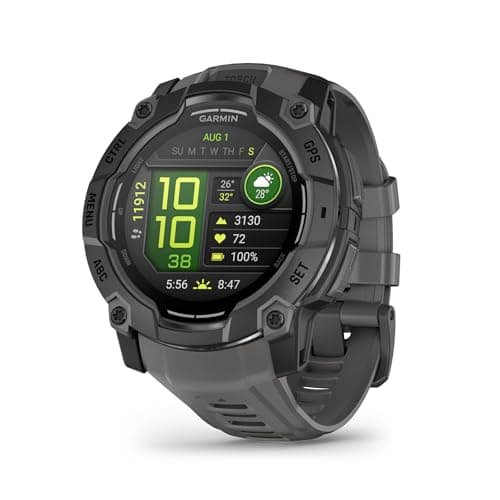
Garmin spent years selling the Instinct as the watch that never needs charging, then put an AMOLED screen in it. The result is genuinely good and slightly conflicted: the Instinct 3 AMOLED keeps the rugged case, the torch and the outdoor sensors, gains a screen that is a pleasure to read, and gives back a large chunk of the battery life that made the line famous. At around £304 for the 50mm model, down from a £349.99 list price, it also sits uncomfortably close to watches that do more.
Whether that trade works depends entirely on what drew you to an Instinct. If it was the idea of a watch you charge monthly, the Solar version still does that and costs less. If it was the toughness and the aesthetic, and you found the old monochrome display grim, this is the fix.
How we review
This review draws on Garmin's published specifications and owner manuals, consistent patterns across verified owner feedback and expert coverage. We have not worn this exact unit for a six-month endurance test, so we report repeated findings rather than one-off impressions, and we flag where Garmin's own numbers are the source.
Somebody who works or trains outdoors, wants a watch that survives being smacked into a doorframe, and is fine charging it every week or two. Hikers, trades, cyclists, anyone who runs in the dark and would use a wrist torch more than they expect to. It is a poor fit for a runner chasing detailed pace analysis, and a poor fit for anyone who wants to leave their phone at home on a run.
The 1.3 inch AMOLED is the reason this version exists, and it does what you would expect: deep blacks, sharp text, readable in a dim garage without hunting for the backlight button. Anyone who has squinted at an older Instinct's memory-in-pixel display in a hotel room at 5am will understand the appeal immediately.
The cost is spelled out in Garmin's own battery life tables. Twenty-four days in smartwatch mode sounds enormous until you notice it assumes raise-to-wake; switch the display to always-on and it falls to around nine days. GPS numbers are similar in shape: 40 hours on GPS alone, 32 hours with all satellite systems, 30 hours with multi-band added, and 86 hours in the stripped-back max battery mode.
Those are strong figures for a watch with this screen. They are also nowhere near the Solar model, which is the awkward part, because "charge it once a month and forget about it" was the pitch that built this product line. You are buying a different watch that happens to share a name.
| Display | 1.3 inch AMOLED |
|---|---|
| Case size | 50 mm (a 45 mm version is also sold) |
| Case material | Fibre-reinforced polymer with metal-reinforced bezel |
| Weight | Approx 59 g |
| Water rating | 10 ATM |
| Durability | MIL-STD-810 thermal and shock |
| Smartwatch battery | Up to 24 days (gesture) / approx 9 days always-on |
| GPS battery | 40 h GPS only, 30 h all systems plus multi-band, 86 h max battery |
| Navigation | Breadcrumb, 3-axis compass, barometric altimeter. No maps |
| Music storage | None |
| Payments | Garmin Pay |
| Warranty | 2 year manufacturer |
The 50mm case is fibre-reinforced polymer with a metal-reinforced bezel, and Garmin's manual confirms the 10 ATM rating and a working range of minus 20 to 60 degrees Celsius. In practice that means you stop thinking about the watch, which is the entire point of an Instinct. Polymer scuffs rather than dents, and unlike a steel case it does not conduct cold into your wrist in February.
The torch deserves its own paragraph because it is the feature owners mention most and reviewers underrate. Variable intensity, a red mode and a strobe, right on your wrist, always there. Finding a dropped bolt behind a rack, checking a bike chain in a dark garage, walking a dog on an unlit path: it replaces reaching for your phone more often than you would guess.
At 59g it wears lighter than the 50mm size suggests. If you have slim wrists, the 45mm version is the sensible choice and costs less.
Two omissions matter. There is no music storage, confirmed by the absence of any GPS-with-music mode in Garmin's battery specifications, so phone-free running with headphones is off the table. And there are no maps: navigation is breadcrumb only, with the compass and altimeter to support it, which is fine for retracing a route and useless for improvising one.
Both are deliberate segmentation rather than oversights. Garmin wants map-and-music buyers on a Fenix or a Forerunner, and at this price that is a real fork in the road. A Forerunner 265 costs similar money, has an AMOLED screen, stores music and analyses running far more thoroughly. It also will not survive being dropped down a stairwell in the same way. If maps are the deciding factor and you would rather not pay fenix money, the Garmin epix Pro (Gen 2) is the cheapest Garmin that gives you full offline topographic mapping behind an AMOLED screen.
Training features are solid rather than deep: heart rate, HRV status, Pulse Ox, advanced sleep tracking, Body Battery, and enough sport profiles to cover everything most people do. For general fitness alongside the NHS recommendation of 150 minutes of moderate activity a week, it is comfortably enough watch.
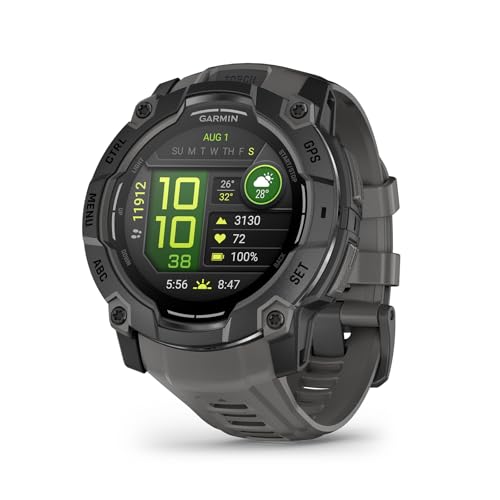
At £304 against a £349.99 list price, the discount helps but does not settle the argument. The Instinct 3 Solar undercuts it and lasts far longer between charges. The Forerunner range beats it on running features and music. What the AMOLED Instinct uniquely offers is the combination of a proper screen, a torch, a case that takes abuse, and multi-band GPS, and if that specific set of things is what you want, nothing else in Garmin's line-up gives you all four.
If you are still weighing up the rugged versus running question, our Garmin Instinct 3 Solar review covers the other half of the decision, and the best Garmin watch guide puts the whole range in order. For tracking effort rather than routes, a chest heart rate monitor pairs with it and is more accurate than any wrist sensor during intervals.
Check price on AmazonGarmin quotes up to 24 days in smartwatch mode with the raise-to-wake gesture, dropping to about 9 days if you leave the display always on, and 30 hours of GPS with all satellite systems and multi-band enabled. Real use with daily training and notifications tends to land in the one to two week range, which is excellent for an AMOLED watch and modest next to the Solar version.
No. You get breadcrumb navigation, a 3-axis compass and a barometric altimeter, so the watch can guide you back along a route or to a saved point, but there are no downloadable topographic maps on the screen. If on-watch mapping matters, you need a Fenix, an Epix or a Forerunner 965 class watch instead.
No, and it is the omission most buyers notice. There is no onboard music storage and no GPS-with-music battery mode in Garmin's own specifications. You can control music playing on your phone from the watch, but you cannot leave the phone at home and run with headphones alone.
Solar if battery life is the point. The Solar model runs for weeks longer and tops up in sunlight, and it costs less. AMOLED if you want a bright, sharp screen that is readable in a dark gym or at 6am, and you accept charging every week or two. The rest of the watch, including the rugged case, torch and GPS, is essentially the same.
Yes. The 50mm case is fibre-reinforced polymer with a metal-reinforced bezel, it is rated to 10 ATM, and Garmin builds it to MIL-STD-810 for thermal and shock resistance. Owners who wear watches to trades and outdoor jobs are precisely who this line is aimed at, and the polymer case shrugs off knocks better than a polished steel one.
Yes, with Garmin's SatIQ system that switches satellite modes automatically to balance accuracy against battery drain. Using all satellite systems plus multi-band costs you battery: Garmin quotes about 30 hours in that mode versus 40 hours on GPS alone.
What a cambered bar is, the three main types (cambered squat bar, bowed bench bar, cambered Swiss bar), what each one does, how much they weigh and how to buy one.
What a landmine attachment is, the rack-mounted, plate-post and floor platform types, how to check bar and rack fit, safety tips, and the best exercises to do.
What a safety squat bar is, how much it weighs, how it changes your squat compared with a straight bar, who it suits and what to check before buying one in the UK.
What a Swiss bar (football or multi-grip bar) is, how much it weighs, why the neutral grip suits sore shoulders, the best exercises and what to check when buying.
Best Exercise is a participant in the Amazon EU Associates Programme, an affiliate advertising programme designed to provide a means for sites to earn advertising fees by advertising and linking to Amazon.co.uk. As an Amazon Associate we earn from qualifying purchases. This comes at no extra cost to you and never influences our independent reviews or rankings.