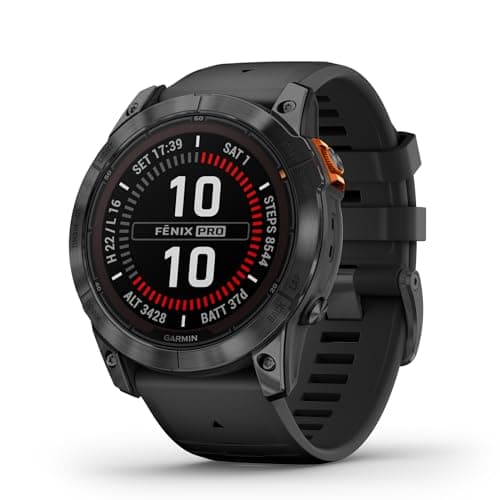
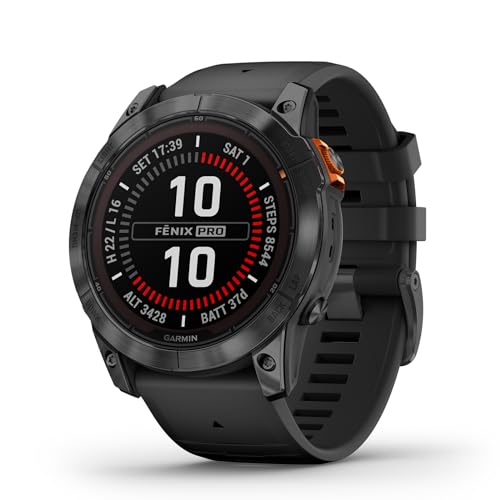
Garmin has spent a decade making the fenix range steadily more capable and steadily more expensive, and the 7X Pro Solar sits at the point where that curve makes the most sense. It's the biggest, longest-lasting fenix of its generation, it carries full offline maps, and now that the fenix 8 has arrived it can be had for around £376 on Amazon UK. That's a lot of watch for the money.
It's also 51mm across, which is the first thing anyone notices and the reason a fair number of people should stop reading here.
How we review
This review draws on Garmin's published specifications and owner's manual documentation, the consistent findings across long-term reviews from established outdoor and endurance outlets, and the recurring themes in verified owner feedback. We have not run a multi-season test of this exact unit, so we report what shows up repeatedly rather than a single reviewer's impression. Specs and prices were correct at the time of writing.
The size question, first
Fifty-one millimetres. On a 19cm wrist it looks purposeful; on a 16cm wrist it looks like a piece of navigation equipment you've strapped on temporarily. It catches on jacket cuffs, it sits high enough to knock against door frames, and there's no smaller version of the 7X because the 7X is the large one.
If that's a problem, the 47mm fenix 7 Pro Solar exists and gives up a chunk of battery life and a little screen real estate to fit almost anyone. Go and try both on in a shop before you commit, because this is not a spec you can reason your way around.
Battery life, and what the solar figures actually mean
Garmin quotes up to 37 days in smartwatch mode with solar charging, and up to 89 hours of GPS recording with roughly 33 hours more on top when solar is contributing (Garmin). Those are the biggest numbers in the category and they're not marketing fiction.
They are, however, conditional. Garmin's solar figures assume around three hours a day of exposure at roughly 50,000 lux, which is bright direct sunlight. Anyone training in the UK between October and March is going to see a fraction of that, and the honest way to think about solar on a fenix is as a drip feed that extends an already enormous battery rather than as a feature that meaningfully changes how often you charge. In a British winter you'll be plugging it in every three weeks or so instead of every four. That's still remarkable.
The Pro refresh also brought an updated optical heart rate sensor and a set of new training metrics across the fenix 7 Pro line (Garmin newsroom). The sensor change is the one that matters day to day, because wrist heart rate on the older fenix 7 was the weakest part of an otherwise excellent watch.
Garmin fenix 7X Pro Solar key specifications
Case size
51mm
Display
1.4in transflective memory-in-pixel, solar charging
Lens
Power Glass (the Sapphire edition uses Power Sapphire)
Battery, smartwatch mode
Up to 37 days with solar charging
Battery, GPS only
Up to 89 hours, plus around 33 hours more with solar
Positioning
Multi-band GNSS with SatIQ
Mapping
Full onboard TopoActive maps with turn-by-turn routing
Water rating
10 ATM
Torch
Built-in multi-LED flashlight with red mode
Amazon UK price
Around £376 at the time of writing
Navigation is the reason to buy it
Full TopoActive mapping stored on the watch, turn-by-turn routing, ClimbPro, round-trip course generation, and multi-band GNSS with SatIQ deciding when to burn battery on multi-band and when to drop back. No phone, no signal, no subscription.
This is the gap between a fenix and everything cheaper. A Forerunner 965 gets you maps too and weighs considerably less, but it doesn't come close on battery, and the Instinct 3 Solar has fenix-level endurance without the mapping. If you want both maximum endurance and proper offline navigation, this generation of the 7X is the cheapest way to get there.
Water rating is 10 ATM across the fenix 7 series, so swimming and surface watersports are fine (Garmin owner's manual).
Where it falls short
The Power Glass lens is the honest compromise on the standard edition. It holds up perfectly well to ordinary wear, and it will pick up scratches from rock, brick and gym plates in a way sapphire won't. If your training involves scrambling or you work with your hands, the Sapphire version is worth the difference. Most people won't notice.
The other limitation is generational. The fenix 8 added a speaker and microphone, ECG, and an AMOLED option with a far prettier screen. None of that makes the 7X Pro Solar worse at what it does, and the AMOLED fenix 8 models trade away a huge amount of battery life to get their brightness, but you are buying the previous platform. Software support will continue for years yet; the newest features will land elsewhere first. If the dull screen is what's nagging at you and 37 days of battery isn't the reason you're here, the Garmin epix Pro (Gen 2) carries the same sensors, the same maps and the same torch behind AMOLED for similar money.
Pros
Up to 37 days smartwatch battery with solar, the best in its class
Up to 89 hours GPS recording, plus around 33 hours more with solar
Full offline TopoActive mapping with turn-by-turn routing
Multi-band GNSS with SatIQ balances accuracy against drain intelligently
Built-in multi-LED torch with a red mode that owners genuinely use
Around £376 now the fenix 8 has taken over the top of the range
Cons
51mm case is too large for a lot of wrists and there is no smaller 7X
Solar figures assume roughly 50,000 lux for three hours daily, which the UK rarely delivers
Power Glass lens scratches where the Sapphire edition would not
No speaker, microphone or ECG, all of which the fenix 8 added
Transflective display looks dull next to any AMOLED watch in a shop
Who should buy it
Anyone whose training happens outdoors, for a long time, away from a charger. Multi-day hikers, ultra runners, bikepackers and anyone who resents charging a watch will get more from this than from any AMOLED alternative, and the mapping means you can actually use it to find your way home.
If you mostly run roads, want something that looks good with a shirt, or have a wrist under about 17cm, buy something smaller. The fenix 8 is the upgrade if budget isn't the constraint, and the Coros Pace Pro is the value alternative if mapping matters more than the Garmin ecosystem.
How long does the fenix 7X Pro Solar battery really last?
Garmin quotes up to 37 days in smartwatch mode with solar charging and up to 89 hours of GPS, rising by roughly 33 hours more with solar. Those figures assume around three hours a day in bright conditions of about 50,000 lux, which is a Mediterranean summer rather than a British November. In UK conditions expect the solar contribution to be a useful bonus rather than the headline, and plan on something closer to three or four weeks of normal mixed use.
Is the fenix 7X Pro Solar still worth buying now the fenix 8 exists?
For a lot of people, yes, and mainly on price. The fenix 8 adds a speaker and microphone, a brighter AMOLED option, ECG and a refined interface, but it costs substantially more and its AMOLED versions do not come close to the 7X Pro Solar's battery life. If maximum endurance and full mapping matter more than the newest features, the 7X Pro Solar is the better value buy at around £376.
What is the difference between the fenix 7X Pro Solar and the Sapphire Solar version?
The lens. The standard 7X Pro Solar uses Garmin's Power Glass, the Sapphire edition uses a Power Sapphire lens that resists scratches considerably better. Sapphire versions also typically come with more onboard storage and a titanium bezel. Everything that determines how the watch trains and navigates is the same, so buy the standard version unless you regularly scrape your watch down rock.
Is the fenix 7X too big for a normal wrist?
It is 51mm, and that is genuinely large. Anyone with a wrist under roughly 17cm should try one on before buying, because the case overhangs and it catches on sleeves. The 47mm fenix 7 Pro Solar gives up some battery life and screen size to fit far more people, and the Instinct range is smaller still.
Does the fenix 7X Pro Solar have maps?
Yes, full onboard TopoActive mapping with turn-by-turn routing, stored on the watch and usable without a phone or a mobile signal. Combined with multi-band GNSS and SatIQ, which switches satellite modes to balance accuracy against battery drain, this is one of the strongest navigation packages Garmin sells.
Does the fenix 7X Pro Solar have a flashlight?
It does, a built-in multi-LED torch on the top of the case with several brightness levels and a red mode. It sounds like a gimmick and it is not. Finding a headtorch at 5am, checking a tyre in a dark garage or running an unlit lane are all noticeably easier, and it is one of the features owners mention most often.
Are adjustable dumbbells worth it? We run the UK numbers on cost and floor space against a fixed hex set, then cover dial, twist and spin-lock types, drop risk and who should skip them.
The best barbell row alternatives for a tired lower back, no barbell, no equipment or a cable stack. Chest-supported rows, dumbbell and landmine options, inverted rows and more, with form cues.
How to do the Cuban press step by step, the light dumbbell or bar weights to use, the rotator cuff and shoulder muscles it trains, common mistakes and easy variations.
How to do the kettlebell gorilla row with good form. Muscles worked, step-by-step cues, what weight to use, common mistakes, variations and a simple sets and reps plan.
Best Exercise is a participant in the Amazon EU Associates Programme, an affiliate advertising programme designed to provide a means for sites to earn advertising fees by advertising and linking to Amazon.co.uk. As an Amazon Associate we earn from qualifying purchases. This comes at no extra cost to you and never influences our independent reviews or rankings.