Recovery
Indoor Sauna UK: Types, Space, Power and Costs Explained
A UK guide to indoor saunas: infrared vs traditional cabins, how much space you need, 13A plug vs hard-wired heaters, ventilation, flooring and running costs.

By Mike Shilling, Recovery & Training Editor · Updated 5 November 2026
Red light therapy isn't known to cause cancer. The red (roughly 630 to 670nm) and near infrared (roughly 810 to 850nm) LEDs in home panels give out non-ionising light that doesn't carry enough energy to break DNA, which is how ultraviolet from the sun and sunbeds causes skin cancer. Reviews of the clinical research haven't found red or near infrared light starting cancer in healthy tissue. The one genuine open question is narrower, and it matters only if you already have cancer: whether light could nudge existing tumour cells to grow. That's the bit worth reading properly, along with who should speak to a GP before buying a panel.
Most of the worry comes from lumping all "light therapy" together. Ultraviolet is the part of the spectrum sitting between X-rays and visible light, and the US Food and Drug Administration says prolonged UV exposure leads to skin cancer and premature ageing (FDA on ultraviolet radiation). Cancer Research UK is blunt about the mechanism: UV from the sun and from sunbeds damages the DNA inside skin cells, and that damage can build up quietly over years into skin cancer, melanoma included (Cancer Research UK on how sunbeds cause skin cancer).
Red and near infrared sit on the opposite side of visible light. Their wavelengths are longer, so each photon carries less energy than a UV photon does; not enough to knock electrons off atoms or snap DNA strands directly. The UV band stops at 400nm. A 660nm red LED is a long way past that, and an 850nm near infrared LED further still.
So the cancer risk you associate with sunbeds doesn't transfer to a red light panel, provided the panel really is red and near infrared only. That last condition is where cheap kit can let you down (more on that below).
Sunbed vs red light panel
A sunbed or sunlamp is a UV device built to tan you, which is UV damage by another name. A red light panel is built to avoid UV completely. If a listing mentions tanning, UVA or UVB, it isn't the product this article is about.
The best evidence here comes from the aesthetics world, where people sit under red and near infrared light for wrinkles and skin tone. A 2023 systematic review in Aesthetic Surgery Journal looked specifically at whether that light is oncologically safe (Glass, 2023). It pooled clinical trial safety data with lab work on human skin cells and cancer cells, plus animal tumour studies.
Its findings were fairly clean on the main question. Red and near infrared light tended to make healthy skin cells multiply without producing dysplasia, the abnormal cell changes that can come before cancer. In the clinical trials, nothing linked the light to serious adverse events, and that includes new or recurring cancers. The author concluded it's safe for aesthetic use, including in people with a cancer history.
That's encouraging, though the review itself admits most of the clinical studies were small and methodologically limited. "No evidence of harm" from small trials isn't the same as decades of population data, which nobody has for home panels yet.
This is the part most articles skip. Red and near infrared light work, as far as anyone can tell, by stimulating cell activity, mainly through the mitochondria. That's the whole point for recovery and skin. The worry is obvious: if light makes cells more active, could it make cancer cells more active too?
A 2020 systematic review in Cancer Medicine went through 67 studies on exactly this, covering cell lab work, animal experiments and human trials (Bensadoun et al., 2020). The picture splits by study type:
Read that carefully. None of it suggests red light creates cancer. What it does show is that light can sometimes stimulate cells that are already cancerous, under certain doses, in certain models. The researchers called for more work on precisely that, which is why clinicians using light in cancer care follow set protocols and are cautious about aiming it straight at a tumour.
For a healthy person treating sore quads, this barely registers. For someone with active cancer, it's a real reason not to freelance with a home panel.
None of this is medical advice, and if any of the following apply, speak to your GP or oncologist before you buy:
Eye safety deserves its own line, because it's the most practical risk with a strong panel. Near infrared is invisible, so a panel can look dim while still pumping out a lot of energy, and your blink reflex never kicks in. Wear the goggles. We go through this properly in our guide on how to use red light therapy.
If you're cleared to go ahead, the cancer question mostly comes down to buying a panel that is what it says it is. Four things to look for:
Of the panels we've reviewed, the Hooga ULTRA360 is the most transparent about irradiance, publishing figures at several distances, and the trade off is a small treatment area. If you want something bigger for full body sessions, the Helios 2 Series 600W covers more skin, though Helios doesn't publish an independent irradiance figure.
Check the Hooga ULTRA360 price on AmazonOn a tighter budget, the BestQool 105W and the RENPHO panel are both spot treatment panels at around £190 to £200, fine for a knee or shoulder but not for full body sessions.
That's a different question from safety, and the honest answer is "maybe, modestly". The evidence for muscle soreness and recovery is mixed, with some decent trials and a lot of small, industry flavoured ones. We've pulled it apart in red light therapy for recovery, including the results that didn't work. If you're comparing it with heat, our red light sauna guide explains how the two differ.
There's no good evidence that it does. Skin cancer is driven mainly by ultraviolet light damaging the DNA in skin cells, and a proper red light panel emits no UV. A 2023 systematic review of red and near infrared light used for skin rejuvenation found no clinical trial data linking it to new or returning cancer, and found it didn't push healthy skin cells towards abnormal growth.
A genuine red light panel shouldn't. Red LEDs sit around 630 to 670nm and near infrared around 810 to 850nm, both well outside the UV band, which ends at 400nm. Check the listing or manual for the exact wavelengths and avoid anything that mixes in UV or calls itself a tanning lamp. A sunbed is a UV device, and that's a different product entirely.
Ask your oncologist or GP before you start, and don't treat over the area where a tumour was or is. Reviews of cancer patients using light therapy for treatment side effects have been broadly reassuring, but some lab and animal studies have shown cancer cells responding to light, and those patients were under clinical supervision with set doses. A home panel isn't that.
Not for cancer, as far as the evidence goes. Near infrared carries even less energy per photon than red light, so it's no more able to damage DNA. The extra risk with near infrared is to your eyes: it's invisible, so you don't blink or look away, which is why goggles matter more with 850nm panels than with red only ones.
Nobody has shown that it does, but you shouldn't shine a panel over a mole that's changing, bleeding, itching or looks unusual. Get it checked by your GP first. If a mole is suspicious, the priority is a diagnosis, and light therapy has no place in that until you've had one.
A UK guide to indoor saunas: infrared vs traditional cabins, how much space you need, 13A plug vs hard-wired heaters, ventilation, flooring and running costs.
Regular saunas may mean fewer colds, but a sauna won't cure one. When a gentle session can ease a blocked nose, and when fever or flu means staying out.
Should your eyes be open or closed during red light therapy? Keep them shut and wear goggles. Why, what the eye research shows, and who should check first.
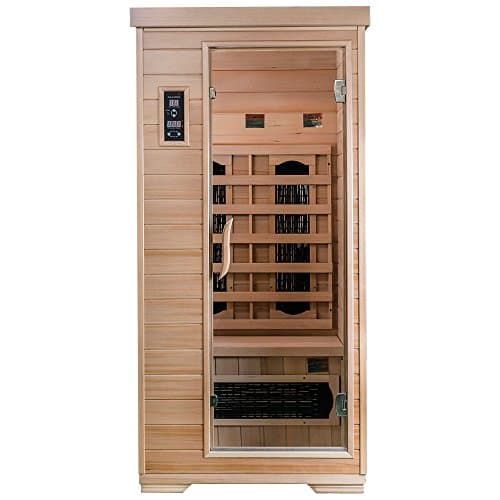
SaunaMed 1 person hemlock infrared sauna review: 1.4kW on a 13A plug, 65°C max, 90cm footprint, real running costs and how it compares with cheaper options.
Best Exercise is a participant in the Amazon EU Associates Programme, an affiliate advertising programme designed to provide a means for sites to earn advertising fees by advertising and linking to Amazon.co.uk. As an Amazon Associate we earn from qualifying purchases. This comes at no extra cost to you and never influences our independent reviews or rankings.