Treadmills
Toputure 12% Incline Walking Pad Review: A Cheap Climb
Our Toputure 12% incline walking pad review: manual 1/6/12% incline, 115cm handrail, 12km/h, 130kg limit and a 40x100cm belt, for £239.99 on Amazon UK.

By Paul Kendrick, Cardio & Endurance Editor · Updated 17 July 2026
We may earn a commission from qualifying purchases made through links on this page, at no extra cost to you. This never affects our ratings.
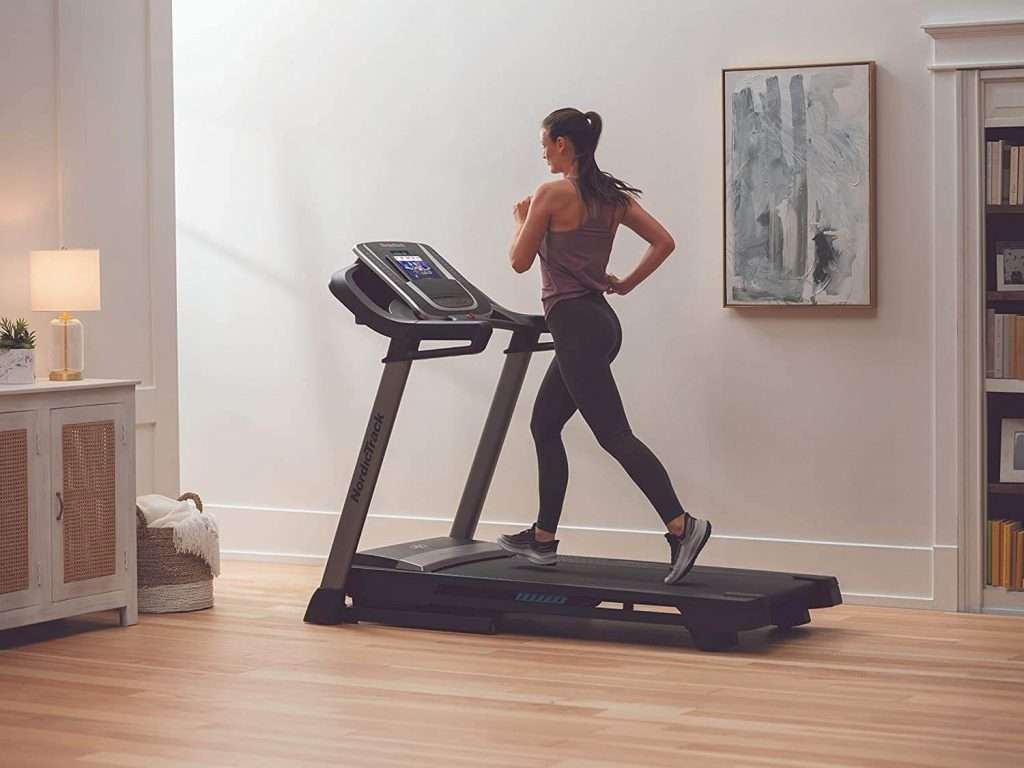
The best treadmills for home use let you walk, jog and train without leaving the house: no gym membership, no travel time and no excuses about the weather. The five compact, foldable models below are among the best home treadmills you can buy in the UK right now, covering everything from tight flats to more demanding daily workouts.
A good home treadmill packs a lot into a small footprint: a usable speed range, shock absorption to protect your joints, and a frame that folds away when you're done. The picks below run from slim walking pads that slide under a sofa to machines with a 20% powered incline, so there's something here for most spaces and goals.
How we chose
We researched the most popular and best-reviewed folding treadmills on Amazon UK, then cross-checked owner reviews, manufacturer specifications and current expert round-ups. We haven't run a long-term hands-on test of every machine here, so this is a researched buying guide rather than a hands-on one. We focused on motor power, top speed, incline, belt size, maximum user weight, noise and how small each one packs away. Prices and specifications were correct at the time of writing, so check the current listing before you buy.
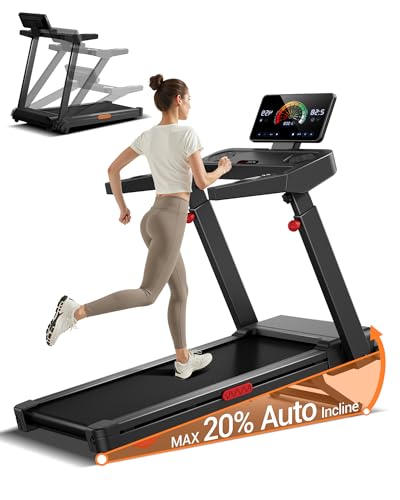
The LONTEK is the most capable machine here for the money, and it's the one we'd point most people towards. The headline feature is a powered incline that adjusts from 2% to 20%, so you can simulate hill work at the touch of a button rather than stopping to prop up the deck by hand. A 3.5 HP motor drives it to a top speed of 14 km/h, the fastest in this line-up, and the frame is rated to 180 kg, which is a genuinely high limit for a folding home treadmill.
The running belt measures 107 x 40 cm, which is on the longer side for a compact machine, and it sits on composite pedals with built-in shock absorbers and shock pads to take some load off your knees. Speed and incline buttons are built into the side handrails, so you can make changes without breaking stride, and a large LED touch screen shows speed, time, distance, incline, calories and heart rate. It arrives around 90% pre-assembled, has built-in transport wheels, and the console height sits in three positions with an adjustable display tilt.
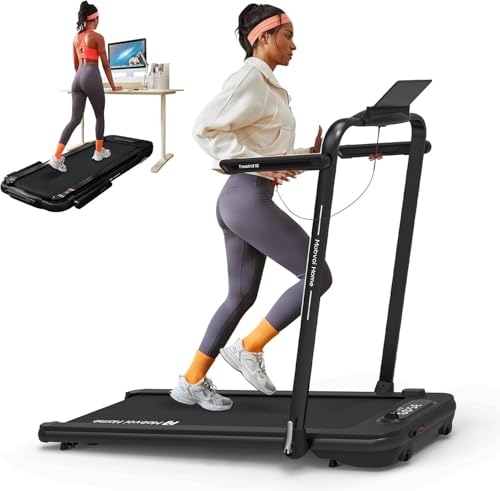
If storage is the problem you're actually trying to solve, the Mobvoi Home Treadmill SE is the pick. It folds down to roughly 13 cm high, about the height of a phone standing on its edge, and at that thickness it genuinely slides under a sofa, a bed or a desk rather than living in the corner of the room. Built-in wheels mean you don't have to lift it to move it.
It's a 3-in-1 design: fold the handrails up and you get a running mode from 1 to 12 km/h, fold them down and it drops to a 1 to 6 km/h walking or workstation mode for use under a desk. The 2.5 HP peak motor takes users up to 120 kg and stays under 60 dB. The belt has five layers with a shock absorption layer, and the run area is 40 x 16 inches. An LED display cycles through speed, duration, distance and calories, a remote handles speed changes, and shortcut buttons jump straight to 3 or 6 km/h. It pairs with Mobvoi's TicSports app for training plans and virtual routes. If you want incline as well, our Mobvoi incline treadmill review covers the model further up the range.
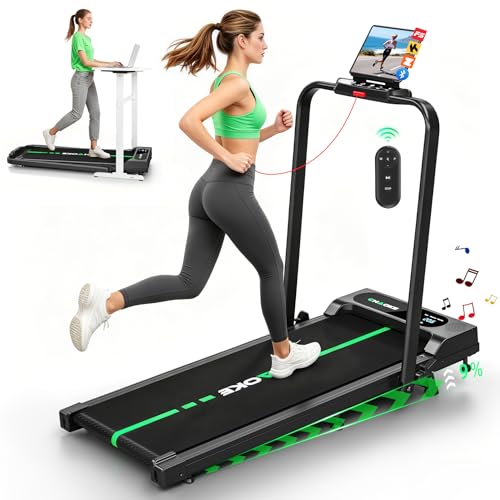
Most budget treadmills ship with an own-brand app that's quietly abandoned a year later. The CHAOKE is the pick here because it works with the apps people actually use: Fitshow, Kinomap and Zwift. That opens up filmed real-world routes, structured sessions and online races, which is the single biggest thing that stops indoor running from getting dull. Built-in Bluetooth speakers pair with your phone, so you're not fighting with earbuds, and an LED display tracks speed, distance, time and calories.
The brushless motor is rated at 2.75 HP continuous duty and runs under 40 dB, the quietest figure quoted in this group, which matters in a flat or a shared house. The 100 x 40 cm running area uses seven layers of non-slip diamond-pattern turf over 10 silicone shock absorbers, and a reinforced steel frame takes it to a 160 kg capacity. Speeds run from 1 to 12 km/h with a 9% manual incline, and there are 12 preset HIIT programmes plus time, distance and calorie countdown modes. It arrives fully assembled, has transport wheels and a clearly marked lubrication port, a magnetic safety key, and a 36-month warranty with UK-based support.
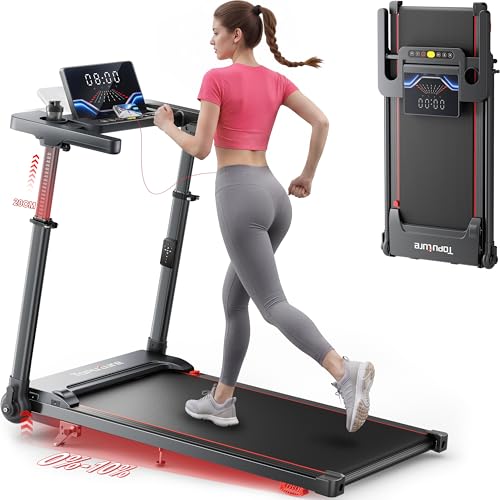
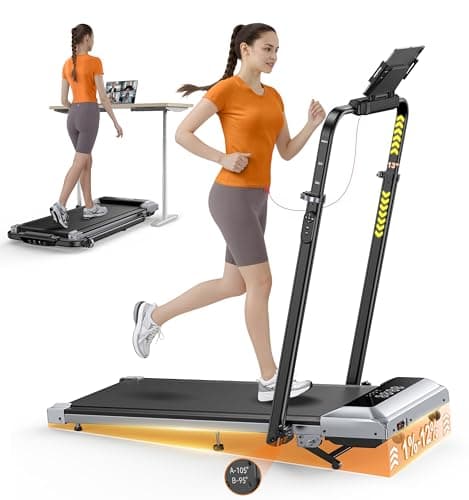
Plenty of treadmills claim to work under a desk. The Toputure is the one built around it. The device stand rotates to 95 degrees to hold a phone or tablet, then flips to 180 degrees to become a small table that will take a laptop, and there's a cup holder and side storage for the bits you'd otherwise leave on the floor. The handrail retracts, and it adjusts for height between 88 cm and 108 cm, which is a rare bit of thoughtfulness: a fixed handrail that sits too low is a common complaint on cheap machines.
Speeds run from 1 to 12 km/h and there's a three-stage incline at 1%, 5% and 10%. The 2.5 HP motor supports up to 130 kg, and the 100 x 40 cm belt runs seven anti-slip layers over eight silicone shock absorbers and two soft rubber pads. An LED display covers time, calories, speed and distance, with a magnetic remote and Bluetooth app control. It needs no assembly, has two front wheels, and folds from 120 x 62 x 115 cm down to 120 x 63 x 13.5 cm at 23.9 kg, so one person can move it without help.
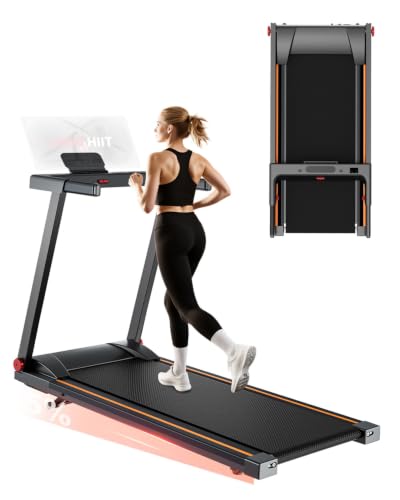
The reason the Superun suits beginners isn't the price, it's the programming. Of its 12 built-in sessions, eight are HIIT modes aimed at more advanced users and four are MIIT modes pitched at people starting out, which is a gentler on-ramp than a machine that only offers interval work. The treadmill adjusts speed automatically through each session, so you can follow a structured workout without deciding what to do next, and the app tracks your data and offers coaching plans.
The 3.0 HP motor is stronger than you'd expect at this price, running 1 to 12 km/h under 55 dB with a 136 kg load capacity. The 100 x 42 cm platform is the widest belt of the five, which is worth having if you tend to drift on a narrow deck, and there's a 5% incline for a bit of extra work. It also connects to wearables and supports multiplayer running events if you want the competitive side.
A few features matter more than the rest when you're buying for home use:
Check the belt before you commit to running
Every treadmill here reaches at least 12 km/h, but a high top speed on a short belt is not the same as a machine you can comfortably run on. Most of these have a belt around 100 cm long, which suits walking and steady jogging. If you're over about 6ft, or you want to run at pace regularly, prioritise deck length over the headline speed figure.
Any of these five will get you fitter at home without a gym membership. For most people the LONTEK is the best all-rounder, with the powered 20% incline, the strongest motor and the highest weight limit. The Mobvoi Home Treadmill SE is the one to buy if storage is your real constraint, the CHAOKE makes the most sense if you want Zwift or Kinomap to do the motivating, and the Toputure is built for anyone planning to walk through their working day.
Match the belt length, weight limit and folded size to how you actually plan to train and where the machine will live, and you'll have something that earns its place for years. If none of these fit, our treadmill guides cover other budgets and formats, and the folding Reebok I Run 4.0 treadmill is worth a look if you would rather buy a big brand with a 10-year motor warranty behind it. Where the folded height is the number that decides it, read our Viavito LunaRun fold flat treadmill review instead, because a fold flat deck stores in places an upright folder simply won't go.
Yes. Every treadmill has a maximum user weight, and it's one of the first specs worth checking. The five machines here range from 120 kg up to 180 kg. Staying comfortably inside that limit matters for both safety and how long the machine lasts, so check it against your own weight before you buy.
It depends on your space and your stride. Most compact home treadmills have a running belt around 100 to 110 cm long and roughly 40 cm wide, which is fine for walking and steady jogging. If you're tall or you plan to run properly, look for the longest belt you can fit, and measure your floor space before you order.
All five reach at least 12 km/h, so they cover walking, jogging and steady running. The real limit is usually belt length rather than top speed. A 100 cm belt suits walking and light jogging, while longer strides at higher speeds are more comfortable on a longer deck.
Our Toputure 12% incline walking pad review: manual 1/6/12% incline, 115cm handrail, 12km/h, 130kg limit and a 40x100cm belt, for £239.99 on Amazon UK.
Are walking pads worth it? Who they suit, the step and calorie gains from treadmill desk research, cost per use, noise, spec limits and when to buy a treadmill.
Can you run on a walking pad? Mostly no: most cap at 6km/h with short belts and no rails. Which 2-in-1 pads allow a light jog, and when to buy a real treadmill.
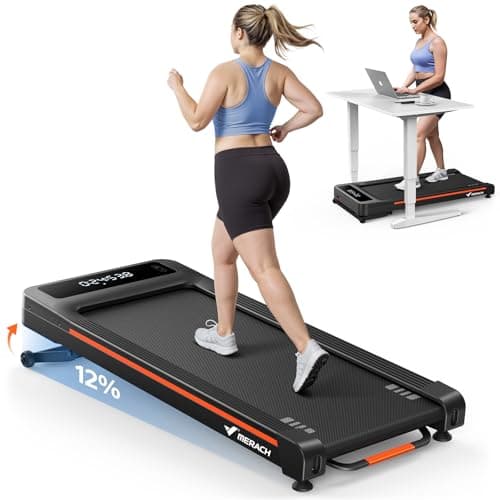
An honest MERACH 12% auto incline walking pad review: 400lb limit, 42cm belt, 6km/h top speed, no fold, no handrail, and why the sprint claims don't hold up.
Best Exercise is a participant in the Amazon EU Associates Programme, an affiliate advertising programme designed to provide a means for sites to earn advertising fees by advertising and linking to Amazon.co.uk. As an Amazon Associate we earn from qualifying purchases. This comes at no extra cost to you and never influences our independent reviews or rankings.