Recovery
Can Red Light Therapy Cause Cancer? What the Research Says
Can red light therapy cause cancer? Why red and near infrared LEDs aren't UV, what studies say about existing tumours, who should check with a GP first.

By Mike Shilling, Recovery & Training Editor · Updated 5 November 2026
Keep your eyes closed and wear the goggles. That's the answer for any red light therapy panel bright enough to do anything useful, and it applies twice over if your panel has a near infrared mode, because near infrared light is invisible and your eyes have no built in way to tell you they're getting too much. Never stare into the LEDs, even for a few seconds to "see if it's working". Closed eyelids alone help, but they aren't a substitute for goggles when you're 15cm from a panel putting out over 100 mW/cm2.
Most of the page one answers for this query come from brands selling masks and panels, plus a few Reddit threads where people argue that eyes open is fine because red light is "gentle". The research says otherwise, and it's more interesting than either side lets on.
Your eyes have two natural defences against bright light. You blink or look away, and your pupil shrinks to let less in. Both are triggered by light you can see, so a bright red glow will at least make you squint.
Near infrared is different. Most panels pair red LEDs (around 630nm to 660nm) with near infrared ones at 810nm to 850nm, and you can't see the infrared part. Switch a panel to infrared only and it can look dim, or barely on, while it's still pumping out serious energy. Nothing tells you to blink. Nothing tells your pupil to close down. That's the main reason "it doesn't look that bright" is a poor guide to whether your eyes are safe.
Then there's the sheer output. Home panels aren't the weak glow lamps they were ten years ago. The Hooga ULTRA360 publishes 132 mW/cm2 at six inches, and the Nebula 1020W publishes 95 mW/cm2 at the same distance. That's the point of buying one: enough intensity to deliver a meaningful dose to your thigh or shoulder in five to ten minutes. Your eyes sit in the same beam when you treat your face or upper body.
So the advice stacks, and each layer covers a gap in the other:
If you're treating your legs or back with the panel pointed away from your head, goggles alone are fine and you can keep your eyes open behind them. When your face is in the beam, do both.
The one habit that causes most trouble
Putting the goggles on after switching the panel on, and taking them off before switching it off. Those few seconds of looking straight at the LEDs, often to find the button, are the highest exposure most people get. Goggles on first, panel off first.
Partly. Blue light carries the most energy per photon of the visible spectrum and is the main driver of photochemical damage to the retina, which is why safety standards treat it as the bigger hazard. Red light carries less energy per photon, and that's where the "red is harmless" idea comes from.
Less hazardous isn't the same as safe at any dose, though. Damage depends on how much light lands on the retina and for how long, and a focused or very close red source can still get there. The clearest evidence comes from an unexpected place: red light machines sold to treat short sightedness in children.
Red light pointed at the eye on purpose is a real area of research, and it cuts both ways.
Repeated low-level red light (RLRL) therapy is used in China and elsewhere to slow myopia in children. The child looks into a desktop device that shines 650nm laser light into each eye for about three minutes, usually twice a day. Trials have reported slower eye growth, and that's why the treatment took off.
The safety picture is less tidy. In 2024, researchers measured two of these devices and calculated how long a child could look into them before hitting the maximum permissible exposure set by laser safety standards. For both, they found that three minutes of continuous viewing approached or exceeded those limits, and for one device the photochemical limit could be reached in under 10 seconds depending on pupil size. Their advice to clinicians was to be cautious until safety standards are confirmed.
A year later, a study in JAMA Ophthalmology compared 52 children who'd used RLRL therapy for at least 12 months with 47 who hadn't. The users had lower cone photoreceptor density near the centre of the retina, and abnormal bright spots near the fovea showed up more often in their eyes (seven treated eyes against one untreated eye). One child had small cyst like changes that cleared three months after stopping. It was a retrospective study, so it can't prove the light caused the changes, and the authors say so. It's still a warning shot, and it involved light far dimmer at the eye than a body panel's output, delivered to children who were told to look right into it.
On the other side, carefully dosed light is being tested as a treatment. LIGHTSITE III randomised 100 people with early or intermediate dry age-related macular degeneration to a clinic device delivering 590nm, 660nm and 850nm light, or a low dose sham. At 13 months, the treated eyes had gained an average of 5.4 letters on the eye chart against 3.0 in the sham group, a small but statistically significant difference, and the trial reported no phototoxicity. Several authors worked for the device maker, which is worth keeping in mind.
Here's what both lines of research have in common: a specific wavelength, a measured dose, a fixed session length and an eye specialist checking the retina. A recovery panel aimed at your face has none of that. If anything, the macular degeneration trials show how tightly controlled "light for the eyes" has to be, and the myopia studies show what can go wrong when the dose isn't right. Neither is a reason to keep your eyes open in front of a 132 mW/cm2 panel.
LED face masks and full body panels need slightly different handling.
Masks are lower powered and sit a few centimetres from your skin. Most have eye holes or built in shields over the eyes, and the usual instruction is to keep your eyes closed for the whole session rather than to wear separate goggles, which wouldn't fit underneath anyway. Follow the manufacturer's guidance for your specific mask, and if it's a red plus blue acne mask, take the blue light component seriously.
Panels are the bigger concern. They're brighter, often include strong near infrared, and you can lean in closer than you mean to. Treating your face with a panel means eyes closed, goggles on, and a sensible distance; 30cm rather than 15cm takes a lot of intensity off your eyes, and you can make up the dose with a longer session. Our guide to using red light therapy covers how to work out time from distance and irradiance.
If facial skin isn't your goal, the simplest fix is to not treat your face at all. For training recovery, the panel belongs on your quads, hamstrings, calves or back, and you can turn your head away.
Usually, yes. Most decent panels ship with a pair of blackout goggles or opaque eye cups. Both the Hooga and Nebula panels include them in the box. They're cheap and uncomfortable after 10 minutes, but they block visible red and near infrared well enough for home use.
Check the Hooga ULTRA360 (goggles included) on AmazonIf your panel came without eye protection, or you've lost it, buy goggles that are fully opaque or rated for the specific wavelengths your panel uses. Tinted sunglasses are not the same thing; plenty of dark lenses let near infrared straight through.
Speak to your optometrist, GP or ophthalmologist before using red light near your face if any of these apply:
Children are a separate case. Don't use a home panel or mask near a child's face, and don't treat a home panel as a cheaper version of the myopia treatment above; that treatment is prescribed and monitored for a reason. Anyone worried about broader safety questions might also want our look at whether red light therapy can cause cancer.
Stop and get checked if you notice blurred vision, a dark or bright spot in your vision, headaches or eye pain after sessions.
That's it. None of this stops red light therapy being useful for recovery; the evidence for muscle soreness and performance is covered in our red light therapy for recovery guide, and none of it depends on light reaching your eyes.
Closed, and with the goggles that came with your panel on as well. Close your eyes the whole time you're facing the LEDs, never look straight into them, and keep the goggles on until the panel is switched off. This matters most with bright panels and with near infrared modes, because near infrared is invisible and gives your eyes no reason to blink.
Not with a modern high output panel at close range. Eyelid skin is thin, which is why the room still glows red when your eyes are shut, so some light gets through. Closing your eyes cuts exposure; opaque goggles over closed eyes cuts it much further. With a low powered face mask, closed eyes plus whatever eye shielding the mask has built in is usually what the manufacturer specifies.
It can if the exposure is high enough and aimed at the retina. A 2024 study found that two red light devices sold to treat myopia in children approached or exceeded retinal safety limits within a three minute session, and a 2025 JAMA Ophthalmology study linked a year or more of that treatment to reduced cone cell density in some children. Those devices are designed to be looked into; a body panel isn't, which is exactly why you shouldn't look into it.
There's genuine research using carefully dosed light on the eye, mainly for myopia in children and dry age-related macular degeneration, but it uses medical devices, set doses and eye specialist supervision. None of it means pointing a home recovery panel at your face with your eyes open is beneficial. If you're interested in light treatment for an eye condition, ask an ophthalmologist.
Many LED face masks have eye cut outs or built in shields and tell you to keep your eyes closed rather than wear goggles. Follow the mask's own instructions, keep your eyes shut for the whole session, and don't use one at all without checking with your optician first if you have an eye condition or take light sensitising medication.
Anyone with a diagnosed eye condition such as macular degeneration, glaucoma, diabetic eye disease or a retinal problem, anyone who has had eye surgery, people taking photosensitising medication, and anyone with light triggered epilepsy if the device flickers or pulses. Children shouldn't use home panels near their face at all.
Can red light therapy cause cancer? Why red and near infrared LEDs aren't UV, what studies say about existing tumours, who should check with a GP first.
A UK guide to indoor saunas: infrared vs traditional cabins, how much space you need, 13A plug vs hard-wired heaters, ventilation, flooring and running costs.
Regular saunas may mean fewer colds, but a sauna won't cure one. When a gentle session can ease a blocked nose, and when fever or flu means staying out.
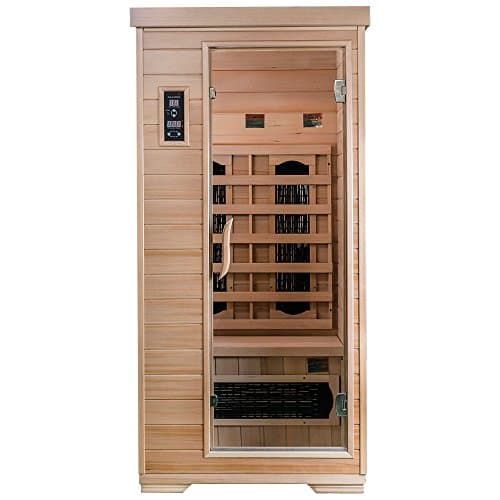
SaunaMed 1 person hemlock infrared sauna review: 1.4kW on a 13A plug, 65°C max, 90cm footprint, real running costs and how it compares with cheaper options.
Best Exercise is a participant in the Amazon EU Associates Programme, an affiliate advertising programme designed to provide a means for sites to earn advertising fees by advertising and linking to Amazon.co.uk. As an Amazon Associate we earn from qualifying purchases. This comes at no extra cost to you and never influences our independent reviews or rankings.