Workouts
Bayesian Curl: How to Do the Bayesian Cable Curl Properly
How to do the Bayesian curl: setup, form cues, what the research says about the stretched position, common mistakes, home band version and a simple plan.

By Paul Kendrick, Cardio & Endurance Editor · Updated 31 July 2026
We may earn a commission from qualifying purchases made through links on this page, at no extra cost to you. This never affects our ratings.
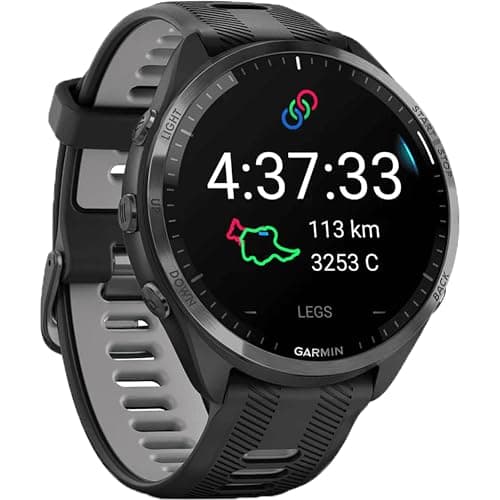
The Forerunner 965 is Garmin's flagship running watch, and the argument for it comes down to one feature the cheaper Forerunners don't have: real maps on your wrist. Everything else in the range gives you the same excellent training analysis. Only the 965 will draw a topographic map, route you round a 12km loop you've never run, and tell you to turn left in 200 metres while your phone stays at home. Add a 1.4in AMOLED panel bright enough to read in July sun, a titanium bezel and battery life measured in weeks rather than days, and you have the watch most serious runners settle on unless they want a Fenix for the extra ruggedness.
It costs around £478 at the time of writing, down from an RRP near £600. That's a lot of money for a running watch, and it's roughly £150 to £200 more than the Forerunner 265, which shares the same sensor, the same training platform and much of the same software.
How we review
This review is based on Garmin's published specifications, the pattern of findings across verified owner reviews and independent expert testing, rather than our own months-long endurance test of this specific unit. We report the criticisms that come up repeatedly, not one-off complaints, and specs are checked against Garmin's own product listing at the time of writing.
Runners who race, runners who train by structured plan, and anyone who runs on trails or in unfamiliar places. If you're building towards a marathon and want the watch to tell you whether today's session is a good idea, the training readiness score and HRV status genuinely help. If you're a parkrun regular who does the same 5k loop twice a week, you're paying for capability you'll never open.
Triathletes should look here too, since the multisport profiles, open water swim tracking and the 31 hours of GPS battery cover an Ironman with room to spare. Anyone with small wrists, or anyone who wants an ECG, should look elsewhere.
Garmin's move to AMOLED on the Forerunner line was overdue, and the 1.4in panel here is the best argument for the upgrade. Colours are dense, the map detail is legible at a glance, and outdoor brightness is high enough that you don't shade the watch with your other hand mid-run. Compared to the old memory-in-pixel screens it's a different class of display.
The trade-off is power. Leave the always-on display enabled and Garmin's own figures drop from around 23 days to roughly 7. Most owners end up leaving it on gesture wake, which works fine for running but feels slightly cheap on a watch costing this much.
Build quality is good rather than luxurious. The bezel is titanium, which is why a 47mm watch weighs about 53 grams, but the case back is polymer. The Fenix line is where you go for a full metal build and sapphire as standard.
This is where the 965 earns its money on a technical level. Multi-band GNSS, which listens to two frequencies from each satellite constellation, cuts the reflected-signal errors that wreck GPS tracks between tall buildings. If your current watch draws you running through the middle of an office block in the city centre, this is the fix.
Multi-band costs battery, dropping GPS-only's 31 hours to something closer to 19. For most runs the standard all-systems mode is plenty; save multi-band for races and city routes where the track matters.
The Elevate v5 optical sensor is the current generation and it's decent, but no wrist sensor is a chest strap. A prospective study of commercially available monitors in athletes found chest straps agreed with ECG far more closely than wrist-based devices, and that wrist accuracy fell as exercise intensity rose (Accuracy of commercially available heart rate monitors in athletes, 2019). If you're running intervals by heart rate or chasing threshold precisely, pair a strap. For easy runs and overnight HRV, the wrist sensor is fine.
The software stack is the real product. Training readiness combines sleep, HRV, recent load and recovery time into a single number each morning, and it's the metric owners mention most often as changing how they train. Endurance score, hill score, race predictions and the daily suggested workouts all sit on top of that. Some of it is noise; the readiness score and HRV status aren't.
| Case size | 47mm, one size only |
|---|---|
| Display | 1.4in AMOLED touchscreen, 454 x 454 |
| Weight | Around 53g |
| Bezel | Titanium |
| Battery, smartwatch mode | Up to 23 days, about 7 days with always-on display |
| Battery, GPS only | Up to 31 hours |
| GNSS | Multi-band GPS, GLONASS, Galileo |
| Maps | Full colour TopoActive maps, turn-by-turn, round-trip routing |
| Water rating | 5 ATM |
| Music | Onboard storage, Spotify, Deezer and Amazon Music offline |
| Sensors | Elevate v5 optical HR, pulse ox, barometric altimeter, compass |
The honest comparison, because most buyers are choosing between these two.
The Forerunner 265 has the same optical sensor, the same training readiness and HRV features, the same AMOLED technology and multi-band GPS. What it lacks is offline mapping, the titanium bezel, and roughly half the battery life. It also comes in two sizes, which matters if 47mm is too much watch for you.
Buy the 965 if you want maps, longer battery or the larger screen. Buy the 265 and put the difference towards a chest strap and race entries if you don't. There's no version of this where the 965 makes you faster.
Garmin's headline numbers assume a fairly quiet watch. Run four times a week with GPS, keep notifications on, wake the screen by gesture rather than always-on, and most owners report charging roughly weekly. Turn on the always-on display, use multi-band on every run and stream music offline and you're charging every three or four days.
That's still comfortably better than an Apple Watch, and it's the practical reason runners keep choosing Garmin. A watch that dies mid-marathon is worse than no watch.
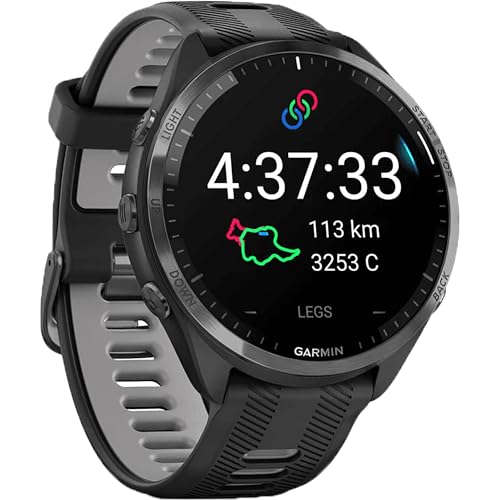
Buy it if you race, run trails, or run in places you don't know. The maps and the battery are worth real money to those people. Skip it if you run the same familiar loops, in which case the 265 is the smarter buy, or if your wrist can't carry a 47mm case. Worth one comparison before you commit: the Garmin epix Pro (Gen 2) sits at a similar price with the same AMOLED mapping, a tougher case and an LED torch on the bezel, trading a little running-specific polish for outdoor hardware.
Whatever you strap on, the watch is a measuring tool rather than a training plan. The NHS still recommends 150 minutes of moderate activity a week plus strength work on two days, and no amount of HRV analysis substitutes for the running itself. Full specifications are on Garmin's official Forerunner 965 page.
Check price on AmazonOnly if you want maps. The 965 adds full colour offline mapping with turn-by-turn directions, a titanium bezel, a bigger 1.4in screen and roughly double the battery life, all for around £150 to £200 more. If you run the same few routes near home and never get lost, the Forerunner 265 gives you the same training metrics for far less.
Garmin quotes up to 23 days in smartwatch mode with the always-on display switched off, about 7 days with it on, and 31 hours of GPS-only tracking. In real use that means most runners charge it once a week, or less if you leave the screen to wake on gesture. Multi-band GPS and music playback cut those numbers substantially.
Yes, and it's the main reason to buy it. Full colour topographic maps are stored on the watch itself, so you get turn-by-turn navigation without your phone and without a signal. It's genuinely useful on trails, in unfamiliar cities and for the round-trip routing feature that builds you a loop of a chosen distance.
Possibly. It comes in one 47mm size and there's no smaller version, so anyone with a wrist under about 15cm should try one on first. It's light for its size at around 53g thanks to the titanium bezel and plastic case back, but the footprint is what it is.
No. Garmin's ECG app runs on the Venu 3 and Fenix 8 in supported markets, not on the Forerunner 965. You get wrist-based heart rate, a pulse ox sensor, HRV status overnight and respiration tracking, but no single-lead ECG recording.
Yes. It's rated 5 ATM, which covers pool and open water swimming, and it has dedicated pool, open water and triathlon profiles. Wrist heart rate underwater is unreliable on every watch, so pair a HRM-Pro Plus or HRM-Fit if you need swim heart rate that means anything.
How to do the Bayesian curl: setup, form cues, what the research says about the stretched position, common mistakes, home band version and a simple plan.
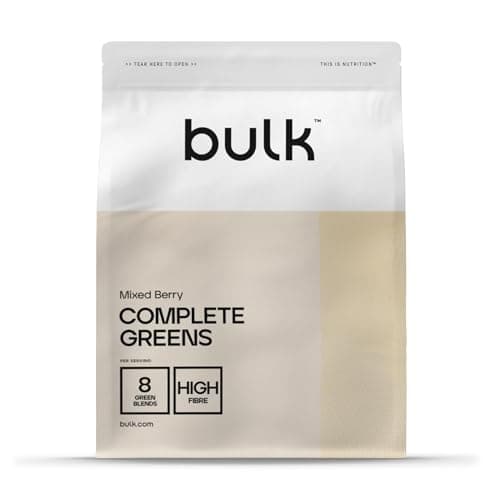
The best greens powders in the UK for 2026, from budget super greens to premium all-in-one vegetable powders, plus an honest look at whether they actually work.
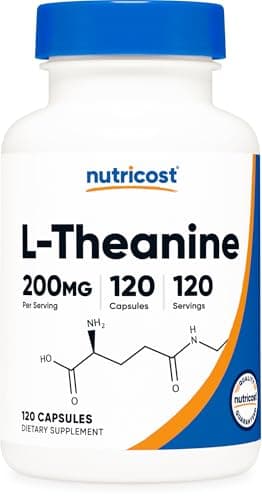
The best L-theanine supplement for UK buyers in 2026: five capsules ranked on dose and cost per day, what the research shows about sleep and caffeine, and the dose worth taking.
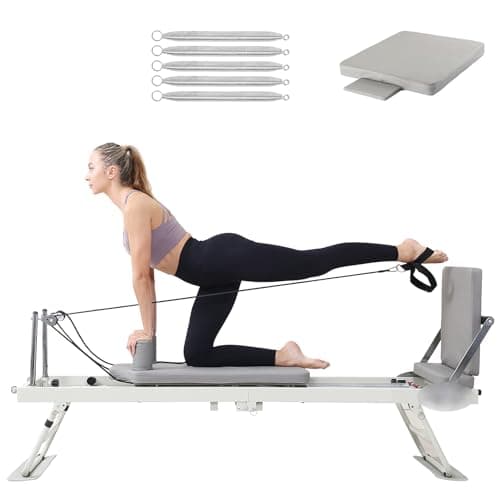
The best reformer pilates machines for home use in the UK in 2026, from a £259 foldable to a £788 wooden frame. Honest picks, real specs and how to choose a pilates machine.
Best Exercise is a participant in the Amazon EU Associates Programme, an affiliate advertising programme designed to provide a means for sites to earn advertising fees by advertising and linking to Amazon.co.uk. As an Amazon Associate we earn from qualifying purchases. This comes at no extra cost to you and never influences our independent reviews or rankings.