Home Gym
Are Vibration Plates Worth It? What the Research Actually Shows
Are vibration plates worth it? Yes for balance, bone health support and low-impact warm-ups; no for weight loss or replacing strength training. The evidence.

By Paul Kendrick, Cardio & Endurance Editor · Updated 17 August 2026
We may earn a commission from qualifying purchases made through links on this page, at no extra cost to you. This never affects our ratings.
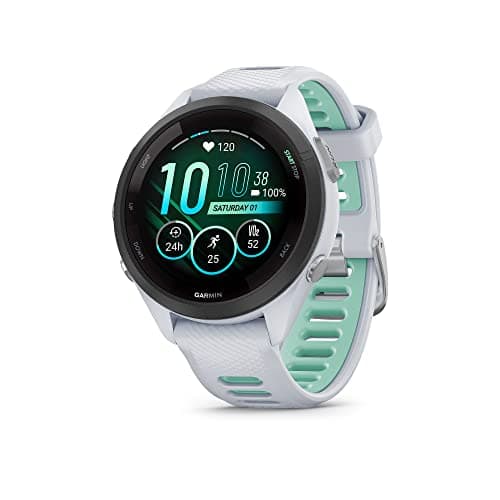
The Forerunner 265S is Garmin's 42mm running watch, and it exists for a simple reason: the standard 46mm Forerunner 265 looks and feels absurd on a slim wrist. Same software, same sensors, same features, smaller body. That is the entire proposition, and Garmin executes it well enough that the 265S is arguably the better buy of the pair for a lot of runners regardless of wrist size.
At the time of writing it sits around £340 on Amazon UK, which puts it squarely between the entry-level Forerunner 165 and the mapping-equipped 965. What you get for the money is Garmin's mid-range training platform with a very good AMOLED screen bolted on, and the honest question is whether the training features justify the jump from cheaper watches. For runners who follow a plan, they do.
How we review
This review is based on Garmin's published specifications, extensive research of long-term owner feedback and independent testing from trusted running technology outlets. We have not run our own multi-month endurance test of this exact unit, so we report only the findings that recur consistently across sources, complaints included.
Runners who follow structured training and want the data to mean something. Training Readiness, Training Status, HRV status and the daily suggested workouts are the reason to buy a 265S over a simpler watch, and they only pay off if you wear it overnight and run often enough to give the algorithms something to work with. Triathletes and cyclists are catered for too, though a dedicated bike computer does that job better.
It is a poor fit for two groups. If your running is casual and unstructured, you are paying for analytics you will glance at once. And if you hike or run in unfamiliar places and want to look at a map on your wrist, the 265S cannot do it, full stop.
The AMOLED panel is the reason this generation of Forerunner exists and it is the thing you notice first. At 360 x 360 across 1.1 inches, text is crisp in a way the older memory-in-pixel displays never managed, and in direct summer sun it stays legible without you angling your wrist. Coming from a Forerunner 245 or 255, the jump is startling.
The case is polymer with a stainless steel bezel, 42mm across and 12.9mm thick, at 39g including the silicone band. That is light enough to forget you are wearing it, which matters because sleep tracking feeds the recovery metrics. The 18mm quick-release straps are a smaller standard than the 22mm on the full-size 265, so replacement bands are slightly less abundant, though still easy to find.
Controls are the sensible hybrid: a full touchscreen for scrolling widgets and maps, five physical buttons for everything that happens mid-run. Sweat, rain and gloves defeat touchscreens; buttons do not. Garmin has been getting this right for years.
| Case size | 42 mm, 12.9 mm thick |
|---|---|
| Weight | 39 g including band |
| Display | 1.1 in AMOLED touchscreen, 360 x 360 |
| Strap width | 18 mm quick release |
| Battery, smartwatch mode | Up to 15 days (5 days always-on) |
| Battery, GPS only | Up to 24 hours |
| Battery, all-systems multi-band | Up to 15 hours |
| Battery, GPS with music | Up to 7.5 hours |
| GNSS | Multi-band, GPS, GLONASS, Galileo, SatIQ auto-select |
| Music storage | Up to 8 GB, around 500 songs |
| Water rating | 5 ATM |
| Sensors | Optical HR, pulse ox, barometric altimeter, compass, accelerometer, thermometer |
| Maps | None, breadcrumb courses only |
Multi-band GNSS is the specification that matters most here and the one people underrate. Running the same route with a single-band watch and a multi-band one in a city with tall buildings produces visibly different tracks: the single-band version cuts corners and wanders across roads, the multi-band one stays on the pavement. Under heavy tree cover the gap is similar. SatIQ handles the switching automatically, dropping to GPS-only when conditions are easy to save battery, and it works well enough that most people never touch the setting.
Wrist heart rate is a different story, as it is on every watch. Garmin's Elevate Gen 4 sensor is among the better ones and it tracks steady efforts closely, but optical sensors on the wrist struggle with intervals, cold weather and anything involving a tight grip. Validation studies of wrist-worn devices consistently find accuracy varies with activity type, wrist movement, skin tone and fit (device validation study on wrist and arm-worn heart rate monitors). If your training depends on precise heart rate zones, pair a chest strap; our best heart rate monitor UK guide covers the options.
This is where the money goes. Training Readiness combines sleep, HRV, recovery time, acute load and stress into a single morning score telling you whether to push or ease off, and unlike a lot of wearable scoring it corresponds reasonably well to how you actually feel. HRV status needs about three weeks of overnight wear before it establishes a baseline, so give it time before judging it.
Daily suggested workouts adjust to your recent training and readiness, which makes them genuinely useful for people without a coach. Race Predictor, PacePro pacing strategies and Training Status round out the set. Running dynamics like ground contact time and vertical oscillation require the HRM-Pro strap or a Running Dynamics Pod; the watch alone does not measure them.
The recurring complaint, and it is a fair one, is that Training Status can get stuck. Several long-term reviewers report VO2 max plateauing and Training Status sitting on the same reading for weeks regardless of what they do, which undermines the whole point of an adaptive metric. Garmin has improved this across firmware updates but it has not fully gone away.
Garmin's 15-day smartwatch figure assumes gesture-wake display and no music. Switch the display to always-on, which is what most people do once they have an AMOLED screen, and the same figure drops to about 5 days. Add a couple of hours of GPS a week and Bluetooth music streaming and you are charging every three or four days.
For running specifically the numbers hold up well: 24 hours GPS-only, 18 hours on SatIQ, 15 hours with all systems and multi-band enabled, and 7.5 hours if you are playing stored music through headphones. That covers a marathon several times over, and it covers most ultras if you drop to GPS-only. The full specification list is on Garmin's UK product page.
No maps. Worth stating twice because it is the single most common regret from buyers who assumed a £340 Garmin would have them. You can follow an imported course as a breadcrumb line and you get back-to-start, but there is no base map to zoom around. The Forerunner 965 is the cheapest Forerunner that does.
No ECG, no cycling dynamics recording from power meters, and no offline third-party apps beyond what Connect IQ offers. Garmin segments its lineup deliberately and the 265S sits exactly where the segmentation says it should.
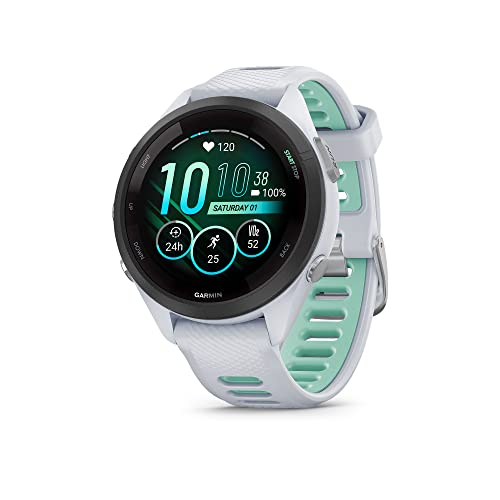
At full price it is a fair rather than exceptional buy, because the Forerunner 165 covers the basics for much less and the 965 adds maps for a few hundred more. Where the 265S becomes compelling is on discount, which happens regularly, and when the 42mm size is the actual requirement. There is no other Garmin that packs multi-band GPS and the full mid-range training suite into a case this small.
If you are building a home training setup around it, our best Garmin watch UK guide compares the range, and the Forerunner 265 review covers the 46mm sibling if wrist size is not a constraint. For indoor sessions on days when running outside is not happening, the best treadmills for home use guide pairs sensibly with the watch's structured workout support.
Check price on AmazonSize, and almost nothing else. The 265S has a 42mm case with a 1.1 inch screen and 18mm straps; the 265 has a 46mm case with a 1.3 inch screen and 22mm straps. Features are identical. Battery figures are close enough not to decide it: Garmin quotes up to 13 days smartwatch mode on the 265 and up to 15 days on the 265S, because the smaller battery is offset by a smaller screen to light up. Pick the one that fits your wrist.
No. It handles courses you import, gives breadcrumb navigation and can point you back to the start, but there is no built-in topographic mapping. If you want proper maps on a Garmin running watch you need to step up to the Forerunner 965 or the fenix line, which costs considerably more.
Garmin quotes 15 days in smartwatch mode, which drops to about 5 days with the always-on display enabled. In practice, running four or five times a week with the screen set to gesture wake, most people get somewhere around a week. Turn on always-on display and stream music over Bluetooth and you will be charging every three or four days.
It is rated 5 ATM, which covers swimming, showering and rain without concern. It has a pool swim profile and open water tracking. It is not designed for diving or high-speed water sports.
If you race or follow structured training, yes. The 265S adds multi-band GPS, Training Readiness, Training Status, HRV status, running dynamics from a compatible accessory and a faster processor. If you run three or four easy times a week and mostly want distance, pace and heart rate on a nice screen, the 165 does that for around £120 less and the extra features will sit unused.
No. The 265S has an optical heart rate sensor and pulse oximeter but no ECG hardware, unlike the Venu line or Polar's Vantage watches. If a wrist ECG matters to you, this is not the watch.
Are vibration plates worth it? Yes for balance, bone health support and low-impact warm-ups; no for weight loss or replacing strength training. The evidence.
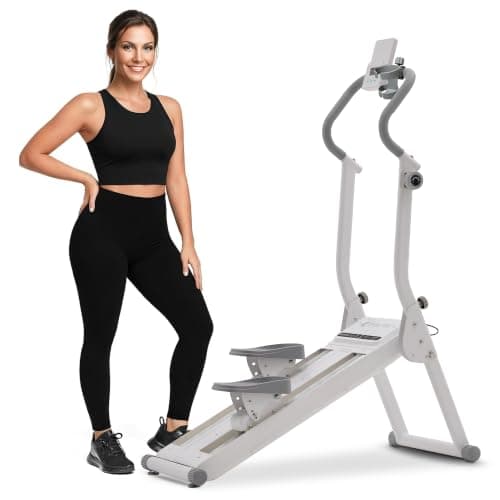
Our ExacMe magnetic stair climber review covers its 16 magnetic resistance levels, 48cm stride, 158kg user limit, app and noise claims, and who should buy it.
What a cambered bar is, the three main types (cambered squat bar, bowed bench bar, cambered Swiss bar), what each one does, how much they weigh and how to buy one.
What a landmine attachment is, the rack-mounted, plate-post and floor platform types, how to check bar and rack fit, safety tips, and the best exercises to do.
Best Exercise is a participant in the Amazon EU Associates Programme, an affiliate advertising programme designed to provide a means for sites to earn advertising fees by advertising and linking to Amazon.co.uk. As an Amazon Associate we earn from qualifying purchases. This comes at no extra cost to you and never influences our independent reviews or rankings.