Recovery
Is a Massage Gun Good for Sciatica? Where to Use It and Where Not To
A massage gun can ease the tight glutes and hamstrings that come with sciatica, but it can't fix a pinched nerve. Where to use it, settings and red flags.

By Mike Shilling, Recovery & Training Editor · Updated 7 November 2026
We may earn a commission from qualifying purchases made through links on this page, at no extra cost to you. This never affects our ratings.
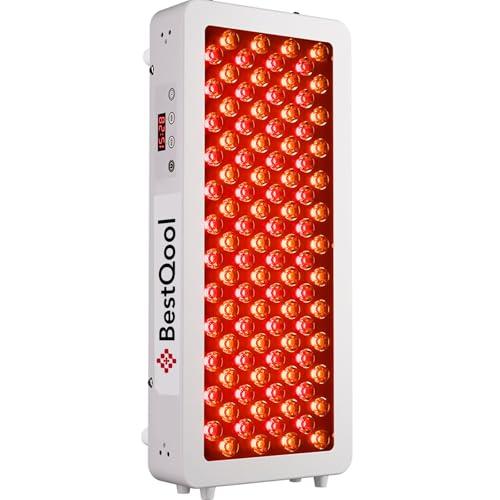
The BestQool Pro100 is the step up from BestQool's compact 105W panel. It costs around £319 at the time of writing on Amazon UK, packs 100 dual chip LEDs into a 160W panel, runs four wavelengths of red and near infrared, and adds a built in timer and ports for linking several panels together. BestQool quotes 109 mW/cm² at 3 inches.
We rate it 3.7 out of 5. It's a bigger, more flexible panel than the 105W, and modular linking is a real reason to pick it. The problem is value. Its claimed output is only about 14% higher than the £189 105W, and the Hooga ULTRA360, at a similar price, claims far more intensity at the same 3 inch distance. If you specifically want a panel you can expand later, the Pro100 makes sense. If you just want the most light per pound, it doesn't.
How we review
This review is research-based. We haven't tested the Pro100 hands-on or measured its output with a meter. We worked from the live Amazon UK listing, BestQool's own February 2025 announcement of the four wavelength Pro series, and comparisons with the red light panels we've already reviewed. We tried to check specs on BestQool's website, but it blocked our requests. Every output figure here is the manufacturer's claim.
The Pro100 suits someone who has decided red light is worth a proper try and wants room to grow. One panel covers a larger patch than the 105W, so a thigh, a shoulder or the middle of your back fits in front of it more comfortably. Later you can buy a second Pro100 and link the two, which edges you towards a half body setup without throwing away the first panel.
It's a weaker choice if you're still curious rather than committed. The BestQool 105W panel uses the same brand's dual chip approach, claims nearly the same irradiance and costs £130 less. And if you already know you want to treat both legs or your whole back in one session, a tall panel does that job better than two linked compact ones. Our guide to red light therapy for recovery explains why panel size and distance shape the dose you actually get.
Check the BestQool Pro100 price on Amazon£319.00The Amazon UK listing covers the headline numbers and little else, so the table shows the gaps alongside the claims.
| Model | Pro100 |
|---|---|
| LEDs | 100 dual chip LEDs |
| Wavelengths | 4 (630nm, 660nm, 850nm, 940nm per BestQool's 2025 announcement; not named on the UK listing) |
| Modes | Red, near infrared or combined |
| Power | 160W (Amazon UK listing) |
| Claimed irradiance | 109 mW/cm² at 3 inches (no figure at other distances) |
| Timer | Built in |
| Expansion | Modular, links to other panels via connection ports |
| Cooling | Built in cooling, details not given |
| Panel size and weight | Not stated on the UK listing |
| Colour | White |
| Price (Amazon UK) | Around £319 at the time of writing |
The two panels share a brand and a design idea, but they're aimed at different buyers.
So the extra money buys a bigger treatment area, two extra wavelengths and the option to expand. It doesn't buy much more intensity.
109 mW/cm² is a decent number, but 3 inches is about 7.6cm, which is closer than most people sit. Light spreads out quickly as you move back, so at 15cm the real figure will be lower, and BestQool doesn't say by how much.
Taken at face value, a 10 minute session at 3 inches works out at about 65 J/cm² (109 mW/cm² for 600 seconds). That's arithmetic on the claim, not a measurement, and it only applies to skin directly in front of the LEDs.
Probably not much for recovery. Most of the muscle studies we've read used wavelengths between about 630nm and 850nm, with 660nm and 808 to 850nm the most common. The 630nm channel sits inside that range. The 940nm channel sits outside most of it, so we wouldn't pay extra for it on its own. Four wavelengths looks good on a box; the dose you get at your working distance matters more.
Sometimes, modestly, and not reliably. The research on photobiomodulation (the clinical term for red and near infrared light therapy) for muscle recovery is small, varied and sensitive to dose.
A 2025 Bayesian network meta-analysis of physical therapies for delayed onset muscle soreness ranked photobiomodulation first for reducing soreness at 24 and 48 hours compared with placebo. Two caveats: the effect had gone by 72 hours, and the photobiomodulation result rested on a single trial.
A separate 2025 meta-analysis on photobiomodulation for muscle soreness included 14 studies, but only four had data it could pool. Those showed less soreness at 72 and 96 hours and better strength at 24 and 48 hours. Four of the 14 studies found no significant effect, and the pooled results had wide confidence intervals.
Then there are the clean nulls. A double blind crossover trial in 60 physical education students applied an 808nm laser to the quads and found no difference from sham treatment in maximal strength or in recovery after a fatigue protocol.
Most of this work used lasers or clinical LED arrays at controlled doses, not a home panel at an unmeasured distance. So even the positive findings don't transfer directly to the Pro100. It's not a treatment for any injury or medical condition, and if you have one, see your GP or a physio. Our guide to how to use red light therapy covers distance, session length and eye safety in more detail.
The biggest one is competition. The Hooga ULTRA360 also quotes output at 3 inches, claims 159 mW/cm² there, and costs about £307.59. That's roughly 46% more claimed intensity for slightly less money, plus a published figure at 6 inches too. The Pro100's one possible edge is coverage: 100 LEDs against the Hooga's 72 on a laptop lid sized panel suggests a larger treatment area, but without dimensions on the listing we can't confirm it.
The listing is also thin. There's no panel size, weight or warranty, and the four wavelengths aren't named. Sellers disagree on the power figure, with Amazon UK saying 160W and some overseas retailers listing 170W. None of that means the panel is bad, but it makes like for like comparison harder than it should be.
Finally, linking panels gets expensive. Two Pro100s cost around £638, and at that point a single tall panel is the cleaner option.
The Pro100 is the bigger, pricier model. It has 100 dual chip LEDs, a 160W rating, four wavelengths instead of two, a built in timer and connection ports so you can link panels together. The 105W (BQ60) sticks to 660nm and 850nm and costs £189. The claimed output gap is small: 109 mW/cm² at 3 inches on the Pro100 against 95.6 mW/cm² on the 105W, so most of the extra £130 buys panel size and expandability rather than intensity.
The UK Amazon listing says four wavelengths of red and near infrared but doesn't name them. BestQool's February 2025 announcement of the four wavelength Pro series lists 630nm, 660nm, 850nm and 940nm. Most recovery research uses wavelengths in the 630nm to 850nm range, so the 940nm channel has the least evidence behind it.
It uses the right kind of light, but the evidence for red light and recovery is mixed and depends heavily on dose. Some meta-analyses find less soreness or better strength in the days after hard exercise, while a double blind trial in 60 students found no effect at all. Treat it as an optional extra on top of sleep, food and sensible training, not a fix for any injury or condition.
Yes. The listing describes a modular design with connection ports so several Pro100 panels can form a larger setup. That's the main reason to choose it over the 105W, which has no linking option. Two panels cost around £638, though, which is well into full body panel territory.
Yes. Near infrared at 850nm and 940nm is close to invisible, so your eyes won't squint against it. Wear blackout goggles when the panel faces your head and never look into the LEDs. Check with your GP or optician first if you have an eye condition or take medication that makes you sensitive to light.
A massage gun can ease the tight glutes and hamstrings that come with sciatica, but it can't fix a pinched nerve. Where to use it, settings and red flags.
Yes, a TENS machine can occasionally make pain worse. Here is why it happens, how to place the pads and set the intensity, how long to use it, who should avoid TENS, and what the evidence says for sciatica.
Can a vibration plate help lymphatic drainage? What whole-body vibration really does to circulation and swelling, what the thin research shows, how to use one safely and who should avoid it.
Can red light therapy cause cancer? Why red and near infrared LEDs aren't UV, what studies say about existing tumours, who should check with a GP first.
Best Exercise is a participant in the Amazon EU Associates Programme, an affiliate advertising programme designed to provide a means for sites to earn advertising fees by advertising and linking to Amazon.co.uk. As an Amazon Associate we earn from qualifying purchases. This comes at no extra cost to you and never influences our independent reviews or rankings.