Nutrition
Active Calories vs Total Calories: What Your Watch Means
Active calories vs total calories explained: what Apple Watch, Garmin, Fitbit and Whoop count, how accurate they are, and how many to eat back for weight loss.

By Paul Kendrick, Cardio & Endurance Editor · Updated 23 September 2026
We may earn a commission from qualifying purchases made through links on this page, at no extra cost to you. This never affects our ratings.
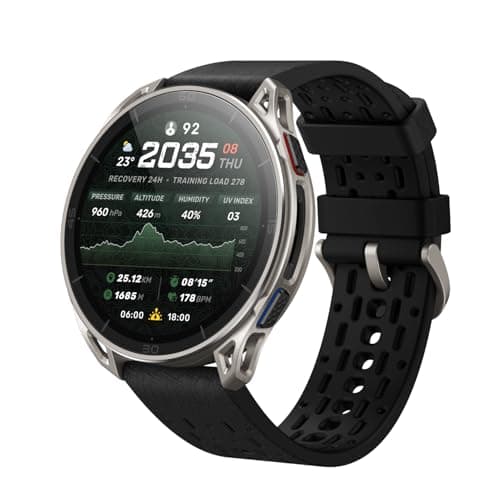
Amazfit already makes a titanium running watch, the Cheetah 2 Pro, and it already makes a sapphire-screened all-rounder with more battery than the Pro for £80 less, the Balance 3. So the Cheetah 2 Ultra has a narrow job to do at £599.90: be the watch you'd wear for a 100km trail race and trust to still be recording at the finish.
On paper it does that. Amazfit's UK spec page lists 60 hours in accurate dual-band GPS mode, up to 80 hours in its ultra long-distance trail scenario, and 30 days of typical use from a 780mAh battery. The case is grade 5 titanium, 52g without the strap, with a 1.5in AMOLED under sapphire. Amazon UK sells it for £599.90, the same price Amazfit charges direct, and it went on sale in May 2026.
How we review
This review is built from Amazfit's published technical specifications, the Amazon UK listing, and side-by-side comparison with the Amazfit, Garmin and COROS watches we've already reviewed. Battery figures are the manufacturer's own; where the marketing and the spec sheet disagree, we say which one to believe.
Trail and ultra runners. Amazfit says so itself, and the feature list backs it up: contour maps, a trail running mode that adjusts your load for gradient and terrain, a colour-coded elevation profile of the route ahead, and a flashlight with red and SOS modes for the hours after dark. If your longest run is a road half marathon, you're paying £230 over the Balance 3 for battery you'll never touch.
It isn't a swimmer's watch either. The 5 ATM rating is fine for a lake or a pool, but the cheaper Balance 3 and T-Rex 3 Pro are both 10 ATM, which feels backwards on the most expensive watch in the range.
Check price on Amazon£599.90Amazfit publishes six different battery figures for this watch, and the Amazon listing quotes the two biggest. Here's how they line up: 60 hours in accurate GPS mode (dual-band, all six systems), 33 hours in "heavy trail running mode", 48 hours in a standard trail scenario, 80 in an ultra long-distance scenario, and 228 hours at maximum GPS battery life with accuracy turned down.
The 33 hour figure is the honest one for race planning. It assumes you're using the maps, the screen and the trail-specific features, which is what you'd actually do in a mountain ultra. That still covers the cutoff at most 100km events. Compare like with like and the gap to the Cheetah 2 Pro is big: 60 hours of accurate GPS against the Pro's 31. The 60 hour figure is for steady recording with the screen mostly off.
Day to day, 30 days typical use means charging once a month if you run four times a week. Heavy use halves that.
| Display | 1.5in AMOLED, 480 x 480, 323 ppi, up to 3,000 nits |
|---|---|
| Cover | Sapphire glass |
| Case | 47.4mm, 15.6mm thick with sensor (13.3mm without) |
| Materials | Grade 5 titanium bezel, frame, back and buttons; fibre-reinforced polymer case |
| Weight (no strap) | 52g |
| Battery | 780mAh: 30 days typical, 15 heavy |
| GPS battery | 60h accurate, 33h heavy trail, 80h ultra trail, 228h max |
| Positioning | Dual-band, six satellite systems |
| Water rating | 5 ATM |
| Storage | 64GB (contour maps, music) |
| Heart rate sensor | BioTracker PPG (5PD + 2LED) |
| Extras | NFC Zepp Pay, red and white flashlight, mic, speaker, barometric altimeter |
| Compatibility | Android 7.0+, iOS 15.0+ |
This is the clearest upgrade over the Cheetah 2 Pro. The Ultra carries full-colour contour maps rather than plain street and trail lines, so you can see a steep climb coming before your legs do. Turn-by-turn directions, automatic rerouting if you go off course, a points-of-interest search and a round-trip route generator are all on the watch, and none of it needs a subscription.
Offline maps on Amazfit watches used to be slow to redraw. The newer renderer on the Balance 3 and Ultra is quicker, and on a 1.5in screen at 3,000 nits the contour shading is actually readable in sunlight. Garmin's mapping is still better at the edges (course import, ClimbPro-style climb breakdowns), but the gap is smaller than the £600 price tag suggests.
The running metrics are the full Amazfit set: lactate threshold, running power, ground contact time, VO2 max trends, finish time prediction and gradient-adjusted pace. The trail running mode is the new part, applying a load factor for gradient, terrain resistance and vertical gain so that a slow, steep hour registers as the hard session it was.
HybridCharge ties training load, overnight recovery and daily stress into one readiness score, which is the same idea as Garmin's Training Readiness under a different name. It's useful for spotting when you've stacked too much volume, and it's no more magic than any other readiness score.
The heart rate still comes from a wrist sensor. A 2025 study against a Polar H10 chest strap found consumer wearables tracked well at rest and on steady treadmill work but lost accuracy badly during burpees (study on wearable heart rate accuracy). Steep hiking with poles is a similar problem for the wrist. If you pace ultras by heart rate, pair a strap; the watch accepts one over Bluetooth, and our heart rate monitor guide covers the options. Our heart rate zone training guide explains how to set the zones up.
Inside Amazfit's own range, the Balance 3 is the value pick: 41 hours of accurate GPS, 10 ATM, the same screen and maps, £369.90. The Cheetah 2 Pro is lighter and smaller but has half the GPS battery, which makes it the weaker buy now the Ultra exists. And the T-Rex 3 Pro remains the rugged option for people who want 10 ATM and buttons that work in gloves.
Outside it, the Garmin Forerunner 970 sits at a similar price and brings Garmin's training platform, which is still the better software by some distance. The COROS APEX 4 costs about £170 less and gives you most of the endurance for trail running, with COROS's cleaner app. We'd pick the Cheetah 2 Ultra over the COROS only if the sapphire AMOLED and colour contour maps matter to you.
Check price on Amazon£599.90For trail and ultra runners, mostly yes. You get 60 hours of accurate dual-band GPS, 80 hours in Amazfit's ultra long-distance trail scenario, full-colour contour maps on 64GB of storage and a 52g grade 5 titanium case. Road runners and hybrid gym users get almost everything they need from the Balance 3 at £369.90.
Battery and maps, mostly. The Ultra has a 780mAh cell and is rated for 60 hours of accurate GPS against the Pro's 31, plus full-colour contour maps and a trail running mode with load settings for gradient and terrain. It's a bigger watch at 47.4mm and 52g, and it costs £150 more at £599.90.
Yes, in a pool or open water. It's rated to 5 ATM, which covers swimming and showering but not diving. That's lower than the cheaper Balance 3 and T-Rex 3 Pro, which are both 10 ATM.
Amazfit quotes up to 30 days typical use, 15 days heavy use, 60 hours in accurate GPS mode, 33 hours in heavy trail running mode and up to 228 hours at maximum GPS battery life. The 33 hour trail figure is the one to plan an ultra around, because it assumes the maps and sensors are working hard.
Yes. The Zepp app syncs to Strava, Runna, TrainingPeaks, Intervals.icu, Google Fit and Apple Health, and you can import structured workouts from TrainingPeaks, Runna and Intervals.icu onto the watch.
No. The box contains the watch, a black silicone strap, a striped green nylon strap and a magnetic charging head that takes a USB-C lead. Bring your own cable.
Active calories vs total calories explained: what Apple Watch, Garmin, Fitbit and Whoop count, how accurate they are, and how many to eat back for weight loss.
The best Bulgarian split squat alternatives, grouped by why you're swapping: balance, knee pain, no bench or training at home. Cues, kit and who each suits.
The best cable kickback alternatives for your glutes, from banded and ankle-weight kickbacks to reverse hypers and back extensions, with cues for home and gym.
Chest supported row alternatives that still unload your lower back: seal rows, DIY incline rows, cable, machine, inverted and band rows, plus which rows to avoid.
Best Exercise is a participant in the Amazon EU Associates Programme, an affiliate advertising programme designed to provide a means for sites to earn advertising fees by advertising and linking to Amazon.co.uk. As an Amazon Associate we earn from qualifying purchases. This comes at no extra cost to you and never influences our independent reviews or rankings.