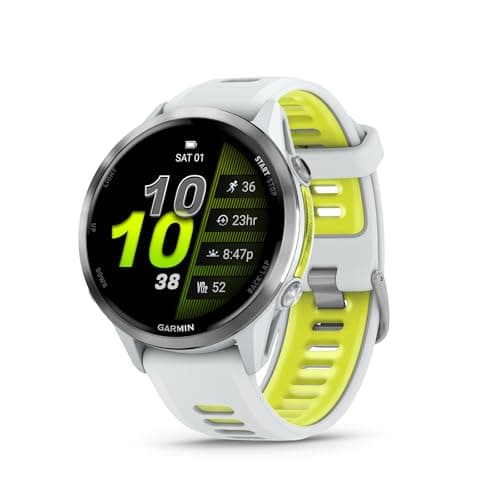
Garmin's Forerunner line has spent a decade creeping upmarket, and the 970 is where it finally collides with the Fenix range. Titanium bezel, sapphire crystal, ECG, an LED flashlight, a speaker and microphone for taking calls, and the brightest AMOLED panel Garmin has put on a watch. At roughly £600 on Amazon UK it is not a casual purchase, and the honest question is whether a runner needs any of that.
For most people the answer is no, and I will say that plainly before the praise starts. If you run four times a week on familiar roads and want accurate pace and a training load number, the Forerunner 265 does that for less than half the money. The 970 earns its price with two things specifically: proper offline mapping, and a level of build quality that survives being scraped down a wall at mile 22.
How we review
This review draws on Garmin's published specifications, the consistent findings across long-term reviews from established running and endurance outlets, and the recurring themes in verified owner feedback. We have not run our own six month endurance test of this exact unit, so we report only findings that show up repeatedly rather than a single reviewer's impression. Specs and prices were correct at the time of writing.
Who it is for
Marathon and ultra runners who navigate unfamiliar routes, triathletes who want everything in one watch, and anyone who has broken the screen on a plastic-bezelled Forerunner and does not want to do it again. It also suits people who run in the dark and will genuinely use the flashlight, which sounds like a gimmick until the first time you need to check your footing on an unlit towpath.
Skip it if you race the same three routes, if you care more about battery life than screen brightness, or if the best Garmin watch guide points you at something cheaper that does what you actually need.
Pros
Titanium bezel and sapphire lens, the most durable Forerunner ever made
Brightest AMOLED display Garmin has shipped, readable in harsh sunlight
Full colour offline maps with turn by turn navigation and round-trip routing
Multi-band GNSS holds accuracy in cities and under tree cover
Built-in ECG, skin temperature sensor and LED flashlight
Speaker and microphone for calls and voice commands
New Running Tolerance metric works without extra hardware
Cons
Around £600, which is Fenix money for a Forerunner
Battery life went backwards from the 965, 15 days versus roughly 23
Running Economy and Step Speed Loss need the HRM 600 strap, sold separately
Only one 47mm size, no option for smaller wrists
Early software had rough edges that took firmware updates to settle
Build and screen
Pick it up and the difference from a 265 is immediate. The titanium bezel gives it a density that plastic never manages, and the sapphire lens means the everyday scrapes that fog a Gorilla Glass watch face simply do not register. At about 56g it is 3g heavier than the 965, which nobody will notice, and it sits comfortably under a jacket cuff.
The screen is the headline. Garmin describes it as its brightest AMOLED yet, and in July sunshine that translates to reading your pace at a glance rather than shading the watch with your other hand. Always-on mode is genuinely usable now, though it costs you battery, which brings us to the argument.
Battery life, and the elephant in the room
Garmin quotes up to 15 days in smartwatch mode and 26 hours of GPS-only tracking, dropping to around 21 hours with all satellite systems and roughly 12 hours once you add multi-band and music. Those are decent numbers in isolation. They are also worse than the watch this replaces, since the 965 managed close to 23 days in smartwatch mode.
Brighter screens cost power, and Garmin made a deliberate trade. For a marathon runner it changes nothing, because 21 hours covers any road race you will enter. For a hundred miler, or for anyone who resents charging a watch weekly, the maths matters. Turn the always-on display off and you claw a meaningful chunk of it back.
Garmin Forerunner 970 key specs
Case size
47mm, titanium bezel
Display
1.4in AMOLED touchscreen, sapphire lens
Weight
Approx 56g
Battery, smartwatch
Up to 15 days
Battery, GPS only
Up to 26 hours
Battery, all systems
Up to 21 hours, about 12 with multi-band and music
GNSS
Multi-band, SatIQ automatic mode
Maps
Full colour offline maps, turn by turn, round-trip routing
LED flashlight, speaker and microphone, Garmin Pay, music storage
New metrics
Running Tolerance, Running Economy, Step Speed Loss
The new running metrics
Garmin launched three new running numbers on this watch. Running Tolerance tracks how much running your body has absorbed recently against what it is used to, which is a more useful load figure than raw mileage for anyone stepping up their training. It works straight out of the box.
Running Economy and Step Speed Loss are the two that need explaining before you buy. Both require the HRM 600 chest strap, sold separately, which pushes the real cost of the full feature set well past £700. Garmin does not hide this, but it is easy to miss in a product listing, and plenty of buyers have been annoyed to discover it after unboxing. If those metrics are why you are buying, budget for the strap.
A strap is worth having anyway. Optical wrist sensors have got good, and a 2025 validation study found wrist-worn devices tracking chest strap readings closely during steady running while struggling more during lower-intensity movement, where reduced blood flow and wrist motion interfere with the signal. Intervals and gym work are where wrist readings wobble most, which is exactly when accurate heart rate matters. Our heart rate monitor guide covers the strap options.
GPS and day to day use
Multi-band GNSS on the 970 is as good as consumer GPS currently gets. Running between tall buildings, along riverside paths under bridges or through dense woodland, the traces stay tight in situations where single-band watches wander by ten or fifteen metres. SatIQ handles the switching automatically, using the power-hungry multi-band mode only where it is needed.
The speaker and microphone are more useful than expected. Voice commands for starting an activity work well with wet or gloved hands, and taking a call from your wrist mid-run is convenient in the way you only appreciate after doing it once. It is not a reason to buy the watch.
Software wise, early firmware on the 970 had rough edges, with owners reporting occasional stutters and inconsistent metrics in the first months. Garmin patched steadily and the watch on shelves now is in far better shape than the one that launched, but it is a fair mark against a £600 device.
Value against the alternatives
Against the Forerunner 965, the 970 wins on durability, brightness and health sensors, and loses on battery and price. Against the Fenix 8, it is lighter and cheaper while giving up the rugged case and the multi-week battery. Against the Forerunner 570, it adds maps, ECG, the flashlight and the titanium build for roughly £150 more, and maps alone justify that gap for anyone who runs unfamiliar routes.
Is the Garmin Forerunner 970 worth it over the 965?
If you already own a 965, probably not. The 970 adds a sapphire lens, a titanium bezel, a much brighter screen, an LED flashlight, ECG, a speaker and microphone, and the new running metrics. What it takes away is battery life, dropping from around 23 days in smartwatch mode on the 965 to about 15 days. Coming from a 265 or an older 945, the upgrade makes far more sense.
How long does the Forerunner 970 battery last?
Garmin quotes up to 15 days in smartwatch mode, up to 26 hours in GPS-only, about 21 hours with all satellite systems, and roughly 12 hours with all systems, multi-band and music together. Real world use with the always-on display and background heart rate lands most runners in the 20 to 24 hour range for GPS recording, which covers a long ultra but not a multi-day one.
Does the Forerunner 970 have maps?
Yes, full colour built-in maps with turn by turn directions stored on the watch, so you get navigation without your phone and without a mobile signal. That includes round-trip routing, which builds you a loop of a chosen distance from where you are standing. It is one of the two big reasons to pick this over a Forerunner 570.
What is Running Economy on the Forerunner 970?
A metric estimating how efficiently you convert energy into forward movement, introduced on the 970 alongside Running Tolerance and Step Speed Loss. The important caveat is that Running Economy and Step Speed Loss need the HRM 600 chest strap, which is sold separately and adds well over £100 to the price. Running Tolerance works from the watch alone.
Is the Forerunner 970 too big for small wrists?
It only comes in 47mm, with no smaller option, so anyone with a wrist under roughly 15cm should try one before buying. At about 56g it is light for the size thanks to the titanium bezel, and it is 3g heavier than the 965 it replaces. If size is the concern, the 42mm Forerunner 570 is the watch to look at.
Does the Forerunner 970 have ECG?
Yes, it carries Garmin's ECG app for recording a single-lead reading and checking for signs of atrial fibrillation, subject to regional availability. It is a wellness feature rather than a medical diagnostic tool, and it does not replace a proper cardiology assessment if you have symptoms.
Are adjustable dumbbells worth it? We run the UK numbers on cost and floor space against a fixed hex set, then cover dial, twist and spin-lock types, drop risk and who should skip them.
The best barbell row alternatives for a tired lower back, no barbell, no equipment or a cable stack. Chest-supported rows, dumbbell and landmine options, inverted rows and more, with form cues.
How to do the Cuban press step by step, the light dumbbell or bar weights to use, the rotator cuff and shoulder muscles it trains, common mistakes and easy variations.
How to do the kettlebell gorilla row with good form. Muscles worked, step-by-step cues, what weight to use, common mistakes, variations and a simple sets and reps plan.
Best Exercise is a participant in the Amazon EU Associates Programme, an affiliate advertising programme designed to provide a means for sites to earn advertising fees by advertising and linking to Amazon.co.uk. As an Amazon Associate we earn from qualifying purchases. This comes at no extra cost to you and never influences our independent reviews or rankings.