Exercise Bikes
Quiet Exercise Bike: How to Ride in a Flat Without Annoying Anyone
What makes an exercise bike noisy, which types are quietest for flats and upstairs rooms, how to stop vibration through the floor, and how to fix squeaks.

By Paul Kendrick, Cardio & Endurance Editor · Updated 31 October 2026
An upright exercise bike is the classic home exercise bike: you sit fairly straight on a wide saddle, the pedals sit directly underneath you and the handlebars are high and close, so nothing about the position asks you to lean or stretch. It's built for seated cardio, usually with quiet magnetic resistance and a console that runs programmes for you. If you want steady rides of 20 to 45 minutes in front of the TV, it's the type most people should buy. If you want sprints and standing climbs, look at a spin bike instead.
Below is what separates an upright from the other bikes on sale, who it suits, the specs that actually matter and the mistakes that catch buyers out.
Three things define the type, and the first is the seat. It's wider and more padded than a spin or road saddle, set on a post that sits almost vertically above the pedals, so your weight goes straight down through your sit bones rather than forward onto your hands. Your back stays roughly upright, like riding a town bike.
Second, the resistance. Nearly every upright sold in the UK now uses magnetic resistance: magnets move closer to a metal flywheel without touching it, which is why these bikes are so quiet and need almost no maintenance. Cheaper models adjust it with a knob; pricier ones use a motor and numbered electronic levels that the console can change for you mid-programme.
Third, the handlebars. They're high, close to the saddle and often fitted with pulse grips. They're there to steady you while seated, not to take your weight while you stand, and most uprights aren't designed for out-of-the-saddle riding at all.
We've compared these in detail in spin bike vs exercise bike, so here's the short version.
Upright vs spin bike. A spin bike copies road-bike geometry: narrow saddle, low bars, a forward lean and a heavy flywheel (typically 8kg to 20kg) that lets you stand and climb. Uprights carry lighter flywheels, usually 3kg to 10kg, and sit you vertically. Choose the spin bike for intervals and classes, the upright for comfortable seated riding and preset programmes.
Upright vs recumbent bike. A recumbent puts you in a bucket seat with a backrest and your legs out in front. It's the most supportive option for bad backs, older riders and people in rehab, as our guide to recumbent bike benefits explains, but it's longer (often 130cm or more front to back) and has a lower training ceiling. An upright typically fits in a metre or less and lets fitter riders push harder.
Upright vs air bike. An air bike uses a fan for resistance and has moving arms linked to the pedals, so the harder you work the harder it pushes back. It's a brutal HIIT tool and it's loud. If you want calm, steady cardio, the upright wins easily; if you want short, full-body conditioning sessions, see our best air bike UK guide.
| Upright | Spin | Recumbent | Air bike | |
|---|---|---|---|---|
| Position | Sitting upright | Leaning forward | Reclined with backrest | Upright, arms working |
| Typical flywheel | 3kg to 10kg | 8kg to 20kg | 3kg to 8kg | Fan |
| Standing riding | No | Yes | No | Possible, rarely used |
| Noise | Quiet | Quiet if magnetic | Quiet | Loud |
| Footprint | Smallest | Small to medium | Largest | Medium |
| Best for | Steady cardio, beginners, flats | Intervals, classes, cyclists | Bad backs, older riders | HIIT and conditioning |
An upright makes most sense if you're new to exercise or coming back to it, and you want something you can get on without thinking. Because the console runs hill and interval programmes, you don't need to plan a session. It's also a good shared household bike, since the position is easy for riders of different sizes and fitness levels to get used to, and the small footprint helps in a flat or spare room.
It's less suited to two groups. Road cyclists who want winter training that feels like their outdoor bike will find the upright position wrong, and riders with significant back pain may find even a vertical posture uncomfortable after 20 minutes, in which case a recumbent is the better call.
As for the health case, it's solid. A 2019 systematic review of indoor cycling found it may improve aerobic capacity, blood pressure, blood lipids and body composition, although the authors flag that few of the 13 included studies were randomised trials, so treat that as encouraging rather than definitive. The NHS recommends adults get at least 150 minutes of moderate or 75 minutes of vigorous activity a week, and 30 minutes on an upright five days a week covers the moderate target.
Flywheel weight, with a caveat. On a friction spin bike, a heavier flywheel genuinely means a smoother, more weighted ride. On a magnetic upright it matters less, because the magnets create the resistance and the wheel mainly governs how fluid the pedal stroke feels at higher cadence. A 6kg to 10kg wheel is plenty for seated riding. Some listings don't publish the weight at all, as with the MERACH MR-S26UK, which makes paper comparisons harder but isn't a reason to rule a bike out.
Resistance levels. Eight levels is the floor and fitter riders outgrow it within months, and it's the main thing holding back the otherwise stable, quiet MERACH H-Frame. Numbered electronic levels (16, 24, 32) are more useful than a loose knob, because "level 14" is repeatable next week and a mark on a dial isn't.
Maximum user weight. Budget uprights are often rated to 100kg to 120kg. Buy a bike rated at least 20kg above your own weight, which gives the frame a margin and usually means a sturdier build. The Viavito Satori is rated to 140kg and the MERACH H-Frame to 150kg.
Seat adjustability. Most uprights only move the seat up and down. Fore-aft adjustment lets you position your knee properly over the pedal, which matters more for taller and shorter riders. Check the listed minimum and maximum inseam or rider height, then set it up using our exercise bike seat height guide.
Step-through frame. Some uprights have a low, curved frame you step through rather than swing a leg over. If your hips are stiff or your balance isn't what it was, that's a feature to look for.
Console and apps. At minimum you want time, distance and resistance level. A watts readout is the single most useful extra, because watts measure the actual work you're doing, and Bluetooth lets you ride along to apps like Kinomap or Zwift. Treat console calorie counts as rough estimates.
These are rough figures based on what we see on Amazon UK in autumn 2026, and sales move them a lot.
The upright we'd point most people towards is the Viavito Satori, which we rate 4.1 out of 5. At around £199 it pairs a 9kg flywheel with 32 electronic resistance levels, shows watts on the console and sends data over Bluetooth to Kinomap and Zwift. The seat is its weak point, so budget for a gel cover if you're sensitive to saddles.
Check the Viavito Satori price on AmazonPaying for a heavy flywheel you won't use. A 15kg wheel on an upright you'll ride seated adds weight and cost but not much else. Put the money into resistance range and a better console.
Ignoring the weight limit. Riding at or above a bike's rated limit loads the frame, seat post and bearings, and it's the quickest route to creaks and wobble.
Buying the cheapest bike for a big goal. If you're planning five rides a week for a year, an 8-level bike with a flimsy frame will frustrate you by spring. Spend into the £150 to £300 band.
Skipping the measurements. Check the footprint and the rider height range before you order, especially in a flat. Uprights are compact, but leave space either side to get on and off.
Setting the saddle too low. Sore knees on a new bike usually mean the seat is too low. At the bottom of the stroke your knee should keep a slight bend.
Expecting to stand up on it. If out-of-the-saddle climbs matter to you, you want a spin bike, and you'll save yourself a return by deciding that before you buy.
An upright exercise bike is a stationary bike that sits you more or less vertically on a wide, padded saddle, with the pedals directly below you and the handlebars high and close. Most use magnetic resistance and a console with preset programmes. It's built for seated pedalling, which makes it the most familiar and space-efficient type of home exercise bike.
For steady, seated cardio and beginners, an upright is usually the better fit: the position is comfier, the console runs the workout for you and it takes up less room. A spin bike is better if you want standing climbs, sprints or studio-style classes, because it has a heavier flywheel and a road-bike position. Neither burns more calories by design; that comes down to how hard you pedal.
A recumbent is usually gentler, because the backrest carries your upper body and you don't lean forward at all. An upright is a reasonable middle ground if leaning over a spin bike hurts but you don't need full back support. If you have a diagnosed back condition, ask your GP or physio before choosing.
On a magnetic upright, 6kg to 10kg is plenty for seated riding. The magnets create the resistance, so flywheel weight mainly affects how smooth the pedal stroke feels at higher cadence rather than how hard the workout can be. Don't pay extra for a heavy flywheel on an upright you'll only ride seated.
In the UK, roughly £150 to £300 gets a solid magnetic upright with a usable console and a sensible weight limit, and that's where most people should buy. Under £150 you'll often get lighter frames and fewer resistance levels. Above £300 you're paying for heavier build, electronic resistance and better app integration.
What makes an exercise bike noisy, which types are quietest for flats and upstairs rooms, how to stop vibration through the floor, and how to fix squeaks.
Exercise bikes with moving arms explained: air bikes, dual-action uprights, recumbent cross trainers and desk pedallers, what the research says and who each one suits.
Buying an exercise bike with a screen in the UK? LCD console vs tablet holder vs built-in HD touchscreen, Peloton membership costs, BYO-tablet apps and price bands.
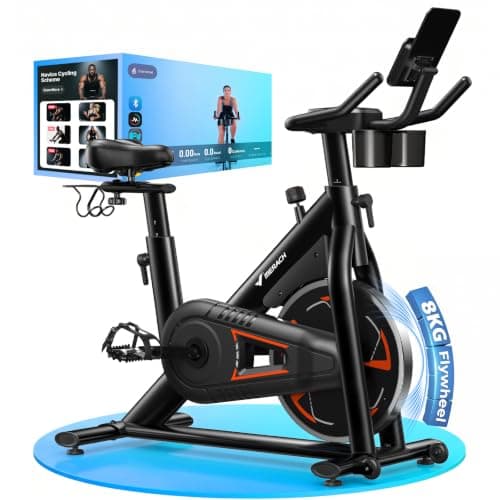
Our MERACH H-Frame exercise bike review: 8kg flywheel, 8 magnetic levels, 150kg limit, apps and Zwift support, and who should buy it at around £260.
Best Exercise is a participant in the Amazon EU Associates Programme, an affiliate advertising programme designed to provide a means for sites to earn advertising fees by advertising and linking to Amazon.co.uk. As an Amazon Associate we earn from qualifying purchases. This comes at no extra cost to you and never influences our independent reviews or rankings.