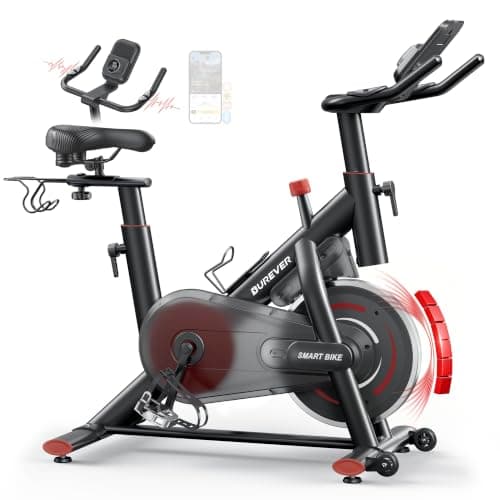
Exercise Bikes
Burever Exercise Bike Review: Touchscreen, 170kg Limit, Big Claims
Our Burever exercise bike review: the touchscreen goal console, 0-100% magnetic resistance, 170kg limit, Zwift support without a power meter, and who should buy it.

By Paul Kendrick, Cardio & Endurance Editor · Updated 18 August 2026
We may earn a commission from qualifying purchases made through links on this page, at no extra cost to you. This never affects our ratings.
Sitting still for eight hours is the part of desk work that nobody solves with a gym membership at six o'clock. An under desk bike is the cheapest attempt at a fix: a set of pedals on a weighted base that slides under your desk so your legs keep turning while you answer email. They cost between £30 and £110, they take up less floor space than a printer, and the good ones are quiet enough that the person on the other end of a Teams call has no idea.
The catch is that most of them are the same moulded plastic shell with a different badge, and the difference between a decent one and a dud comes down to two things: whether the resistance is magnetic, and whether the base stays put when you speed up. This guide covers the models on Amazon UK worth the money, plus the desk clearance measurement that decides whether any of them will work for you.
How we chose
We researched the most popular under desk bikes on Amazon UK rather than running our own long-term test of every model. Owner reviews, manufacturer specifications and expert round-ups all fed into the picks, with weight given to resistance type, noise complaints, base stability and the height of the unit. Prices and specifications were correct at the time of writing and change often, so check the current listing before you buy.
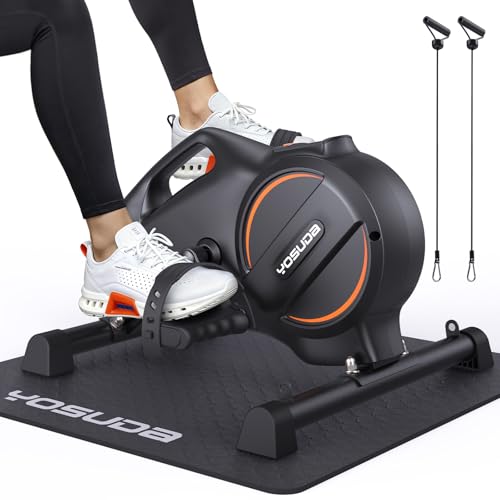
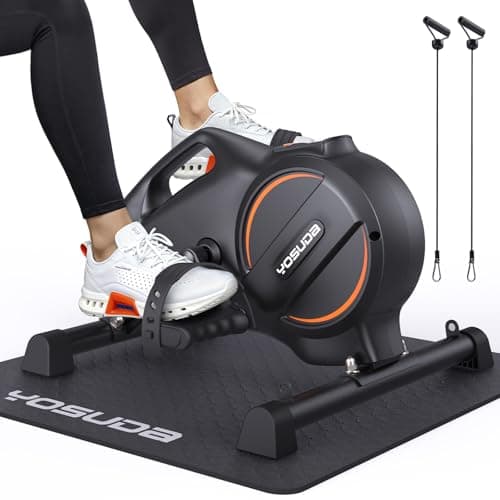
YOSUDA builds proper indoor cycles, and that shows in how solid this little unit feels next to the featherweight competition. Sixteen levels of magnetic resistance is more than any desk worker needs, which is the point: you can drop it to level two and pedal without thinking during a call, then wind it up to eight or ten for twenty minutes of genuine effort when your calendar clears. The non-slip mat that comes in the box does more work than it sounds like it should, because the usual failure of these machines is the base creeping forward across a hard floor until you are pedalling air.
The LCD tracks time, speed, distance, calories and a running total, and it cycles through them automatically if you would rather not touch it. At around £85 it costs three times the budget options. What you get for that is a heavier base, a smoother flywheel and a resistance dial that adjusts in usable increments instead of jumping from nothing to too much.
Check price on Amazon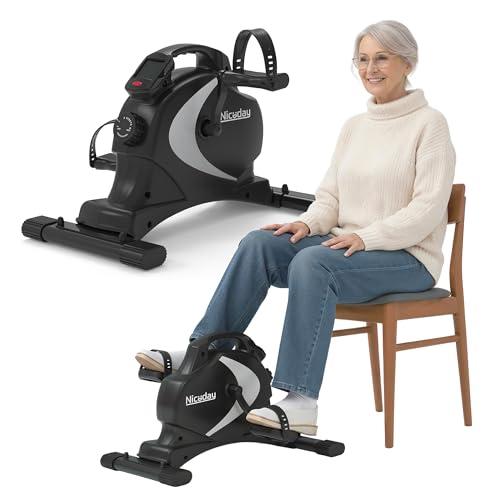
Niceday's version uses eight levels of magnetic resistance and is the one to buy if noise is your main worry, whether that's a shared office or a partner working in the next room. Magnetic resistance means no pad touches the flywheel, so the only sound is a low whirr from the bearings and the faint tick of the pedal straps. It's quiet enough that a headset microphone with any noise suppression at all will filter it out entirely.
It is a touch lower than the YOSUDA, which helps if your desk drawer eats into the space under the desktop. Assembly takes about ten minutes and needs the supplied hex key. The main gripe from owners is that the display is basic and the backlight is dim, so if you sit in a dark corner you'll squint at it.
Check price on Amazon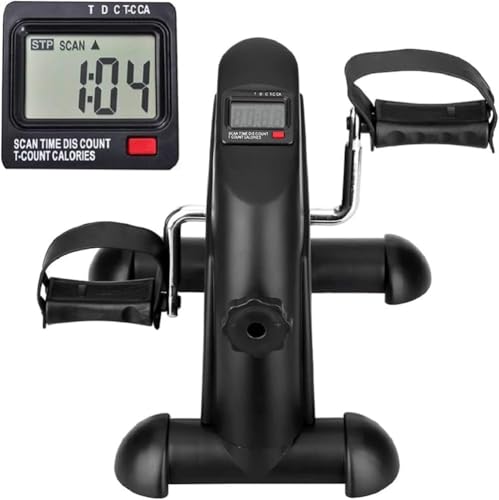
Around £33 buys you a working pedal exerciser, and himaly's is the version of that machine we'd pick. The resistance is a simple screw dial rather than a magnetic system, which means it gets stiffer by tightening a strap against the wheel, and that comes with the usual trade-offs: a bit of friction noise, resistance that changes as things warm up, and a mechanism that will wear out eventually. For light pedalling at a desk, none of that matters much.
What it does well is disappear. It weighs a few kilos, folds nothing but takes up almost no room, and you can move it between rooms without thinking. If you're unsure whether you will actually use an under desk bike, this is the sensible amount of money to risk finding out.
Check price on Amazon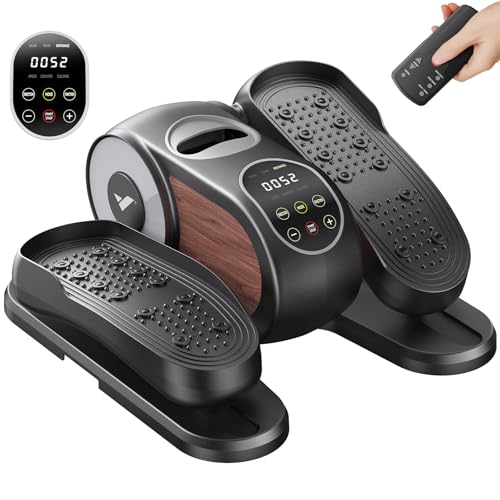
Every mini bike shares one problem: your knees travel up and down, and under a low desk they hit the underside. An elliptical solves that by moving your feet forwards and back on a shallow oval path instead, so the highest point of the stroke is barely above the machine itself. If you've measured your desk clearance and come up short, this is the category to look at rather than a bike.
MERACH's model runs on a motor with twelve speeds and a remote, so it can move your legs for you at a set pace, which makes it useful for anyone recovering from an injury or with limited mobility as well as for desk workers. It's the priciest pick here at around £110 and the heaviest to shift between rooms. The stride is short by design, so treat it as gentle circulation work rather than cardio training.
Check price on Amazon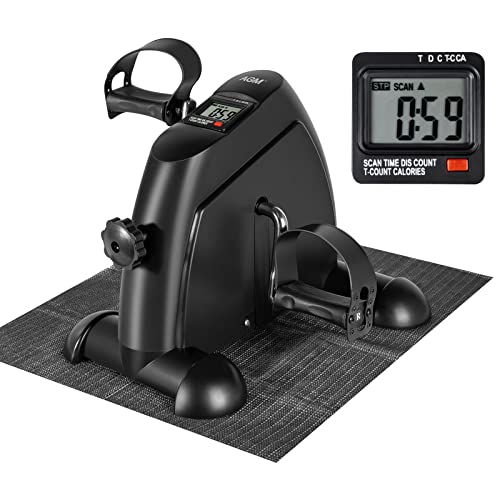
The AGM sits at the budget end and earns its place because of how well it works on a tabletop. Lift it onto the desk, hold a pedal in each hand and turn, and you have a cheap arm cycle for shoulder mobility or post-injury rehab. Plenty of owners bought it for exactly that reason rather than for leg work.
Adjustable resistance comes from a knob on the flywheel housing, and the LCD covers the basics. The anti-slip pads underneath grip carpet well and hard floors less well, so it wants a mat on laminate. At around £34 it is a lot of usefulness for very little money, provided you are realistic about the plastic build.
Check price on AmazonThis is the step people skip and then regret. Get a tape measure, sit in your chair, and measure from the floor to the underside of your desk (not the desktop, the underside, and if there's a drawer or a cross rail, measure to that). Most mini bikes stand roughly 30cm tall and your knee rises another 15cm or so above the pedal at the top of the stroke, so you want around 45cm of clear space. Standard UK desks land between 72cm and 75cm, which is usually fine, but a desk with a shallow drawer can steal 10cm without you noticing.
Two other things decide whether you'll keep using it. The base needs weight or a mat, since a light unit on laminate will walk away from you. And the pedal straps want to be adjustable, because pedalling in work shoes and pedalling in socks are different problems.
Under desk pedalling is not training, and the honest case for it is smaller and more specific than the marketing suggests. In a randomised experiment with 96 physically inactive adults, typing, reading, logical reasoning and phone task performance held up equally well during light pedalling at 17 and 25 watts as during sitting still, with the lower 17 watt rate rated more comfortable (Effects of Desk Pedaling Work Rate on Concurrent Work Performance). So you can pedal gently and still do your job. Push harder and something gives, usually your mouse accuracy.
The value is in what it displaces. The WHO's guidance is blunt about sedentary time being its own risk factor, separate from whether you exercise (WHO physical activity fact sheet), and the UK guidance asks adults for 150 minutes of moderate activity a week plus strength work twice a week (NHS physical activity guidelines). An under desk bike chips away at the sitting half of that. It will not cover the rest, and any product page suggesting otherwise is selling you something.
If you have the floor space and want cardio that genuinely counts, a full-size machine does far more per session. Our best exercise bike UK guide covers uprights and spin bikes, and the folding exercise bikes are the compromise for small rooms. Anyone dealing with back or knee trouble should look at a recumbent bike instead, since the seat takes the load off. And if you have a standing desk already, a walking pad burns considerably more than pedals do. A stepper machine is the other small-footprint option worth a look, and a mini stepper costs about what the bikes on this page do.
They burn a modest number of extra calories and keep your legs moving through a sitting day, which is worth having, but nobody gets fit on one alone. Pedal at a light effort for a couple of hours across a working day and you are adding movement to time you would otherwise spend completely still. Treat it as a top-up to proper training, not a replacement for it.
Measure the gap from the floor to the underside of your desk before you buy. Most mini bikes need roughly 40cm to 45cm of clearance for your knees to clear the desk at the top of each pedal stroke, and a standard UK desk sits at around 72cm to 75cm. If your desk is low, or you are tall, look at a flatter under desk elliptical instead, since the pedals travel forwards rather than up.
Magnetic models are. The resistance comes from a magnet moving closer to or further from the flywheel, so nothing rubs, and at low resistance you get a soft whirr that a decent headset microphone will ignore. Cheap friction or strap-resistance pedallers are the noisy ones, and they also tend to creak as the plastic frame flexes.
Expect somewhere around 100 to 150 calories an hour at the gentle pace you can hold while typing, and more if you push the resistance up during meetings where you are only listening. Any figure on the little LCD screen is an estimate based on time and pedal speed, not on your body weight or heart rate, so treat it as a rough guide.
Yes, and it is one of the more useful things these machines do. Sit the unit on a table or desk, hold the pedals like handles and turn them, and you get gentle shoulder and arm movement that suits rehab work or anyone with limited mobility. Keep the resistance low, since the pedal straps are built for feet and can dig into your hands.
A walking pad burns considerably more energy and gets you upright, but it needs a standing desk and it makes typing harder. An under desk bike costs a fraction as much, works with the desk you already own and lets you keep working normally. If your desk does not raise, the choice is easy.
Our Burever exercise bike review: the touchscreen goal console, 0-100% magnetic resistance, 170kg limit, Zwift support without a power meter, and who should buy it.
Spin bike vs exercise bike compared on riding position, flywheel, resistance, comfort, noise and price, with a clear verdict on which suits your training.
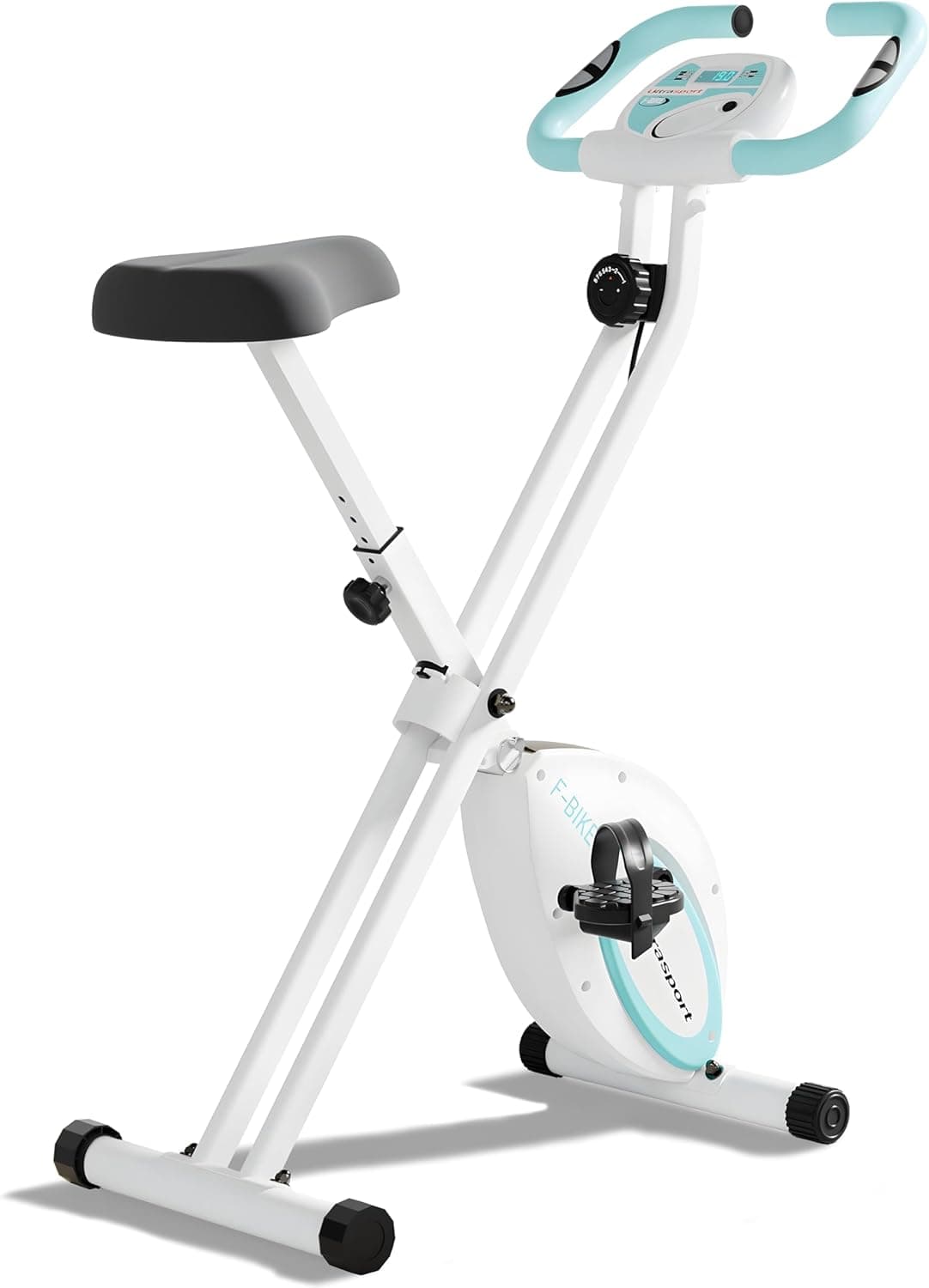
The best foldable exercise bike for UK homes, from budget mini pedallers to a 140kg-rated smart bike and a comfy recumbent. Folded sizes, weight limits and honest downsides.
Is Peloton worth it in the UK? We do the 1-year and 3-year maths on the Bike, Bike+, refurbished and rental options against a £400 bike with the app or Zwift.
Best Exercise is a participant in the Amazon EU Associates Programme, an affiliate advertising programme designed to provide a means for sites to earn advertising fees by advertising and linking to Amazon.co.uk. As an Amazon Associate we earn from qualifying purchases. This comes at no extra cost to you and never influences our independent reviews or rankings.