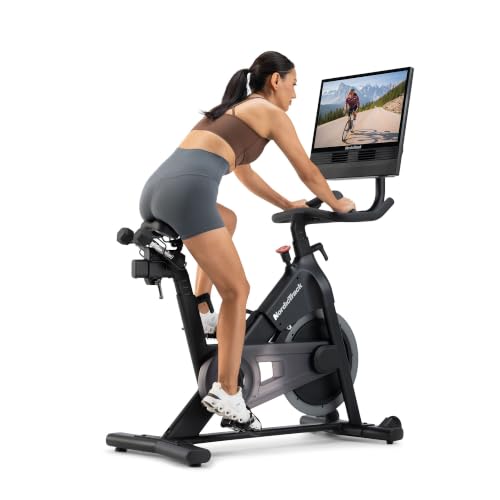
Exercise Bikes
NordicTrack 24 Studio Bike Review: A Big Screen With a Monthly Bill
An honest NordicTrack 24 Studio Bike review: 24in pivoting touchscreen, 24 resistance levels, 113kg limit, real iFIT costs and how it compares with Peloton.

By Paul Kendrick, Cardio & Endurance Editor · Updated 21 November 2026
Buy the Garmin Edge 540 unless you plan routes on the bike. The two computers share the same 2.6 inch screen, the same 26 hour battery, the same multi-band GNSS and the same training tools, and the 840's extras are a touchscreen, double the storage and the ability to create courses and search locations on the unit itself. At £216 against £340.52 on Amazon UK when we checked, that's roughly £125 for a handful of navigation conveniences. Some riders will happily pay it. Most won't miss them.
There's a second question worth asking before you buy either, because both are now previous-generation units. Garmin replaced them with the Edge 550 and 850 in September 2025, which is why the 540 and 840 are discounted, and why the 840 was down to its last few units on Amazon when we looked.
Every figure below comes from Garmin's Edge 540 and 840 specifications, which cover all four versions (standard and Solar for each) on one page.
| Spec | Edge 540 | Edge 840 |
|---|---|---|
| Controls | Buttons only | Buttons plus touchscreen |
| Display | 2.6 in, 246 x 322 pixels, transflective | 2.6 in, 246 x 322 pixels, transflective |
| Storage | 16 GB | 32 GB |
| Battery, demanding use | Up to 26 hours | Up to 26 hours |
| Battery saver mode | Up to 42 hours | Up to 42 hours |
| Solar version battery | Up to 32 hours (60 in saver) | Up to 32 hours (60 in saver) |
| Weight | 80.4 g (84.9 g Solar) | 84.8 g (88.9 g Solar) |
| Dimensions | 57.8 x 85.1 x 19.6 mm | 57.8 x 85.1 x 19.6 mm |
| On-device course creator | No | Yes |
| On-device location search | No | Yes |
| Multi-band GNSS | Yes | Yes |
| ClimbPro, stamina, power guide | Yes | Yes |
| Water rating | IPX7 | IPX7 |
| Amazon UK price (at writing) | £216.00 | £340.52 |
Look down that table and the pattern is obvious: the rows that differ are almost all about navigation. Body size, screen and battery are identical, so the 840 isn't a bigger or longer-lasting computer, it's the same one with extra input options.
Garmin added touch to the 840 without taking the buttons away, which matters more than it sounds. On older touch-only Edges, rain and full-finger gloves turned the screen into a lottery. On the 840 you still press physical buttons for lap, start and stop, and you only touch the glass when you want to pan or zoom the map or swipe between data pages.
So the touchscreen earns its keep in one situation: when you're looking at the map a lot. Riding abroad, exploring new gravel or trying to work out whether a lane in the Peak District goes through or dead-ends at a farm gate, a swipe beats five button presses. Our Edge 540 Solar review makes the same point from the other side, since panning and zooming by button is the 540's most common complaint.
If you mostly ride loaded routes and glance at turn prompts, you'll never notice the lack of touch; and in a wet British January, plenty of riders actively prefer buttons.
The 840 has 32 GB of storage, the 540 has 16 GB. That sounds like a big gap, but think about what fills it: maps. Both units come with regional cycling maps preloaded and let you add more over Wi-Fi, so 16 GB is fine if you ride in the UK and take the odd trip to one or two European countries.
The extra space matters if you want maps for a lot of regions loaded at once, say a long tour crossing several countries, and you don't want to swap them around before each trip. For a typical club rider, it's a spec-sheet difference rather than a riding one.
The two features that separate these computers more than the touchscreen are the on-device course creator and on-device location search, both 840-only according to Garmin's spec table. They let you build a route or find a café, station or address on the head unit itself, with no phone involved.
That's handy on holiday, or when a planned route goes wrong and you want a new one to the nearest train station. It's far less useful if you already plan everything in Garmin Connect, Strava or Komoot and sync it across, which is how most people use a bike computer. The 540 still reroutes you if you miss a turn; it just won't let you start a brand new course from scratch on the bars.
Everything that makes either unit a serious training computer is shared. Both have multi-band GNSS, which gives far cleaner tracks under trees and in steep valleys than single-band units. Both get ClimbPro for cycling, courses and free riding, real-time stamina, the power guide, cycling ability analysis, popularity heatmaps and the extended display feature that lets a Garmin watch share its data screens.
Battery life is the same too: Garmin quotes up to 26 hours in demanding use and up to 42 hours in battery saver mode for both standard models. That's comfortably more than any sportive or long summer day needs, and it's the main reason these older units still make sense against Garmin's newer range.
Both come in a Solar variant with Garmin's Power Glass lens, quoted at up to 32 hours in demanding use and up to 60 hours in battery saver mode with sun. Garmin says solar adds up to 25 minutes per hour in battery saver mode, but that assumes bright, direct sunshine. In UK conditions it's a top-up, not a charger, and the extra cost only pays back for audax riders, tourers and bikepackers. The Solar versions also weigh around 4 g more.
The Edge 850 and its button-only sibling, the Edge 550, launched in September 2025 as direct replacements. The big upgrade is the screen: Garmin's Edge 850 specifications list a 2.7 inch display at 420 x 600 pixels, far sharper than the 246 x 322 panel on the 540 and 840, and maps redraw noticeably faster. The 850 also adds a built-in speaker that reads out turn prompts and works as a bike bell, plus Garmin Pay.
The catch is battery. Garmin quotes the 550 and 850 at up to 12 hours in demanding use and 36 hours in battery saver mode, which is less than half of the older pair's 26 hours of demanding use. For a three hour Sunday ride that doesn't matter. For a 300 km audax, it decides the question.
Buy the newer model if screen clarity and map speed are your priority, you want the speaker or Garmin Pay, and your rides rarely go past 10 hours. Stick with the 540 or 840 if you ride long, hate charging, or simply want the best value; at £216 the 540 gives you the same training platform for a lot less.
Buy the Edge 540 if you plan routes on your phone or computer, ride in all weather and gloves, and want the most computer for the least money. It's the better buy for most riders by some distance, and £216 is a strong price for multi-band GNSS and 26 hours of battery.
Check the Garmin Edge 540 price on AmazonBuy the Edge 840 if you navigate unfamiliar roads often, want to create courses or search for places on the unit, or carry maps for many countries at once. It's also the pick if you simply find button-driven map panning maddening. Stock is getting thin now that it's been replaced, so don't wait too long if it's the one you want.
Check the Garmin Edge 840 price on AmazonLook elsewhere if you want a much bigger screen, in which case our Garmin Edge 1050 review covers the flagship. If you're not tied to Garmin, the Wahoo ELEMNT BOLT V3 is a simpler alternative at a £299.99 list price, though its GPS traces sit behind Garmin's multi-band units under tree cover.
Garmin's own spec sheet lists four differences: the 840 has a touchscreen alongside the buttons, 32 GB of storage instead of 16 GB, an on-device course creator and on-device location search. It also weighs 84.8 g against 80.4 g. The screen, battery, multi-band GNSS, ClimbPro, maps and training features are the same on both.
Only if you plan routes on the unit itself or navigate unfamiliar roads a lot. At £216 for the 540 and £340.52 for the 840 on Amazon UK at the time of writing, you're paying about £125 for the touchscreen and on-device routing. Riders who build routes in Garmin Connect or Komoot and send them over should buy the 540.
Yes. Garmin quotes up to 26 hours in demanding use and up to 42 hours in battery saver mode for both. The Solar versions stretch that to up to 32 hours in demanding use and up to 60 hours in battery saver mode, but only with bright direct sun.
Yes. Garmin launched the Edge 550 and Edge 850 in September 2025. They have a much sharper 2.7 inch screen and the 850 adds a speaker and Garmin Pay, but Garmin quotes only up to 12 hours of demanding-use battery for both, less than half the 540 and 840's 26 hours.
Yes. It has the same TopoActive cycling maps, Wi-Fi map manager and turn-by-turn navigation as the 840. What it lacks is the ability to create a course or search for a location on the device itself, so you plan routes on your phone or computer and sync them across.
An honest NordicTrack 24 Studio Bike review: 24in pivoting touchscreen, 24 resistance levels, 113kg limit, real iFIT costs and how it compares with Peloton.
What muscles does cycling work? Mainly your quads, glutes, hamstrings and calves, with core and arms stabilising. See each pedal stroke phase and what to add.
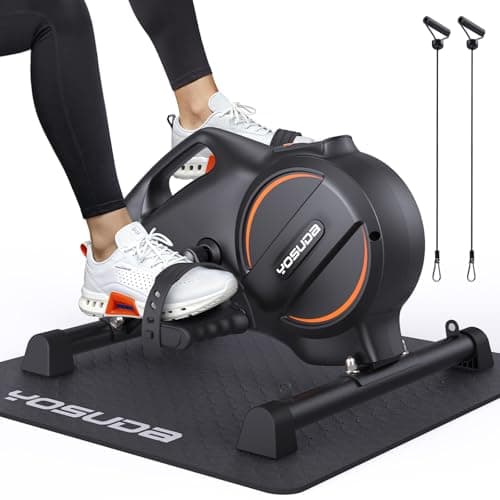
The best under desk bikes and mini exercise bikes in the UK for 2026: quiet magnetic pedal exercisers for home offices, checked against real desk heights, noise and resistance.
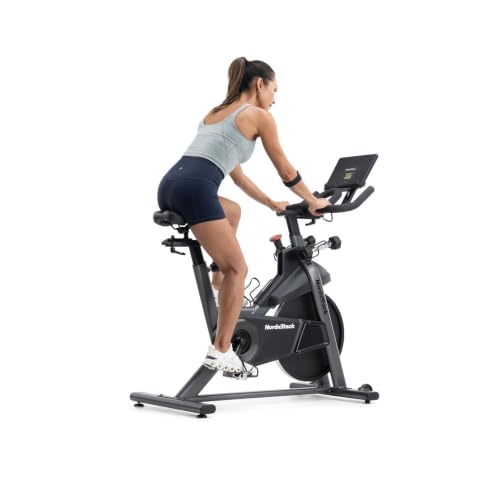
An honest NordicTrack T Series 9 Bike review: 16 resistance levels, SPD pedals, tablet holder, iFIT subscription costs and who should buy it instead of a rival.
Best Exercise is a participant in the Amazon EU Associates Programme, an affiliate advertising programme designed to provide a means for sites to earn advertising fees by advertising and linking to Amazon.co.uk. As an Amazon Associate we earn from qualifying purchases. This comes at no extra cost to you and never influences our independent reviews or rankings.