Rowing Machine vs Treadmill: Which Should You Buy for Home?
By Paul Kendrick, Cardio & Endurance Editor · Updated 22 November 2026
If you can only fit one cardio machine in your home, buy a rowing machine unless you run. A rower trains your legs, back and arms together, puts no impact through your joints, stores upright in a corner and costs less for a quality model. A treadmill wins outright if you are a runner, are training for a 5k or marathon, or mostly want to walk, because it is the only one of the two that trains the movement you actually care about.
This guide is about the buying decision between two machines for a home gym. If you are weighing up rowing against running outdoors, our rowing machine vs running guide covers that instead.
Quick comparison
Rowing machine vs treadmill at a glance
Main muscles
Rower: legs, glutes, back, arms, core. Treadmill: legs and glutes
Rower: many stand upright. Treadmill: folds, but stays bulky
Quietest option
Magnetic rower
Running specificity
Treadmill only
Power needed
Rower: none (monitor runs on batteries). Treadmill: mains socket
Maintenance
Rower: low. Treadmill: belt lubrication and alignment
Muscles used
This is the clearest difference between the two. A rowing stroke starts with a hard leg drive, then the hips open and the arms finish the pull, so your quads, glutes and hamstrings do most of the work while your lats, upper back, biceps and core carry the rest. Rowing coaches often describe the split as roughly 60% legs and 40% upper body and trunk, and our rowing machine muscles worked guide goes through each phase in detail.
A treadmill is a legs machine. Walking and running load your quads, hamstrings, glutes and calves, with your core working to hold you upright and your arms swinging for balance rather than for force. Turn up the incline and your glutes and calves work harder, but your upper body still does very little.
So if you want one machine that touches most of your body, the rower does more. If you lift weights for your upper body anyway, this matters less than it sounds.
Impact and your joints
Rowing is zero impact. Your feet are strapped to the footplates and never leave them, and your weight sits on the seat, so there is no landing force on your ankles, knees or hips. That makes a rower a sensible choice for heavier beginners, people coming back from a lower-limb injury and anyone whose knees complain after a run.
A treadmill depends entirely on how you use it. Walking, even at a steep incline, is low impact. Running is not: every stride lands with a force of roughly two to three times your body weight, and a cushioned deck softens that only a little. Plenty of people run happily for decades, but if impact is the thing you are trying to avoid, a treadmill only helps if you stick to walking.
Rowing is not risk-free either. Poor technique, especially rounding your lower back at the catch or yanking with the arms early, is the usual cause of rowing back pain, so it is worth spending your first few sessions on form.
A quick technique check
The order on the drive is legs, then body, then arms; on the way back it reverses to arms, then body, then legs. If your knees come up before your hands have passed them on the recovery, the handle has to travel over your knees and your back will round. Fix that order and most rowing aches go away.
Calories at matched intensity
People often claim one machine burns far more than the other. The honest answer is that at the same effort, the gap is small, and how hard and how long you train matters much more than which machine you pick.
The Compendium of Physical Activities gives MET values (a measure of energy cost, where sitting still is 1) for stationary rowing at different power outputs, and its running table does the same for set speeds. Using the standard formula, here is roughly what a 75kg person burns in 30 minutes:
Approximate calories in 30 minutes for a 75kg person
Rowing, moderate, under 100 watts (5.0 METs)
About 195 kcal
Rowing, vigorous, 100 to 149 watts (7.5 METs)
About 295 kcal
Running, 8km/h or 5mph (8.5 METs)
About 335 kcal
Running, 9.7km/h or 6mph (9.3 METs)
About 365 kcal
Rowing, vigorous, 150 to 199 watts (11.0 METs)
About 435 kcal
These are estimates, and your own figure will move with your weight, fitness and technique. What the table shows is that a steady jog edges out a steady row, but a hard row beats a jog. One lab study compared the same nine men on a treadmill, an elliptical and a rower and found their peak oxygen uptake was similar on all three, although peak heart rate was a little higher on the treadmill and the men burned more fat at a given relative intensity there (Journal of Sports Science and Medicine, 2021). That is a small sample, but it fits the wider picture: either machine can take you to your limit.
One practical point favours the treadmill for weight loss. Walking briskly on an incline is easy to sustain for an hour while you watch something, whereas an hour of rowing takes real fitness and decent technique. If long, easy sessions are what you will actually do, that counts.
Footprint and storage
Rowers are long but narrow, and many put most of their floor space back when you finish. The Concept2 Model D is 244cm long in use, yet it splits into two pieces with a quick-release lock and both halves stand in a corner. Most water rowers and a lot of magnetic models tip up on their front wheels and stand on end against a wall, taking up little more floor than a dining chair.
Treadmills fold, but folding does not make them small. The Horizon T101 is a typical home model: 181 x 84cm set up, and 116 x 85cm folded, but it stands 154cm tall and weighs about 82kg, so it wheels into a corner rather than hiding under a bed. Flat-folding treadmills and walking pads go further, though they give up deck length, motor power and often the running speeds a runner needs. Our walking pad vs treadmill guide covers that trade-off.
Measure your ceiling too. A rower stood on end is tall, so check the manufacturer's upright dimensions against your room before you buy.
Noise
The quietest machine here is a magnetic rower. Resistance comes from magnets near a flywheel with no contact, so you mostly hear the seat rolling and a faint whirr, which is why they suit flats and late-night sessions.
Air rowers are loud. The fan makes a whoosh that gets louder the harder you pull, and it is easily the noisiest option in the room, although the sound is a steady rush rather than a thud. Water rowers sit in between with a slosh that some people find relaxing and others find irritating.
A treadmill brings two kinds of noise: the motor hum and belt whirr, which are modest on a good machine, and the impact of your feet. Walking is fine. Running produces a rhythmic thump that travels through floors and into the room below, which is the real problem for upstairs rooms and flats. A thick treadmill mat helps with vibration but does not remove it.
Running specificity
This is where the treadmill has no rival. If your goal is a faster 5k, a first half marathon or simply getting back into running, you need to run. Running builds the tendon stiffness, calf and foot strength and stride mechanics that rowing never touches. A rower will improve your aerobic fitness, and some of that does carry over, but runners who swap all their running for rowing find their legs are not ready when they go back to the road.
A treadmill also gives you precise control over pace and incline for intervals, and it keeps you training through winter darkness and wet weather. For runners, a rower makes a good second machine for easy aerobic days or for staying fit through a running injury, but it cannot be the main one.
Cost and maintenance
You get more for your money with a rower. Decent magnetic rowers start at a few hundred pounds, and the Concept2, the machine most gyms and rowing clubs use, sits near the top of the home market yet still costs less than many mid-range running treadmills and holds its second-hand value unusually well. A treadmill good enough for regular running, with a long deck and a strong motor, typically costs more, and the cheapest models are mostly suited to walking.
Running costs follow the same pattern. Most rowers need no mains power at all (the Concept2 monitor runs on batteries), and upkeep is a wipe of the rail and a drop of oil on the chain now and then. A treadmill draws electricity every session, and the belt needs periodic lubrication and occasional tensioning and centring to stop it slipping or wearing unevenly. Our guide to how to lubricate a treadmill shows what that involves. The motor and electronics are also more parts that can fail, so the warranty matters more on a treadmill.
Which should you choose?
Pick the machine that matches your main goal, then check it fits your room.
Choose a rowing machine if:
You want one machine that works your whole body and you do not already lift weights.
Your knees, ankles or hips do not tolerate running, or you are starting from a high body weight.
Space is tight and you want something that stands upright out of the way.
You live in a flat or train early or late (pick a magnetic model for the least noise).
You want the best quality for the money and minimal maintenance.
Choose a treadmill if:
You run, or want to start running, and especially if you have a race in mind.
You mainly want to walk, including incline walking for long, easy sessions while watching TV.
You prefer a movement that needs no technique to learn.
Upper-body work is already covered by your strength training.
If impact is your main worry and you still want an upright, running-like movement, a cross-trainer sits between the two; compare it in our rowing machine vs cross-trainer and elliptical vs treadmill guides. When you have settled on a type, browse our rowing machines or treadmills reviews to find a model that suits your budget and room.
For most people buying one machine for a small home, yes. A rower works your legs, back and arms in one movement, has no impact on your joints, costs less for a good one and stands upright against a wall when you are done. A treadmill is the better buy if you run, are training for a race, or mainly want to walk, because nothing else copies running as closely.
Does a rowing machine or a treadmill burn more calories?
At the same effort level the difference is small. The Compendium of Physical Activities lists vigorous rowing at 100 to 149 watts at 7.5 METs and running at 8km/h at 8.5 METs, so a steady jog edges a steady row. Push the rower to 150 to 199 watts and it rises to 11 METs, beating a jog. The machine you will use hardest and most often burns the most.
Which is better for bad knees, a rower or a treadmill?
A rower. Your feet stay strapped to the footplates the whole time, so there is no landing force to absorb. Walking on a treadmill is also gentle, but running on one still puts a repeated impact through the knees, even on a cushioned deck. Anyone with a knee injury should check with a physio first, as the deep knee bend at the catch of each rowing stroke does not suit everyone.
Which takes up less space, a rowing machine or a treadmill?
A rower, in most cases. A Concept2 Model D is 244cm long in use but splits in two and stands upright in a corner. Many magnetic and water rowers tip up on their end too. A folding treadmill still leaves a tall, heavy block behind when folded: the Horizon T101, for example, folds to 116 x 85cm but stands 154cm high and weighs about 82kg.
Is a rowing machine quieter than a treadmill?
A magnetic rower is the quietest of the lot, with little more than seat rollers and a faint whirr. An air rower makes a loud whoosh that rises with effort, and a water rower sloshes. A treadmill adds motor hum and the thud of your feet on the belt, which carries through floors, so a magnetic rower is the safer pick for flats and upstairs rooms.
Can a rowing machine replace a treadmill for running training?
Not fully. Rowing builds your aerobic engine, and that fitness carries over to running, but it does not train the impact tolerance, stride or calf and foot strength that running needs. Runners can use a rower for easy aerobic days or to cross-train through an injury, then keep their key runs on the road or a treadmill.
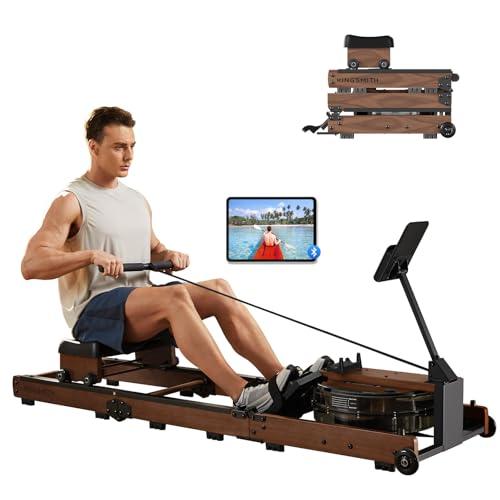
KINGSMITH water rowing machine review: triple-fold frame, 5-level water resistance, 180kg limit, Kinomap support and £499 price, plus the trade-offs to know.
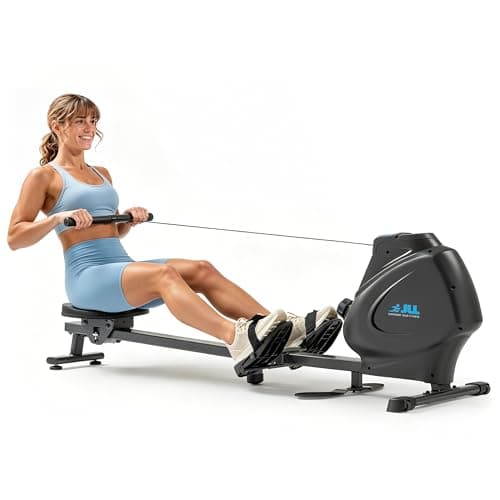
An honest JLL folding magnetic rowing machine review: how this JLL rowing machine's 16 magnetic levels, standing footplates, SunnyFit app and 130kg limit compare with JLL's water rower, the R300 and the MERACH.
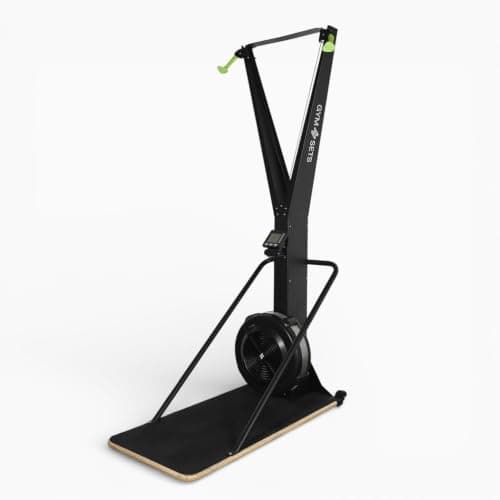
GymSets Essential Ski Erg review: £424.99 flywheel ski machine with a base and monitor, compared honestly with the Concept2 SkiErg and Half Human Air Ski.
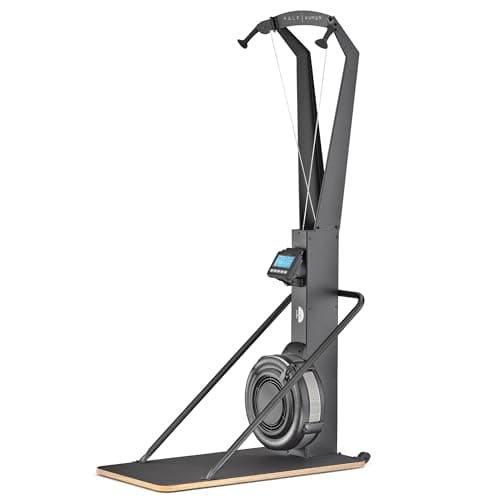
Half Human Air Ski Machine review: 10 air resistance levels, floor stand included, Bluetooth apps and a 150kg limit for £699, compared with the Concept2 SkiErg.
Best Exercise is a participant in the Amazon EU Associates Programme, an affiliate advertising programme designed to provide a means for sites to earn advertising fees by advertising and linking to Amazon.co.uk. As an Amazon Associate we earn from qualifying purchases. This comes at no extra cost to you and never influences our independent reviews or rankings.