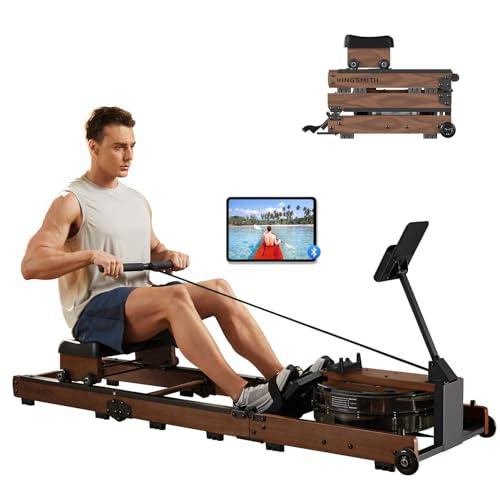
KINGSMITH is best known in the UK for the WalkingPad, the folding under-desk treadmill that made its name by packing a full machine into a space most people already have. This rower applies the same idea to water rowing, a category where the machines are famously long and only ever "fold" by standing on their end. The KINGSMITH folds three ways, down to roughly 70 x 57 x 50 cm, and the listing suggests the folded unit doubles as a small side table. At £499 it costs more than the oak water rowers we rate at around £300 and far less than a WaterRower.
The short version: it's the most compact water rower we've seen, and the 5-level resistance adjustment fixes a genuine annoyance with water machines. What you give up is the rock-solid feel of a one-piece wooden frame, and the LED monitor is the basic type. The listing is also new, so there's no long run of owner feedback to lean on yet.
How we review
This review is researched rather than hands-on. We've worked from KINGSMITH's Amazon UK listing and published specifications, compared it against the other water rowers we've reviewed, and looked at what early owners report. We haven't run this machine through a months-long test, and because the listing is so new we've flagged where the long-term picture simply isn't available yet.
Who it is for
This rower makes sense for one kind of buyer above all: someone who wants the water stroke but lives somewhere without a spare corner. A standard upright water rower still needs a clear patch of wall and close to two metres of headroom when stored, and in a flat with low ceilings or a sloped loft room that's a dealbreaker. Folded to a cube of about 70 cm, the KINGSMITH can sit beside a sofa, go under a desk or roll into a cupboard.
It suits heavier users better than most compact rowers too, because the 180kg maximum user weight is high for a folding design. If you've been put off magnetic folding rowers by limits of 100 to 120kg, that number matters.
It's a weaker choice if you already have the floor space. Our Orisyn water rowing machine review covers a solid oak machine with the same 180kg limit for around £297, and the Dripex wooden water rower costs roughly £200. Both store upright, both feel stiffer underfoot, and both leave you £200 to £300 better off.
Triple-fold design packs down to about 70 x 57 x 50 cm, far smaller than an upright water rower
5-level water resistance adjustment, rare on a water rower, so no syphoning to change the load
180kg maximum user weight is high for a folding machine
Front transport wheels and a removable seat make moving it easier
KS Fit and Kinomap app support for routes and coached sessions
Listing says no frequent water changes, no draining and no leaks when stored upright
Cons
LED monitor is basic and won't satisfy anyone training to watts or splits
Folding joints mean more frame flex than a one-piece wooden water rower
Brand-new listing with very few owner reviews, so durability is unproven
£499 is around £200 more than solid oak water rowers with the same weight limit
Around 30kg is heavy to lift despite the wheels
The fold, and why it matters
Every water rower we've reviewed handles storage the same way: you lift the front, tip the machine onto its back end and roll it against a wall. That works well enough in a house, but it leaves a tall, narrow object standing in the room, and the tank sits at the top where it's easiest to knock.
KINGSMITH's triple fold is a different approach. The rail sections fold back onto the tank unit, the seat comes off, and the result is a compact block of roughly 70 x 57 x 50 cm. That's about the size of a small bedside cabinet. The listing pitches the folded rower as a small table, and with the walnut-finish panelling that isn't as silly as it sounds, though we'd stop short of putting a cup of tea on anything containing a few litres of water and moving hinges. Unfolded, the machine measures around 185 x 57 cm on the floor, so you still need a strip about two metres long to row.
The obvious question with any folding rower is how much movement the joints add. A one-piece rail, like the oak frames on the TOPIOM water rower, has nothing to flex; a rail that folds in three places has to lock solid at each joint, and even good hinges give a little under a hard drive. We'd expect the KINGSMITH to feel slightly less planted than a wooden water rower during sprints. For steady rowing at 20 to 26 strokes a minute it's unlikely to bother most people, but if you're a heavy, powerful rower who pulls hard intervals, a fixed frame will feel more reassuring.
KINGSMITH foldable water rowing machine specifications
Resistance
Water tank with 5-level resistance adjustment
Maximum instant resistance
40 kg (KINGSMITH figure)
Water tank
44 cm
Maximum user weight
180 kg
Unfolded dimensions
Approx 185 x 57 x 30 cm (listed item size)
Folded dimensions
70 x 57 x 50 cm
Machine weight
Approx 30 kg
Storage
Triple fold, front transport wheels, removable seat
Monitor
LED with real-time workout data
Apps
KS Fit, Kinomap
Finish
Walnut
Price
£499 on Amazon UK
Resistance: water with a dial
Water rowers normally have no resistance setting. The paddles push against the water in the tank, and the harder and faster you pull, the more the water pushes back. It's why they feel so natural, but it also means the only way to make the stroke heavier or lighter is to change how much water is in the tank, which involves a syphon, a jug and a bit of mess.
KINGSMITH adds a 5-level adjuster on top of that, with a maximum instant resistance of 40kg. In practice this should let you set a light stroke for a recovery row or a warm-up and a heavier one for strength-biased pieces, all without touching the water level. Effort still drives the load, so level 1 at full power will still feel hard; the dial shifts the starting weight of the catch rather than locking you into a fixed resistance the way a magnetic brake does. That's a better compromise than the JLL water rowing machine, which bolts a separate magnetic brake onto its tank and can start to feel braked rather than fluid at high settings.
The 44cm tank is a decent size for a compact machine. A bigger tank generally gives a smoother, more continuous feel through the drive, and 44cm is in line with what you'd find on mid-range upright water rowers rather than a shrunken compromise.
Then there's maintenance. The listing says the water is "kept longer", needs no frequent changes and no draining, and won't leak when the machine is stored upright. We'd take that as meaning the tank is well sealed rather than maintenance-free: standing water in any sealed tank can cloud over time, and the usual fix is a purification tablet every few months. That's true of every water rower, including the £1,000 ones.
Monitor and apps
The LED monitor shows real-time workout data, and the listing doesn't claim much more than that. Expect the basics: time, distance, strokes, stroke rate and calories. If you train to 500m splits or watts, this isn't the machine; a Concept2 Model D is the reference for numbers you can trust and compare.
The app support helps. KS Fit is KINGSMITH's own app, and Kinomap adds scenic routes and coached sessions that make 30 minutes on a rower pass more quickly. Kinomap needs a subscription for full access, but the machine works fine without it.
Thirty minutes is a useful benchmark, as it happens. In a randomised study of post-menopausal women, three 30-minute indoor rowing sessions a week at 60 to 80% of peak heart rate for ten weeks raised peak oxygen uptake and cardiac output, with measurable improvements in rowing workload visible after six weeks. A smaller preliminary study of indoor rowing in visually impaired adults found that six weeks of training cut fat mass and body fat percentage and improved back strength. Neither study used a KINGSMITH, obviously, but they show what consistent rowing does, and a machine that lives beside the sofa rather than in the garage is one you're more likely to use consistently. The NHS asks adults for 150 minutes of moderate activity a week, which five 30-minute rows would cover.
At £499 the KINGSMITH sits in an awkward middle. Solid oak water rowers with upright storage cost around £300, and our best water rowing machine UK guide has several of them. They give you a stiffer frame, a classic look and the same basic stroke for less money. A WaterRower Classic costs roughly twice as much and buys you solid walnut, decades of proven durability and a far better resale value.
What the KINGSMITH offers that none of those do is the fold. If you've measured your space and an upright water rower simply won't fit, the extra £200 over a budget oak machine is the price of being able to own a water rower at all, and that's a fair trade. If space isn't the problem, it's poor value next to the oak alternatives. Our best foldable rowing machines guide covers cheaper magnetic options if you're flexible on the water feel.
The other caveat is time. This listing is brand new, and with only a handful of owner reviews there's no evidence yet on how the hinges, seals and seat rollers hold up after a year of use. KINGSMITH's WalkingPad record suggests a brand that supports its products in the UK, but we'd still keep the packaging until you're past the returns window.
On paper it solves the biggest problem with water rowers, which is that they're long and awkward to store. It folds to roughly 70 x 57 x 50 cm, takes users up to 180kg and lets you adjust water resistance across five levels. The weak points are a simple LED monitor and a folding frame that won't feel as solid as a one-piece wooden rower. It's a good buy for small homes, not for anyone who wants a WaterRower-style heirloom.
How small does the KINGSMITH rower fold?
KINGSMITH quotes a folded size of 70 x 57 x 50 cm, thanks to a triple-fold design. That's far smaller than the usual water rower trick of standing the machine on its end, which still needs around two metres of height. Front wheels let you roll it, though at roughly 30kg you'll want to tip it rather than lift it.
Do you have to change the water in the KINGSMITH rower?
The listing says the water is kept longer, so you don't need frequent changes or draining, and that it won't leak when stored upright. That doesn't mean zero maintenance. Every sealed water tank benefits from purification tablets every few months to keep the water clear, so budget a few pounds a year for that.
How does the 5-level water resistance work?
Most water rowers have no dial at all: resistance rises with how hard and fast you pull, and the only adjustment is adding or removing water. KINGSMITH adds a 5-level adjuster and quotes a maximum instant resistance of 40kg. It gives you a lighter or heavier stroke without syphoning water in and out, though effort still drives the load as it does on any water rower.
Does the KINGSMITH water rower work with apps?
Yes. It connects to the KS Fit app and to Kinomap, which offers scenic routes and coached sessions. Kinomap is a paid subscription for full access, but you can row with the LED monitor alone and never pay a penny beyond the machine.
Is it worth £499?
If storage space is the reason you haven't bought a water rower, yes, because nothing else at this price folds this small. If you have room for an upright wooden rower, cheaper oak machines around £300 give you a stiffer frame and a similar stroke, and the extra £200 is buying portability you won't use.
An honest JLL folding magnetic rowing machine review: how this JLL rowing machine's 16 magnetic levels, standing footplates, SunnyFit app and 130kg limit compare with JLL's water rower, the R300 and the MERACH.
GymSets Essential Ski Erg review: £424.99 flywheel ski machine with a base and monitor, compared honestly with the Concept2 SkiErg and Half Human Air Ski.
Half Human Air Ski Machine review: 10 air resistance levels, floor stand included, Bluetooth apps and a 150kg limit for £699, compared with the Concept2 SkiErg.
Orisyn water rowing machine review: FSC oak frame, a 180kg limit, Bluetooth stats, upright storage for about £297, plus the catches of a lesser-known brand.
Best Exercise is a participant in the Amazon EU Associates Programme, an affiliate advertising programme designed to provide a means for sites to earn advertising fees by advertising and linking to Amazon.co.uk. As an Amazon Associate we earn from qualifying purchases. This comes at no extra cost to you and never influences our independent reviews or rankings.