Treadmills
Non-Electric Treadmill: Manual vs Curved, Pros, Cons and Who Should Buy
Non-electric treadmills explained: cheap flat manual models vs £2,000+ curved self-powered machines, how each compares with motorised ones, and who should buy.

By Paul Kendrick, Cardio & Endurance Editor · Updated 7 October 2026
To lubricate a treadmill, unplug it, loosen the belt slightly, apply 100% silicone treadmill lubricant to the deck underneath the centre of the belt on both sides, then run it at a slow walking pace for a few minutes to spread it before re-tightening and centring the belt. The whole job takes about 10 minutes and costs around £10 in lube. Most home treadmills need it every three months or so, but your manual has the final say, and a few decks are pre-waxed and shouldn't be touched at all.
It's the one bit of maintenance that genuinely decides how long a treadmill lasts, and it's also the one most owners skip until something starts squeaking. Here's how to do it properly.
The running belt doesn't float. Every stride presses it down onto a flat deck board, and the motor has to drag that belt across the deck thousands of times a session. A thin film of silicone between the two keeps the friction low.
When that film wears off, a few things go wrong at once. Friction climbs, so the motor draws more current to hold the same speed, which heats the motor and the motor control board. The underside of the belt starts to scuff and glaze. And the belt can begin to hesitate under your foot strike, which you'll feel as a tiny stutter every time you land. Leave it long enough and you'll often notice a sluggish start, a louder motor or a faint burning smell before anything actually breaks.
Motors and control boards are the expensive parts. A bottle of silicone is not. That's the whole argument.
Read your manual before anything else. Manufacturers set the interval for their own deck and belt, and lubricating on the wrong schedule (or with the wrong product) can void a warranty.
Without the manual to hand, these are sensible starting points:
Some decks should NOT be lubricated
Certain treadmills and walking pads use a pre-waxed or "maintenance-free" deck, where the lubricant is built into the board's surface. Adding silicone on top can gum up that coating and make the belt slip. If your manual says the deck is pre-waxed, or says not to lubricate, believe it and leave it alone.
The most reliable test takes 30 seconds. Unplug the treadmill, lift the edge of the belt halfway along the deck and slide your fingers underneath onto the deck surface. A healthy deck feels slightly slick and leaves a faint waxy residue on your fingertips. A dry deck feels like bare laminate.
Other symptoms point the same way:
Don't confuse belt slip with a dry deck, though. If the belt slips but the deck still feels slick, the belt probably needs tightening rather than lube. Over-lubricating a deck that's already fine makes slipping worse, not better.
Use 100% silicone treadmill lubricant. That's the short answer, and it's the one almost every manufacturer gives. NordicTrack specifically says to use silicone-based treadmill lubricant and to avoid standard oil or grease.
What you should never use:
The best option is always the lubricant your manufacturer sells or names in the manual. If it's out of stock or no longer made, a pure silicone treadmill oil does the same job. Two we've checked are 100% silicone and currently in stock on Amazon UK:
We've assessed these on their listed ingredients and specs rather than testing them on a deck ourselves. Either will do the job; what matters far more is the type of lubricant and how much you use.
You'll need the silicone lube, an Allen key that fits your rear roller bolts (usually supplied with the treadmill), and a dry lint-free cloth.
Belt tension check
A properly tensioned belt usually lifts about 5 to 7cm at the centre of the deck on most home treadmills, but check the figure in your manual. Too tight strains the motor and the roller bearings; too loose and the belt slips under your foot.
Less than you think. The aim is a thin film across the deck, not a puddle. As a rough guide, a full-size home treadmill takes a few short squeezes per side, while a walking pad needs maybe half of that.
If you're unsure, start small. You can always add a little more after walking it in and re-checking with your fingers. Taking excess out is far more annoying, because it means wiping under the belt and running the machine until the surplus works its way to the edges.
Using the wrong product. This is the big one. WD-40 and petroleum-based sprays feel like they're working for a day or two, then the belt starts to drag and the deck gets sticky. It can cost you a belt, and sometimes the deck as well.
Lubricating a pre-waxed deck. If the manual says maintenance-free, adding silicone won't help and can make things worse.
Squirting lube on top of the belt. It goes underneath, between belt and deck. On top, it's just a slip hazard.
Uneven bolt turns. Loosening one side three turns and the other side one turn is the fastest way to a belt that wanders and frays against the side rails.
Overtightening to fix a hesitating belt. If the belt stutters because the deck is dry, cranking the bolts won't fix it. It just loads up the motor and bearings. Check the deck first.
Never checking at all. Plenty of the faults covered in our guide to treadmill mistakes to avoid come down to maintenance that nobody did. Put a reminder in your phone for every three months.
Walking pads need the same care, arguably more. Their motors are small and their decks are short, so a dry belt shows up quickly as noise and strain. Plenty come with a small bottle of silicone in the box, which tells you the manufacturer expects you to use it.
The process barely changes. Most have two hex bolts at the rear, a belt you can lift by hand, and a deck that needs a lighter dose than a full-size machine. If you use yours for several hours a day under a desk, check the deck monthly rather than quarterly, because those hours add up faster than most running routines. If you're still choosing one, our guide to the best walking pads in the UK compares the current options.
Also think about where it sits. A treadmill on thick carpet pulls fibres and dust into the underside of the belt, which mixes with the silicone and grinds away at the deck. A firm mat helps, and we've covered the details in our guide to using a treadmill on carpet.
Since the belt's already loose and the machine's unplugged, it's worth a five-minute once-over:
Better-built treadmills tolerate neglect for longer, but none of them tolerate it forever. Even a premium folding machine like the one in our Sole F80 review still needs its deck checked and lubricated on schedule. If you're shopping for a new machine, our best treadmills for home use guide covers the models that hold up best.
Check your manual first, because it overrides any general rule. As a rough guide, most home treadmills need lubricating every three months or roughly every 130 to 250 miles (about 40 to 50 hours of running), whichever comes first. NordicTrack's UK guidance, for example, says every three months or 130 miles. Light walkers can often stretch it further, but check under the belt at least every three months.
Use a 100% silicone treadmill lubricant, ideally the one your manufacturer specifies. Don't use WD-40, household oils, grease or hardware-shop silicone sprays that contain petroleum distillates, because they can break down the belt and deck coating and attract dirt into the gap.
Yes. Too much silicone pools at the edges of the deck, collects dust and can make the belt slip on the rollers. If you see lube seeping out from the sides or the belt starts hesitating under your foot, wipe off the excess with a dry cloth and run the belt for a few minutes before using it again.
Most do, and many ship with a small bottle of silicone in the box. Walking pads have short decks and small motors, so a dry belt strains them quickly. The method is the same as a full-size treadmill, just with less lube. Some models are sold as maintenance-free, so read the manual before adding anything.
Unplug the machine, lift the edge of the belt and run your fingers along the deck underneath. If it feels dry and leaves no slick residue on your fingertips, it needs lubricating. Other signs are a squeak or rubbing noise, the motor labouring at low speeds, a burning smell, or the belt hesitating each time your foot lands.
Non-electric treadmills explained: cheap flat manual models vs £2,000+ curved self-powered machines, how each compares with motorised ones, and who should buy.
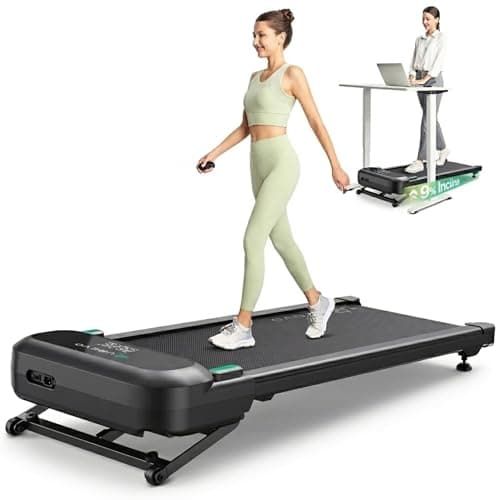
Our honest UREVO SpaceWalk 5L walking pad review: 9% auto incline, dual brushless motor, 136kg limit and a narrow 40x100cm deck, for £349.99 on Amazon UK.
Walking pad vs treadmill compared on deck size, top speed, motor, incline, weight limit, storage and UK price, with a clear verdict on which one to buy.
What a curved treadmill is, how the self-powered slat belt works, what research says about calorie burn vs motorised treadmills, and whether one suits you.
Best Exercise is a participant in the Amazon EU Associates Programme, an affiliate advertising programme designed to provide a means for sites to earn advertising fees by advertising and linking to Amazon.co.uk. As an Amazon Associate we earn from qualifying purchases. This comes at no extra cost to you and never influences our independent reviews or rankings.