Treadmill Mat: Do You Need One, What Size and How Thick?
By Jack Atkins, Home Gym Equipment Specialist · Updated 31 October 2026
Do you need a treadmill mat? Not strictly, because a treadmill will run on a bare floor, but a mat costs £15 to £40 and solves several slow, expensive problems at once. On carpet it keeps fibres and dust away from the motor and stops the frame sinking unevenly. On wood, laminate or vinyl it stops scratches, rubber marks and lube drips, and it takes some of the edge off the vibration that reaches whoever lives downstairs. Buy one that's bigger than the base of your machine, 4mm thick for hard floors or 6mm for carpet, and you're covered.
The rest of this guide covers when a mat really matters, how to measure for one, which thickness and material to pick, and what's different for walking pads.
Do you actually need a treadmill mat?
It depends on the floor, so we've split it that way.
On carpet
This is where a mat matters most. Treadmills pull cooling air in near the floor, and deep pile closes that gap while the belt and fan draw in fluff, pet hair and dust. Sole's F63 manual tells owners to vacuum underneath the treadmill every month because dirt there "can get sucked up" into the parts under the motor cover, and it warns against using the machine on deeply padded, plush or shag carpet at all, saying damage to both carpet and treadmill may result (Sole F63 owner's manual). A mat gives you a smooth surface you can actually vacuum and a level base for the feet.
Carpet also builds static with a moving belt and rubber-soled trainers, and it takes deep dents from the feet. We've covered all of this in detail, including when you need a plywood board under the mat, in our guide to putting a treadmill on carpet.
On hard floors
People often skip the mat on hard floors because there's no fluff to worry about, and that's usually a mistake. The risks are different but just as real:
Scratches and dents. A treadmill shifts a few millimetres with every footstrike, so the feet slowly grind grit into wood and laminate.
Rubber marks. Rubber feet and rear rollers can leave dark marks or yellowish stains on vinyl, LVT and light-coloured floors that don't scrub off.
Belt dust and lube. Sole's manual notes that black dust from the belt sometimes appears on the floor behind the treadmill and calls that normal. Add the odd drip of silicone lube from the edges of the deck and a light floor will show it within weeks.
Noise and vibration. Footfall noise travels through the floor structure rather than through the air. Horizon's treadmill user guide points out that a wood floor reverberates more than carpet over concrete and says a heavy rubber mat can help reduce reverberation through the floor (Horizon Series treadmill user's guide).
A thin PVC mat handles the first three. For the fourth, especially in a flat or an upstairs room, you'll want something thicker and denser (more on that below).
What about the warranty?
We checked manuals from Sole and Horizon and neither makes a mat a condition of the warranty, so we won't tell you a mat protects your cover. What the Sole manual does say is that carpet type and dirt build-up can cause damage, and a warranty assessor will read the same manual you have. Check yours for wording about carpet, air vents and floor protection before you set up.
How to measure for a treadmill mat
The commonest mistake is buying a mat that's a few centimetres short. The rear rollers end up half on and half off, the deck sits at a slight angle, and you've made things worse than no mat at all.
Measure the base, not the handrails. Run a tape along the longest point of the frame that touches the floor, from the front wheels or feet to the rear rollers. Then measure the widest point at floor level. Upright rails and console arms can be wider than the base, and the mat only needs to cover what sits on the floor.
Add about 15cm to both numbers. That leaves roughly 7cm on each side, enough to catch drips and keep the feet well away from the edge.
Check the folded position. If you fold the treadmill and roll it on its wheels, make sure those wheels still land on the mat when it's upright.
Keep the clearance behind it. Sole asks for at least 3.5 feet (about 1.1m) clear behind the treadmill. The mat doesn't change that, so don't push the machine back to the wall to fit a smaller mat.
As a rough guide, walking pads need about 150 x 75cm, most folding treadmills need around 180 x 80cm, and large non-folding machines often need 200 x 100cm or more. NordicTrack's own large equipment mat is 216 x 107cm in vinyl (NordicTrack UK floor mat), which tells you how big a long-deck running machine can get.
How thick should a treadmill mat be?
Thickness should follow the floor, not the price.
Mat
Best for
Watch out for
4mm PVC
Hard floors, tight loop carpet
Does little for noise; feet can press through medium pile
6mm PVC
Most carpet, walking pads, general use
Plastic smell for a week or two
10mm+ dense rubber
Upstairs rooms, flats, heavy machines
Heavy, pricier, strong smell at first
EVA foam jigsaw tiles
Floor exercise areas, not treadmills
Dents under the feet, joins separate
On a hard floor a 4mm mat is all the protection you need. On carpet, 6mm is the sweet spot because it spreads the load from each foot without letting the machine rock. Going thicker only helps if the mat is dense; a thick, soft mat lets the feet sink at different rates, which is exactly the wobble you were trying to avoid.
PVC, rubber or foam?
PVC covers most mats under £40. It's firm, waterproof and easy to wipe, and it's what NordicTrack uses for its own mat. The downsides are a plastic smell when new and corners that curl after weeks folded in a box. Unroll it in a warm room for a day or two before the treadmill goes on.
Rubber is heavier, grips better, damps more vibration and shrugs off dents. It's the one to pay for if you're upstairs or in a flat, though a large rubber mat is a two-person job to move. Some black rubber can transfer colour onto very light carpet, so check the listing.
EVA foam tiles are the one to avoid directly under a treadmill. They're light and cheap, but they compress permanently under the feet and creep apart with vibration. If you're kitting out a whole room, look at proper rubber gym flooring instead and put the treadmill on that.
Walking pad mats
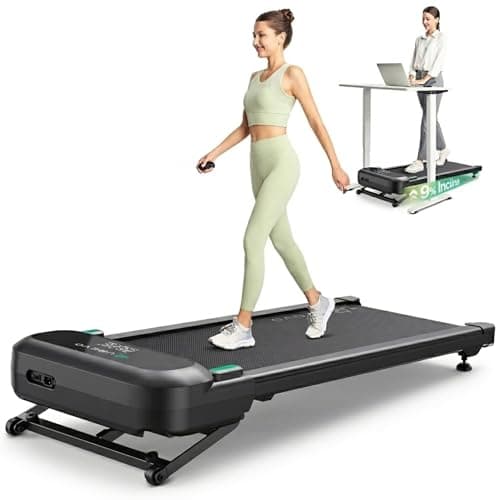
Walking pads need a mat at least as much as a full-size treadmill does. The whole machine sits only a few centimetres off the floor, so on carpet the motor housing is almost in the pile, and on hard floors the thin frame passes more vibration straight into the boards. A flat 6mm mat around 150 x 75cm suits nearly every walking pad we've covered, including the MERACH 12% incline walking pad.
If your pad lives under a desk, check the mat fits between the desk legs and that the desk can still go high enough with the extra few millimetres. Our guide to setting up a walking pad under a desk covers desk height and positioning.
Two treadmill mats worth buying
We haven't tested these mats ourselves. We chose them from Amazon UK listings by size, thickness and stock, and both were in stock when we checked on 31 October 2026.
For full-size treadmills on hard floors: the OZE SPORTS treadmill mat is 180 x 75cm and 4mm thick. With our 15cm margin it suits a base up to about 165cm long and 60cm wide, which covers plenty of folding treadmills. Measure first: wider machines need a 200 x 100cm mat, and on thick carpet you'd want 6mm.
For walking pads and compact treadmills, or any carpet: the HAPBEAR treadmill mat is 152 x 76cm and 6mm thick, which fits a base up to roughly 137 x 61cm. That's most walking pads and smaller folding machines, and the extra thickness suits carpet.
For a long-deck running machine such as the Sole F80, measure carefully; you'll probably need a 200 x 100cm mat or a brand mat like NordicTrack's.
Common mistakes
Buying by treadmill name rather than measurement. Listings say "fits most treadmills", but a few centimetres matter.
Leaving a curled mat to flatten under the machine. It won't flatten evenly. Let it relax first, then level the treadmill on top.
Forgetting to re-level. Once the mat is down, push on each corner and adjust the feet until nothing rocks, then check belt tracking at walking pace.
Never cleaning under it. Lift the front, vacuum the mat and the floor every month or so, and while you're down there check whether the belt needs attention. Our guide on how to lubricate a treadmill shows how.
Quick answer
Hard floor: 4mm PVC, 15cm bigger than the base. Carpet or walking pad: 6mm. Upstairs or flat: 10mm+ dense rubber. Never foam tiles.
You don't strictly need one, but for £15 to £40 it's the cheapest protection you can buy. On carpet it keeps the motor area away from fibres and dust and stops the feet sinking unevenly. On hard floors it prevents scratches, rubber marks and lube stains, and it takes a little of the edge off vibration travelling into the floor.
What size treadmill mat do I need?
Measure the base of your treadmill at its longest and widest points, including the feet, rear rollers and front wheels, then add about 15cm to each measurement. Most walking pads suit a mat around 150 x 75cm, typical folding treadmills need around 180 x 80cm, and big non-folding machines often need 200 x 100cm or more.
Is a 4mm or 6mm treadmill mat better?
On hard floors and tight loop carpet, 4mm is enough to stop scratches and marks. On most bedroom and lounge carpet, go for 6mm, which spreads the load of the feet better and keeps the frame level. If the treadmill is upstairs and noise is the main worry, a dense rubber mat of 10mm or more does more than either.
Do walking pads need a mat?
Yes, a walking pad arguably needs one more than a big treadmill. The motor housing sits only a few centimetres off the floor, so on carpet it's close to the pile, and on hard floors the thin frame transmits more vibration. A flat 6mm mat around 150 x 75cm suits most walking pads.
Why does my new treadmill mat smell?
Most budget treadmill mats are PVC, and a new one gives off a plastic smell for the first week or two. Unroll it in a warm, ventilated room for a day or two before the treadmill goes on, which also lets any curled corners flatten. Rubber mats can smell even stronger at first, but it fades in the same way.
Can I use interlocking foam tiles under a treadmill?
We wouldn't. Soft EVA foam tiles are fine for floor exercises, but the feet of a 30kg to 130kg treadmill press permanent dents into them and the joins can creep apart under vibration. A one-piece PVC or rubber mat is firmer and stays put.
Buying a treadmill with a screen in the UK? Built-in touchscreens vs a tablet with Kinomap or Zwift, iFIT and Peloton costs, auto incline and lock-in risk.
Non-electric treadmills explained: cheap flat manual models vs £2,000+ curved self-powered machines, how each compares with motorised ones, and who should buy.
Our honest UREVO SpaceWalk 5L walking pad review: 9% auto incline, dual brushless motor, 136kg limit and a narrow 40x100cm deck, for £349.99 on Amazon UK.
Walking pad vs treadmill compared on deck size, top speed, motor, incline, weight limit, storage and UK price, with a clear verdict on which one to buy.
Best Exercise is a participant in the Amazon EU Associates Programme, an affiliate advertising programme designed to provide a means for sites to earn advertising fees by advertising and linking to Amazon.co.uk. As an Amazon Associate we earn from qualifying purchases. This comes at no extra cost to you and never influences our independent reviews or rankings.