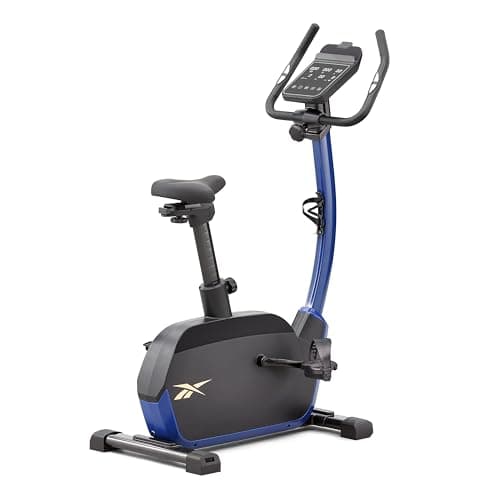
The Reebok FR30 is an upright exercise bike for people who want the console to do more of the work. Where most bikes at this price give you a tension dial and a basic LCD, the FR30 runs 32 levels of computer-controlled magnetic resistance from a touchscreen, with 28 programmes, pulse grips, Bluetooth and support for Zwift and Kinomap. At £399 on Amazon when we checked, it sits at the top of the mainstream upright bracket rather than the budget end.
Our short verdict: it is a well-thought-out bike for seated cardio, and the electronic resistance and programme range are what you are paying for. The compromises are a 120kg user limit and a 9kg flywheel, both fine for most riders but worth knowing about if you are heavy or want to stand and sprint.
One naming note before we start. Reebok uses the FR30 badge on several machines, and we have already reviewed the Reebok FR30z treadmill. This review is about the upright bike only.
How we review
We have not ridden this bike ourselves. This review is built from Reebok's published specifications, the full Amazon UK listing, UK retailer product information and recurring themes in owner feedback. Where a detail is not published (such as whether apps can control the resistance), we say so rather than guess.
The FR30 makes most sense for someone who will ride three or four times a week, mostly seated, and who gets bored pedalling at one fixed level. The 18 pre-set programmes change the resistance automatically, the heart rate programmes adjust to your pulse, and the four user slots let different people in the house save their own sessions. If you want to follow scenic routes or ride with others on a tablet, the Kinomap and Zwift support is the extra hook.
It is a weaker fit for two groups. Riders over 120kg should look elsewhere, because the weight limit is firm. And anyone who wants out-of-the-saddle climbs and studio-style intervals will be better served by a spin bike with a heavier flywheel and a road-bike position. If you are still deciding on bike type, our upright exercise bike guide covers what an upright does well and where it falls short.
Pros
32 levels of computer-controlled magnetic resistance, changed from the console rather than a knob
28 programmes including 18 presets, 3 heart rate control modes and 4 user profiles
Bluetooth with Zwift and Kinomap compatibility, plus a built-in tablet holder
Gel seat adjusts vertically and horizontally, so fit is easier to get right
Compact 110cm by 55cm footprint with transport wheels
Magnetic resistance runs quietly, which suits flats and early mornings
Cons
120kg maximum user weight is lower than some similarly priced rivals
9kg flywheel is adequate for seated riding but not for hard standing efforts
Needs a nearby power socket because the resistance is electronic
Pulse grip heart rate is rough and ready compared with a chest strap
The listing does not confirm whether Zwift can control resistance automatically
Resistance and ride feel
The headline feature is the resistance system. Instead of turning a tension knob by feel, you pick a level from 1 to 32 on the console, and the programmes move it for you. Thirty-two steps is a lot of range for an upright, and it means the jumps between levels are small, which makes it easier to nudge effort up without suddenly grinding to a halt.
Because the resistance comes from magnets that never touch the flywheel, there are no pads to wear out and very little noise beyond the drive and your own breathing. That is a big part of why magnetic uprights suit shared homes. If quiet operation is your main concern, our quiet exercise bike guide goes into what makes the biggest difference.
The 9kg flywheel is where the FR30 is merely average. On a magnetic upright, the magnets set how hard the workout is; flywheel weight mostly affects how smooth the pedal stroke feels as you spin faster. For seated riding at normal cadence, 9kg is perfectly serviceable. It will feel less planted than a heavy spin bike if you try sprints at high cadence, and it is not designed for standing climbs at all.
The console is a six-window LED display with touch controls, showing speed, time, distance, calories, heart rate and RPM. That is a more legible layout than the single cycling readout on cheaper bikes, and the illuminated bezel helps in a dim garage or spare room.
The programme list is the FR30's strongest argument against cheaper uprights. You get three manual target modes (ride to a set time, distance or calorie figure), 18 preset profiles, three heart rate control programmes and four user-defined slots. There is also a recovery mode, which measures how quickly your pulse drops after a session, and a body fat test using the grips. Treat both as a rough trend indicator rather than a measurement.
The heart rate control programmes deserve a sensible caveat. Pulse grips need you to hold the handles steadily, and readings from palm sensors drift when your hands are sweaty or moving. They are good enough to keep you in roughly the right zone, but if you want to train by heart rate properly, a chest strap is far more reliable. If you are new to zones, the British Heart Foundation has a clear explainer on heart rate and exercise that covers the basics.
On apps, Reebok lists Zwift and Kinomap compatibility over Bluetooth, and the integrated holder takes a tablet or phone. What the listing does not spell out is whether those apps can set the resistance on the bike for you (so a virtual hill gets harder automatically) or simply read your data. If that matters, ask the seller before buying. For a wider look at screen and app options, see our exercise bike with screen guide.
Fit, comfort and build
The gel seat adjusts up and down and forwards and backwards, which is more useful than it sounds. Fore and aft adjustment lets you put your knee in a better position over the pedal, and it is often missing on cheaper uprights. The saddle height range is 61cm to 87cm. Getting that height right matters more than almost anything else for knee comfort: aim for a very slight bend in the knee at the bottom of the stroke.
The pedals are self-levelling with adjustable straps, the handlebars adjust, and there is a water bottle holder and floor levellers to stop it rocking on an uneven surface. At 35kg built, it is solid enough to stay put without being a nightmare to shift, and the front wheels mean you can tip it and roll it to a corner.
The 120kg maximum user weight is the build spec we would flag. It is a reasonable figure for many households, but some bikes at a similar price are rated higher. If you are near the limit, the extra headroom of a higher-rated frame is worth paying for.
Value and alternatives
At £399 the FR30 is not cheap for an upright. Plenty of magnetic bikes at £200 to £300 will give you a solid seated workout with manual resistance and a basic display. What the FR30 adds is electronic resistance, a real programme library, heart rate control and app support from a familiar brand, all in one package. If you will actually use the programmes, that is good value; if you know you will just pick a level and ride, a cheaper bike does the same job.
The FR30 has appeared at different prices across UK retailers, so it is worth comparing before you buy. To see how it stacks up against the rest of the market, our best exercise bike UK guide compares the strongest options at each budget, and the exercise bikes hub collects every bike we have reviewed.
Is a bike like this worth it for fitness?
For most adults, regular sessions on a bike like this are an easy way to hit the NHS recommendation of at least 150 minutes of moderate activity a week. The evidence for indoor cycling is encouraging too: a systematic review of indoor cycling studies found it may improve aerobic capacity, blood pressure, blood lipid profile and body composition. The machine itself matters less than whether you keep using it, and a console that varies the workout is one of the better ways of avoiding boredom.
Yes, for seated home cardio it is one of the better-equipped uprights around £400. You get 32 levels of computer-controlled magnetic resistance, 28 programmes, Bluetooth with Zwift and Kinomap compatibility and a gel seat that adjusts both up and down and fore and aft. The limits are a 120kg maximum user weight and a 9kg flywheel, which is fine for seated riding but not built for standing sprints.
Does the Reebok FR30 bike work with Zwift?
Reebok lists the FR30 as compatible with Zwift and Kinomap over Bluetooth, and there is a tablet holder on the console. The listing does not say whether Zwift can change the resistance for you on climbs, so if automatic resistance control matters to you, check that with the retailer before you buy.
Is the Reebok FR30 bike the same as the Reebok FR30z treadmill?
No. The FR30 name is used across several Reebok machines, including this upright bike, a cross trainer and the FR30z treadmill. They share branding and a similar console style, but they are entirely different products, so check the listing title before you order.
What is the weight limit on the Reebok FR30 exercise bike?
Reebok rates it for a maximum user weight of 120kg. That covers most riders, but if you are close to that figure a bike rated to 136kg or more will give you more margin and usually a stiffer frame.
Does the Reebok FR30 bike need to be plugged in?
The resistance is computer-controlled rather than set by a manual knob, which means the console and resistance motor need power. Plan to put it within reach of a wall socket rather than assuming it will run on its own.
How much space does the Reebok FR30 bike take up?
Reebok gives the footprint as 110cm long and 55cm wide, with a height of 145cm. It weighs 35kg, and front transport wheels make it manageable to move around once it is built.
The best foldable exercise bike for UK homes, from budget mini pedallers to a 140kg-rated smart bike and a comfy recumbent. Folded sizes, weight limits and honest downsides.
An honest review of the 2026 Toputure Smart Exercise Bike at £199.99: 32-level electromagnetic resistance, app control, the sub-20dB claim and who it suits.
What makes an exercise bike noisy, which types are quietest for flats and upstairs rooms, how to stop vibration through the floor, and how to fix squeaks.
What an upright exercise bike is, how it differs from spin, recumbent and air bikes, the specs that matter, UK price tiers and the mistakes to avoid.
Best Exercise is a participant in the Amazon EU Associates Programme, an affiliate advertising programme designed to provide a means for sites to earn advertising fees by advertising and linking to Amazon.co.uk. As an Amazon Associate we earn from qualifying purchases. This comes at no extra cost to you and never influences our independent reviews or rankings.