Exercise Bikes
Upright Exercise Bike: What It Is, Who It Suits and What to Buy
What an upright exercise bike is, how it differs from spin, recumbent and air bikes, the specs that matter, UK price tiers and the mistakes to avoid.

By Paul Kendrick, Cardio & Endurance Editor · Updated 31 October 2026
The quietest exercise bike for a flat is one with magnetic resistance and a belt drive, set up on a dense rubber mat and ridden seated. That combination removes the two noises that cause most complaints: rubbing and clatter from the bike itself, and thudding vibration through the floor. If you live above someone, the second matters more than the first, and no bike fixes it on its own.
Below we break down what actually makes a bike noisy, why the decibel claims on listings don't mean much, how to stop vibration reaching the flat below, and the five-minute maintenance jobs that kill most squeaks.
There are really two separate problems here, and people often blame the wrong one.
Airborne noise is what you hear in the room: the whirr of the flywheel, the swish of a fan, a squeaky pedal, the beep of a console. It travels through the air and gets dampened by walls and doors fairly well.
Impact and vibration noise is the low thud that travels through the structure of the building. Every pedal stroke pushes the bike into the floor, and if you stand up and sprint, your bodyweight lands on it in rhythm. On a timber floor that energy goes straight into the joists and comes out as a dull drumming in the room below. This is why someone downstairs can complain about a bike you think is silent.
UK building regulations treat sound between flats as a specific design problem (it's the subject of Approved Document E: Resistance to sound), but older conversions and many rentals were built long before current standards. If you're in a converted Victorian house, assume the floor will carry vibration well and plan around it.
This is the biggest single factor in how loud a bike is in the room.
Almost every decent home bike now uses a belt, and for good reason. A poly-V or flat belt runs with a faint hum, whereas a chain clicks over the sprockets, needs oiling and gets noisier as it stretches. If you're looking at a cheap or second-hand bike with a chain, that alone is a reason to walk away for flat use.
A heavier flywheel carries more momentum, so the pedal stroke stays smooth instead of surging and stalling. That smoothness matters for noise too: an uneven stroke makes the whole bike rock slightly on its stabilisers, and rocking is exactly what turns into knocking on a floor. A heavier frame also stays planted. Light, cheap uprights and folding X-frame bikes are the worst offenders for wobble. Our spin bike vs exercise bike guide explains the differences in build between the types.
You'll see "under 20dB", "under 15dB" and even "10dB" on exercise bike listings. We don't quote these as fact, and you shouldn't buy on them either. They almost never say how far from the bike the reading was taken, at what cadence, at what resistance, or with what rider weight, so there's no way to compare one claim with another. They also only describe airborne noise, never the vibration you're sending into the floor.
What's more useful is knowing what the threshold looks like from your neighbour's side. Under the UK government guidance on how councils deal with noise nuisance, councils can issue warning notices for noise between 11pm and 7am above a permitted level of 34dBA (measured inside the complainant's home) where background noise is 24dBA or lower, or 10dBA above background where it's higher. Councils can also act on statutory nuisance at any time of day. A quiet bike is unlikely to get you near that, but a thumping one late at night could cause a dispute long before anyone gets a meter out, so courtesy is the real standard to aim for.
These fixes cost little and make more difference in a flat than swapping bikes.
The two-minute test
Ask someone to stand in the room below (or next door) while you ride for a minute seated, then a minute standing. You'll learn more about your setup from that than from any spec sheet, and you'll know exactly which sessions to keep to daytime hours.
Most "my bike has got louder" problems are loose or dry parts, and they're quick to fix with an Allen key set and some grease.
For a flat, we'd look at a magnetic, belt-driven spin bike with a heavy flywheel and a solid frame. The JOROTO X2 is our default pick: an 18kg flywheel, magnetic resistance, a belt drive and a 160kg user limit for around £255 at the time of our review.
Check the JOROTO X2 price on AmazonThe Sunny SF-B1805 has a 20kg flywheel and the same no-contact magnetic resistance, though it costs more and has no console. The JLL IC400 Pro pairs a 22kg flywheel with magnetic resistance and a poly-V belt, but it was showing as unavailable on Amazon UK when we last checked, so treat it as one to watch. If your budget is tighter, our best exercise bike under £200 roundup covers cheaper options; just check each one is magnetic and belt-driven before you buy.
| Factor | Quietest choice | Avoid |
|---|---|---|
| Resistance | Magnetic (manual or electromagnetic) | Air fan, worn felt pad |
| Drive | Belt | Chain |
| Frame | Heavy, stable, levelled | Light frames that rock |
| Floor | Dense rubber mat plus anti-vibration pads | Bare floorboards |
| Riding at night | Seated, steady cadence | Standing sprints and climbs |
A bike with magnetic resistance and a belt drive is the quietest type you can buy. The magnets never touch the flywheel, so there's no rubbing, and a belt runs almost silently compared with a chain. Air bikes are the loudest, because their resistance comes from a fan that gets noisier the harder you pedal.
Yes, as long as you deal with vibration as well as mechanical noise. Put the bike on a dense rubber mat, level the stabilisers so it doesn't rock, and stay seated rather than doing standing sprints late at night. Your downstairs neighbours are far more likely to hear thumping through the floor than the hum of the flywheel.
Treat them as marketing. Listings rarely say how the figure was measured (how far away, at what cadence or resistance), so you can't compare one bike's claim with another's. A magnetic belt-drive bike genuinely is quiet, but the number on the box tells you very little.
The usual causes are a loose pedal, a loose crank bolt, a dry seat post or saddle clamp, and on friction bikes a worn or glazed felt pad. A click once per pedal revolution almost always points to the pedals or cranks. Tighten everything, grease the seat post and check the pedal threads before assuming anything is broken.
Mechanically they can be equally quiet if both use magnetic resistance and a belt. Spin bikes are heavier, which keeps them planted, but they invite out-of-the-saddle efforts that thump through the floor. Upright bikes keep you seated, which helps in a flat, though lighter ones can rock if they aren't levelled.
What an upright exercise bike is, how it differs from spin, recumbent and air bikes, the specs that matter, UK price tiers and the mistakes to avoid.
Exercise bikes with moving arms explained: air bikes, dual-action uprights, recumbent cross trainers and desk pedallers, what the research says and who each one suits.
Buying an exercise bike with a screen in the UK? LCD console vs tablet holder vs built-in HD touchscreen, Peloton membership costs, BYO-tablet apps and price bands.
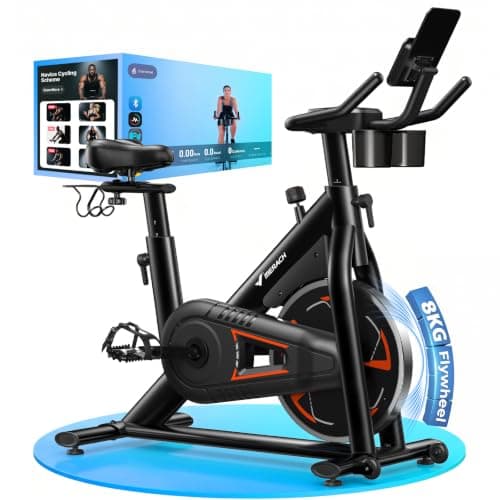
Our MERACH H-Frame exercise bike review: 8kg flywheel, 8 magnetic levels, 150kg limit, apps and Zwift support, and who should buy it at around £260.
Best Exercise is a participant in the Amazon EU Associates Programme, an affiliate advertising programme designed to provide a means for sites to earn advertising fees by advertising and linking to Amazon.co.uk. As an Amazon Associate we earn from qualifying purchases. This comes at no extra cost to you and never influences our independent reviews or rankings.