Home Gym
How Long Should a Skipping Rope Be? Sizing Chart by Height
How long should a skipping rope be? A height to rope length chart in cm and feet, the stand-on-it test, and how to shorten an adjustable rope properly.

By Jack Atkins, Home Gym Equipment Specialist · Updated 6 November 2026
We may earn a commission from qualifying purchases made through links on this page, at no extra cost to you. This never affects our ratings.
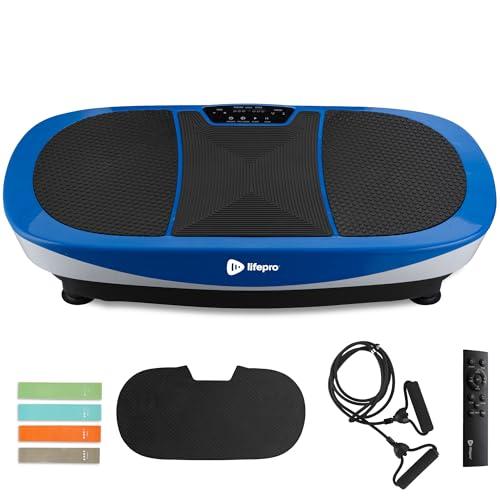
The LifePro Rumblex Max is the newest triple motor plate in LifePro's range, and at £299.99 it's now the cheapest one too. You get three motors, 99 speed levels, 7 vibration modes, 16 preset programmes and a 226kg user rating, which on paper is more control than the Rumblex Plus 4D offered at £349.99. Our verdict: this is the Rumblex to buy if you want one, with two caveats. The deck is noticeably narrower than its siblings, and the health claims on the listing are much bigger than the science behind them.
There's also a practical point. When we checked Amazon UK for this review, both the Rumblex Plus and the Rumblex 4D Pro showed as currently unavailable, while the Max was in stock (with a low stock warning). For a lot of buyers that settles the choice before any spec comparison starts.
How we review
This is a research-based review. We've worked from LifePro's Amazon UK listing, a UK retailer's published spec sheet for the same model, our existing reviews of the Rumblex Plus and 4D Pro, and the peer reviewed research on whole body vibration. We haven't tested this unit ourselves, so where a spec isn't confirmed by more than one source we say so.
Three independent motors drive the platform. LifePro describes them as producing oscillating, pulsating and lateral movement, which you can run separately or combined across 7 modes. Retail spec sheets put the motors at 300W, 30W and 300W (630W in total, which matches the Amazon title), with an amplitude of 0 to 10mm and a frequency range of 6 to 14Hz.
That frequency range is worth pausing on. Oscillating plates that rock side to side typically work at these lower frequencies, and that's fine for balance and gentle movement work. Research protocols vary widely in frequency and amplitude, so don't assume the outcomes in those studies transfer directly to a home plate like this one. Nobody has trialled the Rumblex Max specifically.
The 99 speeds and 16 programmes are where the "Max" earns its name. In practice, owners of every LifePro plate tend to settle on three or four speeds and stop exploring. The preset programmes are more useful than the speed count, because they vary intensity over a 10 minute block without you having to stab at the remote mid-squat.
Check the LifePro Rumblex Max price on AmazonLifePro's listed dimensions are 78 x 40 x 14cm and the unit weighs about 21kg. Compared with the Plus (around 75 x 46cm and 18.3kg), the Max is slightly longer, a good 6cm narrower front to back, and heavier. The extra length helps with a wide squat stance. The narrower depth matters more if you want to do press-up holds or planks with your hands on the deck, because there's less room to place them without your wrists hanging over the edge. If you mainly stand on it, you won't notice.
At 14cm tall it slides under most beds and sofas. It doesn't fold, and at 21kg you'll want to lift with your legs rather than your back.
We have no measured noise data for the Max. Going by owner feedback on its siblings, the motors themselves are fairly quiet and the main sound is the deck buzzing into the floor. A thick rubber mat underneath helps a lot on laminate, tile or a timber floor above a neighbour, and our best gym flooring guide covers sensible options.
The remote is a conventional handheld unit running on two AAA batteries. That's a small step back from the wrist remote on the Plus, which was one of the features we liked most about it, since changing speed while holding a plank with a handheld remote is fiddly.
| Motors | 3 (approx 300W + 30W + 300W, 630W total) |
|---|---|
| Vibration types | Oscillating, pulsating and lateral |
| Speed levels | 99 |
| Modes | 7 |
| Preset programmes | 16 (10 minutes each) |
| Frequency / amplitude | 6 to 14 Hz / 0 to 10 mm (retailer spec) |
| Maximum user weight | 500 lb / approx 226.7 kg |
| Dimensions | Approx 78 x 40 x 14 cm |
| Unit weight | Approx 21 kg |
| Controls | On-unit panel plus handheld remote (2 x AAA) |
| Included | 2 loop resistance bands, 4 mini bands, remote |
| Speakers | Not listed |
All three share the same basic idea: three motors, combined vibration modes, a heavy steel-framed deck. The differences are in the details and, right now, in what you can actually order.
Pick the Max if you want the most control for the least money and you'll mainly do standing work: squat holds, calf raises, lunges and band exercises. It's £50 less than the Plus listed at and roughly half the £588 the Pro used to sell for, and the 16 programmes make it easier to get a decent 10 minute session without planning one.
Pick the Plus if it comes back into stock and you want the wider deck for hands-on-platform work, the Bluetooth speakers and the wrist remote. Those three features are the real reason to spend more. Its 60 speeds are fewer than the Max's 99, which in practice makes no difference.
Pick the 4D Pro only if you find it discounted and want LifePro's flagship build with beeps removed and band anchor rings on the platform. At its old price it was hard to justify, and the Max covers most of the same ground.
If you're not sure you'll stick with a vibration plate at all, try a cheaper single motor option first. Our best vibration plate UK guide ranks plates across budgets, and the Bluefin 4D review covers the main rival at this kind of money.
The Amazon listing talks about lymphatic drainage, calorie burn and body toning. Here's what the better research says instead.
On strength, a 2023 meta-analysis in the Journal of Clinical Medicine looked at older adults and found whole body vibration improved lower limb strength, including the knee extensors and flexors and the ankle plantar flexors. It found no significant effect on upper limb strength, lower limb power or muscular endurance (J Clin Med, 2023). That's a real result in a group with plenty of room to improve, and a narrow one.
On bone, a 2025 PeerJ meta-analysis pooled seven randomised trials with 202 participants aged 55 and over. It found a small, statistically significant effect on total femur bone mineral density, but trivial and non-significant effects at the femoral neck and lumbar spine, and the authors rated the certainty of evidence as low (PeerJ, 2025). Modest and mixed is the fair summary, and nothing like a guarantee of stronger bones.
We couldn't find credible research showing a home plate drains the lymphatic system in any clinically meaningful way, and standing still on a vibrating platform burns very little extra energy. If you want fat loss, the plate isn't the tool.
So use it as a training aid. It adds an unstable, mildly demanding stimulus to leg exercises, it gets reluctant exercisers moving for 10 minutes, and it can be a gentle option for older users working on balance. It doesn't replace proper strength work: the NHS recommends muscle-strengthening activities on at least 2 days a week, and a plate is a supplement to that. For a longer look at the evidence, read our guide on whether vibration plates are worth it.
See today's LifePro Rumblex Max priceBuy the Rumblex Max if you're over 50 and want a low impact way to load your legs and challenge your balance at home, if you'll genuinely do squat holds and band work on it three or so times a week, or if you wanted a Rumblex Plus and can't get one. The programmes and the 226kg rating make it a sensible, sturdy machine for the price.
Skip it if your main goal is weight loss, if you want to do lots of press-up and plank work on the deck (the narrower platform works against you there), or if you already train with weights and want faster progress. £300 buys a decent set of adjustable dumbbells with far stronger evidence behind them. Anyone with a pacemaker, recent surgery, a joint replacement or who's pregnant should check with a GP before using any vibration plate.
To get the most from it, keep sessions short and active. Our vibration plate exercises guide has a simple routine built around quarter squats, calf raises and supported holds.
At £299.99 it's the cheapest way into LifePro's triple motor range, and it's the one model in that range that's actually in stock on Amazon UK as we write this. It's worth it if you'll use it for short leg, balance and band sessions a few times a week. It isn't worth it as a weight loss tool, because the research doesn't support that.
Both use three motors. The Max adds more control (99 speed levels and 16 preset programmes against the Plus's 60 speeds) and costs less at £299.99 versus the £349.99 the Plus listed at. The Plus has the wider deck, roughly 46cm deep against about 40cm on the Max, plus Bluetooth speakers and a wrist remote. The Max ships with a standard handheld remote.
LifePro rates it to 500lb, which is about 226.7kg. The unit itself weighs roughly 21kg, so it sits firmly on the floor and is a two-hand lift when you want to move it.
Neither the Amazon UK listing nor the UK retail spec sheets we checked mention speakers or Bluetooth for the Max, while the Plus and Pro both list them. Assume it has none unless the current listing says otherwise.
The preset programmes run for 10 minutes, and retail guidance for this model advises staying under 20 minutes a day even though manual sessions can be set longer. Ten to fifteen minutes, moving between squat holds, calf raises and press-up holds, is plenty for most people.
Probably not by much. A 2025 meta-analysis of seven trials in older adults found a small, statistically significant effect on total hip bone density and no significant effect at the femoral neck or lumbar spine, with low certainty overall. Weight bearing and strength training remain the main tools for bone health.
How long should a skipping rope be? A height to rope length chart in cm and feet, the stand-on-it test, and how to shorten an adjustable rope properly.
How to clean a yoga mat properly: a 30-second after-class wipe, a weekly clean and a deep clean, plus what's safe for PVC, TPE, natural rubber, PU, cork and cotton mats.
How to use lifting straps properly, step by step. Lasso wrapping, figure 8 and closed-loop straps, how many wraps, which way the tail goes, and when not to strap.
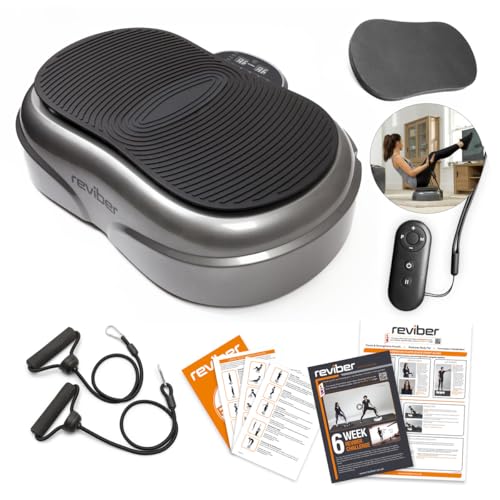
Our Reviber Fusion vibration plate review: 14mm oscillation, a 500W motor, 20 levels and a 5 year motor guarantee, plus the low weight limit and what the research says.
Best Exercise is a participant in the Amazon EU Associates Programme, an affiliate advertising programme designed to provide a means for sites to earn advertising fees by advertising and linking to Amazon.co.uk. As an Amazon Associate we earn from qualifying purchases. This comes at no extra cost to you and never influences our independent reviews or rankings.