Home Gym
Are Vibration Plates Worth It? What the Research Actually Shows
Are vibration plates worth it? Yes for balance, bone health support and low-impact warm-ups; no for weight loss or replacing strength training. The evidence.

By Paul Kendrick, Cardio & Endurance Editor · Updated 15 October 2026
We may earn a commission from qualifying purchases made through links on this page, at no extra cost to you. This never affects our ratings.
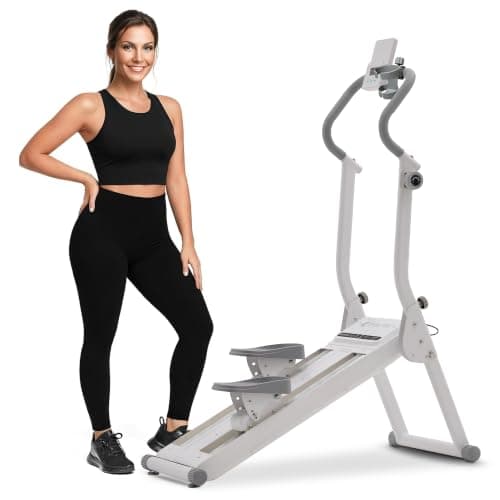
The ExacMe Magnetic Stair Climber is a solid, well-specified stepper for home use, but it isn't the revolving-staircase StairMaster that its "stair climber" name suggests. At £399.90 on Amazon UK you get 16 levels of magnetic resistance, a long 48cm stride, a 158kg user limit, adjustable pedal angles and inclines, Bluetooth app support and a folding frame. Those are good numbers for the money. The weaknesses are a short one-year warranty, a few marketing claims that don't stand up, and a stepping motion that's closer to an upright stepper than climbing a real flight of stairs.
We rate it 4.0 out of 5. It's a sensible buy if you want a hard, low-impact leg and cardio workout in a spare room and you understand what kind of machine it is. If you specifically want the gym StepMill experience, this won't give you that.
How we review
We assess products from the manufacturer's specifications, the Amazon UK listing, patterns in owner feedback and comparison with similar machines we've covered on this site. We haven't tested the ExacMe stair climber ourselves, so we've flagged where the claims are ExacMe's own and where we think they're overstated.
The machine was listed at £399.90 with only a handful of units left when we checked, so stock may come and go.
Check price on Amazon£399.90This matters more than any spec, so it's worth getting straight before you spend £400. A commercial stair climber such as the StairMaster StepMill is a revolving staircase. Real steps turn on a loop, and you lift each foot up onto the next step as it rolls down towards you. It's heavy, mains-powered and usually costs several thousand pounds.
The ExacMe works differently. It's an independent-pedal stepper: two large foot plates sit on arms, and each one moves down under your weight against magnetic resistance while the other rises. Tall handles give you something to grip, plus a frame to mount a phone and a bottle. You never lift your foot off the pedal, so the hip flexion is smaller than on real stairs, and there's no "stepping up" phase where you carry your body weight onto a higher surface.
That doesn't make it a bad trainer. Pushing a loaded pedal down still works the quads, glutes and calves hard, and the heart rate climbs quickly. But if you've read our StairMaster vs treadmill comparison and want exactly that StepMill feeling, a pedal stepper is a different animal. ExacMe's long stride and incline settings are clearly an attempt to make it feel more like climbing, and on paper they help.
| Machine type | Independent-pedal stepper with handles |
|---|---|
| Resistance | Magnetic, 16 levels, up to 35kg (77lb) |
| Stride length | 48cm |
| Pedal angle settings | 3 |
| Incline settings | 3 |
| Frame | 3mm alloy steel, dual-triangle support |
| Max user weight | 158kg |
| Connectivity | Bluetooth app |
| Claimed noise | Under 20dB (manufacturer claim) |
| Dimensions | Approx 122 x 58 x 165cm |
| Weight | Approx 26kg |
| Folding | Yes |
| Warranty | 1 year |
The 16-level magnetic system is the main reason to look at this over a cheap mini stepper. Budget steppers usually rely on hydraulic cylinders, which warm up and soften as you use them, so the effort drifts during a 20-minute session. Magnetic resistance doesn't heat-fade in the same way, and with a quoted ceiling of 35kg there's enough load at the top end to make strong legs work. The lower levels are light enough for someone getting back into exercise.
Stride length is the other headline. ExacMe quotes 48cm against roughly 36cm on ordinary steppers, and a longer pedal travel means a deeper knee and hip bend on each step. That's closer to the range of motion you'd use on a real staircase, and it should feel less like shuffling on the spot. Taller users in particular tend to find short-stroke steppers cramped, so the extra travel is a genuine plus.
The three pedal-angle settings and three incline settings change where the work lands. A steeper, more upright setup generally loads the quads and calves more, while a shallower, longer push brings in more glute and hamstring. Nine combinations sounds like a lot; in practice most owners will find one or two they like and stick with them, but the option to vary it is welcome.
A 3mm alloy steel frame on a dual-triangle base is a sensible design for a machine that has to resist sideways rocking as you shift weight from foot to foot. The 158kg maximum user weight is well above many folding steppers, which is reassuring for heavier users and suggests a reasonable safety margin for everyone else.
At around 122 x 58 x 165cm it isn't small. You'll need clear floor space and, because you stand on pedals that rise, enough headroom above your own height. Check your ceiling before ordering if you plan to use it in a loft room or under a sloped ceiling. The 26kg weight is manageable for one adult to fold and shift into a corner, which you can't say for a 100kg commercial StepMill.
The warranty is the weak point here. One year is short for a £400 cardio machine, and stepper pivots and pedal bearings are the parts that tend to wear. Keep your receipt and the Amazon order details, and register any fault promptly.
ExacMe says the machine runs below 20dB. For context, 20dB is around the level of rustling leaves or a quiet whisper at a distance. No loaded cardio machine with pedals, pivots and a person stepping on it will measure that at ear height, and we'd treat the number as wishful.
What's fair to say is that magnetic resistance is one of the quieter systems available. There's no fan, no belt and no hydraulic hiss, so the noise you get is mostly the pedals and your own footfalls. That should suit a flat or an upstairs room better than a treadmill, but don't expect total silence for neighbours below. A rubber equipment mat will help with vibration.
The listing says 20 minutes on the machine equals 40 minutes of stair climbing or 90 minutes of swimming. There's no study behind that, and it doesn't make physical sense: the energy you burn depends on your body weight, the resistance you choose, your stepping rate and how long you can keep it up, not on the badge on the frame. Someone stepping slowly on level 2 won't match a hard swim, whatever the machine.
What the research does support is that stepping and stair climbing are efficient cardio. In an eight-week trial of sedentary young women, building up to five two-minute stair ascents a day, five days a week, raised VO2 max by 17.1% compared with controls. A McMaster University study of stair-climbing "exercise snacks" found that three short, vigorous climbs a day, three days a week for six weeks, improved peak oxygen uptake in sedentary adults, though the gain was modest. And a 2024 randomised trial in inactive adults found that three 30-second all-out stair climbs per session raised VO2peak by about 7% over six weeks, while 40 minutes of moderate cycling didn't produce a significant change.
Those studies used real staircases, not a pedal stepper, so they're a guide rather than proof that this machine will do the same. The useful message is that short, hard stepping efforts work, and a machine at home makes it easier to fit them in on a wet Tuesday evening.
Bluetooth connectivity lets you pair the stepper with a fitness app to track sessions, and there's a holder for your phone and a cup holder for a drink. These are useful additions rather than reasons to buy. As with most budget-to-mid-range home cardio kit, the quality of the app experience varies and some owners will simply use the console or a stopwatch. Don't pay extra for it on the strength of the app alone.
The ExacMe makes most sense for people who want a hard, low-impact lower-body workout at home and don't have room (or budget) for a treadmill or commercial climber. It suits runners looking for a knee-friendlier cardio day, heavier users who need the 158kg rating, and anyone who's outgrown a small mini stepper and wants a longer stride and more resistance.
It's also a good fit if you like short, intense sessions. Five to ten minutes of hard intervals on a stepper will leave most people breathing heavily, which lines up with the exercise-snack research above.
Skip it if you want the authentic StepMill experience; this is a pedal stepper, and no amount of incline adjustment changes that. It's also not ideal if you have very limited headroom, or if you want a long warranty on a machine you'll use daily for years. And if you want full-body cardio with a strong upper-body component, a vertical climber or rower will spread the effort more evenly.
If space and budget are tight, the Xiser mini stair stepper is a compact, commercial-grade option that slides under a bed, though it has no handles and takes some balance. For a whole-body climbing movement that uses your arms as well as your legs, our Relife vertical climber review covers a cheaper machine with a very different motion, and our best vertical climber UK guide compares several more. You'll find other cardio and strength equipment in our home gym section.
Check price on Amazon£399.90No. A gym StairMaster StepMill is a revolving staircase: the steps rotate downwards and you keep climbing them. The ExacMe is an independent-pedal stepper with handles, where each foot pushes a pedal down against magnetic resistance. It trains the same muscles and gets your heart rate up in a similar way, but it doesn't reproduce the full lift-your-leg-onto-a-step motion.
There's no evidence for that claim. ExacMe doesn't cite a study, and the energy you burn depends on your body weight, the resistance you pick and how hard you push, not the brand of machine. Treat it as marketing.
ExacMe claims under 20dB, which is quieter than a whisper and not a realistic figure for any loaded cardio machine with moving pedals and a person stepping on it. Magnetic resistance is genuinely quiet compared with friction or hydraulic steppers, so it should suit flats, but expect some pedal and frame noise.
The listing gives a maximum user weight of 158kg, supported by a 3mm alloy steel frame with a dual-triangle base. That's a higher limit than most compact steppers, which often top out around 100kg to 120kg.
The listed dimensions are roughly 122cm long, 58cm wide and 165cm tall, and it weighs about 26kg. It folds, but you'll still want a clear patch of floor and enough ceiling height for your head when you're standing on raised pedals.
It can be, because the low resistance levels are gentle and the handles give you something to hold. Beginners should start with short sessions at low resistance, since stepping machines tire the quads and calves quickly even when the effort feels easy at first.
Are vibration plates worth it? Yes for balance, bone health support and low-impact warm-ups; no for weight loss or replacing strength training. The evidence.
What a cambered bar is, the three main types (cambered squat bar, bowed bench bar, cambered Swiss bar), what each one does, how much they weigh and how to buy one.
What a landmine attachment is, the rack-mounted, plate-post and floor platform types, how to check bar and rack fit, safety tips, and the best exercises to do.
What a safety squat bar is, how much it weighs, how it changes your squat compared with a straight bar, who it suits and what to check before buying one in the UK.
Best Exercise is a participant in the Amazon EU Associates Programme, an affiliate advertising programme designed to provide a means for sites to earn advertising fees by advertising and linking to Amazon.co.uk. As an Amazon Associate we earn from qualifying purchases. This comes at no extra cost to you and never influences our independent reviews or rankings.