Elite has been making indoor trainers in Italy since long before anyone rode a virtual watopian volcano, and the Justo 2 is the company's answer to the question of what a flagship trainer should do in 2026. The answer, mostly, is stop irritating you. Built-in Wi-Fi means the trainer connects to Zwift by itself rather than through whichever Bluetooth device happens to be feeling cooperative. A cassette arrives fitted. The claimed accuracy is better than 1 percent, which is the level where you stop wondering whether your FTP test was real.
At roughly £979 on Amazon UK it is not a casual purchase, and there are trainers at half the price that will get you fit. What the Justo 2 buys is reliability of both connection and numbers, and if you train to power rather than feel, those two things are the whole product.
How we review
This review is based on Elite's published specifications for the Justo 2, the Amazon UK listing, and recurring findings across independent trainer testing and verified owner reports. We have not run our own season-long test of this specific unit, so we stick to claims that hold up across several sources rather than single opinions.
Who it is for
Buy this if your winter training is structured: intervals to a plan, a race on Zwift most weeks, an FTP number you actually act on. The accuracy and the Wi-Fi both pay off in that context, and the 7kg flywheel plus 24 percent gradient ceiling mean the trainer never becomes the limiting factor.
If you ride indoors twice a month to keep your legs turning over, this is far more trainer than you need. A wheel-on unit or a cheaper direct drive model will do that job, and our best turbo trainer UK guide covers the sensible steps down.
Claimed accuracy better than 1 percent, good enough to train and test on
Built-in Wi-Fi kills the single most common source of indoor training frustration
12-speed road cassette fitted out of the box, saving around £50 and an afternoon
Handles 2,300W and gradients to 24 percent, so it never runs out of headroom
Belt drive is genuinely quiet; your chain will be the loudest thing in the room
Ethernet port as well as Wi-Fi, useful in a garage with poor signal
Cons
Around £979, which is a lot next to competent trainers at half the money
17kg with no wheels, so it stays where you put it
Needs mains power, unlike a few rivals that can run unplugged in Bluetooth mode
No fore-aft movement, unlike a Wahoo KICKR MOVE, so long sessions still numb the sit bones
Elite's own app is the weakest part of the package next to Zwift
Non-Shimano and non-SRAM road drivetrains need a separate freehub body
Accuracy and road feel
The Justo family is built around an optical torque sensor rather than a strain gauge inferred from motor current, and Elite claims better than 1 percent accuracy across the range. In practice that means the number on your screen matches the number a decent crank-based power meter reports, which is the whole point of a premium trainer. Anything worse than 2 percent and your zones drift enough to matter over a training block.
Ride feel comes from the 7kg flywheel and the way the trainer applies resistance when the gradient changes. Coming off a virtual climb onto a descent, the Justo 2 releases resistance smoothly instead of the sudden slackening cheaper units give you, and grinding up a 15 percent ramp at 60rpm it stays even rather than pulsing. This is the difference you feel within one ride and then stop noticing, which is exactly as it should be.
Elite Justo 2 key specifications
Type
Direct drive, interactive smart trainer
Claimed accuracy
Better than 1 percent
Max power
2,300 W at 40 km/h
Max simulated gradient
24 percent
Flywheel
7 kg
Connectivity
Wi-Fi, Ethernet, Bluetooth, ANT+ FE-C
Cassette
12-speed road cassette pre-fitted
Weight
17 kg
Power
Mains powered
Compatibility
Zwift, TrainerRoad, MyEtraining and other FE-C apps
Wi-Fi is the real upgrade
Every experienced indoor cyclist has a Bluetooth story: the trainer dropping out forty seconds into a fifth interval, the laptop pairing to the heart rate strap but not the trainer, the phone that decides to hand off to a smart speaker mid-race. Elite's fix is to skip the personal-area radio entirely for the main connection and put the trainer on your home network, where it talks to Zwift directly.
It works, and once you have used it the old way feels primitive. Two practical notes. The Ethernet port matters more than it looks if your trainer lives in a garage or shed where Wi-Fi is thin, and firmware updates arrive without you hunting for the phone app, which is a small mercy given how often trainer firmware used to be the cause of the problem it was meant to fix.
Training with it
Indoor cycling gets an unfair reputation as junk miles, largely because unstructured indoor riding is genuinely dull and easy to fudge. Done properly it is potent: a 12-week programme of three indoor cycling sessions a week improved body composition, aerobic capacity and lipid profiles in a 2020 study of women with obesity, and the same principle applies to a rider chasing an FTP number. The trainer removes every excuse the weather can supply, which is most of them in a British February.
For general health the bar is lower than most cyclists assume. The NHS asks for 150 minutes of moderate activity a week, which three trainer sessions clear comfortably. What the Justo 2 adds is the ability to know precisely what you did, so progression stops being guesswork.
Pair it with a chest strap rather than relying on wrist optical heart rate, which struggles during hard intervals; our best heart rate monitor UK guide covers the options worth buying.
Against Elite's own range, the Avanti is the value pick and the Direto XR-T the older workhorse; the Justo 2 adds Wi-Fi, better accuracy and a fitted cassette over both. Against Wahoo, the KICKR CORE 2 undercuts it substantially and gets you most of the way there, while the full KICKR range trades on ecosystem rather than raw numbers.
The honest summary is that the top three or four direct drive trainers are now close enough that accessories, price on the day and which app you use should decide it. If none of this feels worth £979, the exercise bikes section covers smart bikes and spin bikes that need no bicycle at all.
Is the Elite Justo 2 accurate enough for structured training?
Yes. Elite claims better than 1 percent accuracy from its optical torque sensor, which puts it level with the best trainers on the market, and independent testers have generally found the Justo family holds that claim across the power range. For threshold and VO2 work you can trust the numbers without a separate power meter.
What does the built-in Wi-Fi actually do?
It removes Bluetooth from the equation. The trainer talks straight to Zwift or MyEtraining over your home network, so you avoid dropouts caused by a phone wandering out of range, a crowded 2.4GHz band or a laptop mislaying the connection mid-interval. Firmware updates also install without a phone.
Does the Elite Justo 2 come with a cassette?
Yes, a 12-speed road cassette is fitted out of the box, which saves you roughly £50 and a trip to a bike shop. Older 10 and 11-speed drivetrains need a spacer, and SRAM XDR or Campagnolo users need the relevant freehub body.
How loud is the Justo 2?
Very quiet by trainer standards. With a belt drive and no fan, nearly all the noise you hear is your own drivetrain, so a clean, well-indexed chain matters more than the trainer does. Flatmates will hear the fan you point at yourself before they hear the trainer.
Justo 2 or Wahoo KICKR?
They are close. The Justo 2 has the edge on claimed accuracy and ships with a cassette; the KICKR has a larger accessory ecosystem and slightly better name recognition in the UK. If you already own Wahoo kit, stay in that family. If you are starting fresh, the Justo 2 is the better value once you account for the cassette.
Can it simulate steep climbs?
It handles gradients up to 24 percent and can absorb up to 2,300W, so it will not run out of resistance on anything Zwift or a real climb throws at you. Sustained low-cadence grinding at high gradients is where cheaper trainers feel notchy and this one does not.
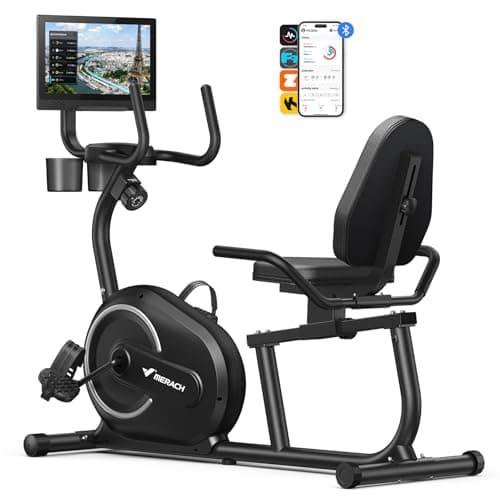
An honest review of the MERACH recumbent exercise bike with a 15.6in HD rotating screen: screen mirroring caveats, 8 resistance levels, fit range and how it compares with cheaper recumbents.
The real benefits of a recumbent bike, from back support and low joint load to easy mounting, plus honest trade-offs, calorie estimates and how to set one up.
The best recumbent exercise bikes in the UK for 2026, from a £183 starter bike to a £1,399 Sole. Honest picks for sore knees, dodgy backs and long TV sessions.
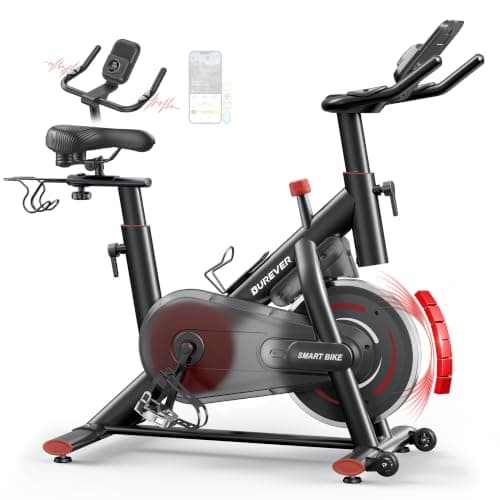
Our Burever exercise bike review: the touchscreen goal console, 0-100% magnetic resistance, 170kg limit, Zwift support without a power meter, and who should buy it.
Best Exercise is a participant in the Amazon EU Associates Programme, an affiliate advertising programme designed to provide a means for sites to earn advertising fees by advertising and linking to Amazon.co.uk. As an Amazon Associate we earn from qualifying purchases. This comes at no extra cost to you and never influences our independent reviews or rankings.