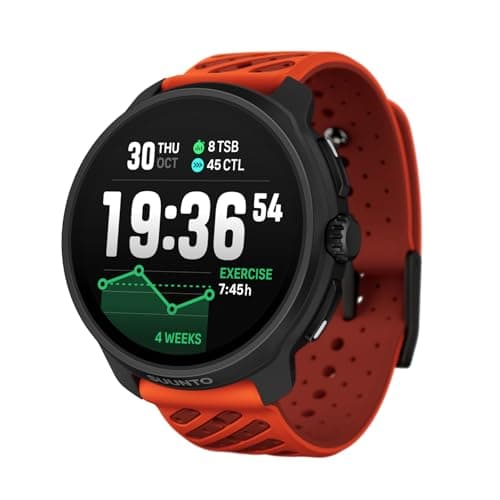
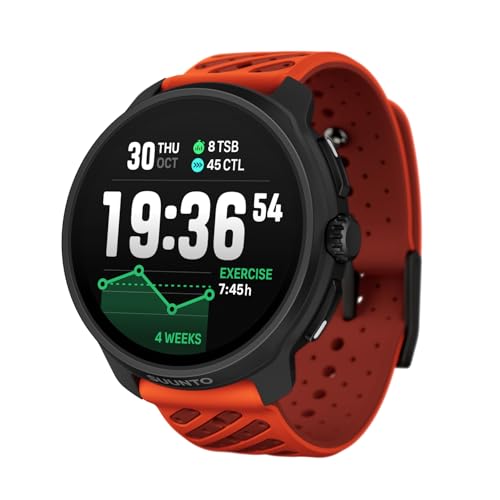
Suunto's problem for a decade was never the hardware. Race 2 is the clearest illustration yet: a 1.5 inch AMOLED, dual-band GNSS, offline outdoor maps with no subscription attached, 55 hours of full-accuracy GPS, and a price on Amazon UK of around £413. Garmin charges more than that for watches that navigate with a breadcrumb line on an empty screen.
What you give up is the layer Garmin has spent fifteen years building: the app ecosystem, the depth of training analysis, the sheer number of third-party integrations. That trade is the whole review.
How we review
This review draws on Suunto's published specifications and support documentation, the consistent findings across long-term reviews from established running and outdoor outlets, and recurring themes in verified owner feedback. We have not run our own six month endurance test of this exact unit, so we report what shows up repeatedly rather than one reviewer's impression. Specs and prices were correct at the time of writing.
What Suunto changed
The first Race was a bargain with two rough edges: a heart rate sensor that wandered, and a case that felt chunkier than the spec sheet implied. Race 2 addresses both. The design is slimmer and lighter, the back panel and optical sensor have been redesigned, and the AMOLED grows to 1.5 inches while getting brighter (Suunto).
Underneath, the processor is quicker and there is more memory, which matters more than it sounds when you are panning a map on a watch. Sport modes pass 115. Suunto Coach, the adaptive training guidance layer, comes as part of the package rather than a paid tier.
Suunto Race 2 key specifications
Display
1.5in AMOLED touchscreen
Battery, training, performance mode
Up to 55 hours with dual-band GPS
Battery, training, tour mode
Up to 200 hours, lower GPS accuracy, heart rate off
Battery, daily use
Up to 18 days with heart rate on, up to 30 days with it off
Positioning
Dual-band GNSS
Mapping
Free offline outdoor maps with ClimbGuidance
Sport modes
115 plus
Training
Suunto Coach adaptive guidance, 300 plus partner apps
Download a region over Wi-Fi and you get a proper topographic map on the wrist: contours, tracks, paths, the lot, with your position on it and no phone required. Suunto charges nothing for this, and there is no map store, no unlock, no premium tier waiting three months in.
Compare that with what £413 buys elsewhere. Garmin's Venu range has no maps at all. Its Forerunner range only gets them near the top. Once you have run somewhere unfamiliar with a real map under your thumb, breadcrumb navigation feels like being handed a compass and a rumour.
ClimbGuidance is the other half. It detects climbs ahead on a route, shows the gradient profile and tracks how much of the ascent is left, which is the difference between pacing a hill and hoping about it. On UK terrain, where the same 200m of ascent can be a gentle drag or a wall, that readout is worth more than another sport mode.
Battery claims, untangled
Suunto publishes four numbers and Amazon prints a fifth, so it is worth being precise. Performance mode, meaning dual-band GPS at full accuracy, runs up to 55 hours. Tour mode, with lower GPS accuracy and the heart rate sensor off, stretches to 200 hours. Daily use with wrist heart rate on is quoted at up to 18 days, and up to 30 days with it off. The Amazon listing headline says 16 days, which is lower than Suunto's own daily figure.
In practice the numbers people report cluster around ten to fourteen days of ordinary wear with a few GPS hours a week, dropping quickly if you leave the display always on. Fifty-five hours of dual-band tracking is the figure that matters for anyone doing a long day in the hills, and it is roughly double what an Apple Watch Ultra manages before Low Power Mode.
Where Garmin still wins
The Suunto app has improved a lot and it is no longer the liability it was around 2020, but Garmin Connect remains deeper: more history, better structured workout building, a bigger ecosystem of third-party services that sync without complaint. Suunto's route planning is decent, its analysis of training load is reasonable, and neither is at the level of Garmin's training status and race predictor machinery.
Wrist heart rate deserves the same honesty. A Cleveland Clinic comparison of five optical monitors against ECG found agreement varied sharply by exercise type, with chest straps still the reference standard, and no amount of sensor redesign changes that physics. The Race 2 pairs with Bluetooth straps without fuss, which is what I would do for interval sessions.
Third-party apps are thinner too. If your training runs through a particular app or a coach's platform, check the integration before you buy rather than after.
None of this is a reason to avoid the watch. It is a reason to be honest about what the saving buys you.
Pros
Full offline topographic maps included free, with no subscription
55 hours of dual-band GPS tracking, roughly double an Apple Watch Ultra
ClimbGuidance turns hilly routes from guesswork into pacing
Redesigned optical sensor tracks steady running far better than the first Race
1.5in AMOLED is bright, sharp and quick to respond after the hardware bump
Around £413 for hardware Garmin charges considerably more to match
Cons
Suunto app is behind Garmin Connect for depth and history
Training analysis is basic next to Garmin's training status and race predictions
Fewer third-party integrations, so check yours before buying
Published battery figures conflict with the Amazon listing headline
Optical heart rate still struggles on intervals, as they all do
Resale value and support network are smaller than Garmin's in the UK
Who should buy it
Buy the Race 2 if you run, ride or walk somewhere with contour lines and you refuse to pay Garmin's mapping premium. That is a large group of people in this country, and for them this is the obvious watch at the price.
Skip it if your training is governed by structured plans and load metrics, or if you already live in Garmin Connect with years of history. The Garmin Forerunner 970 is the better training computer if the budget stretches. If you want the same Suunto approach in a smaller case, the Suunto Race S costs less; if you want it in a tank, the Suunto Vertical 2 adds a flashlight and a much bigger battery.
Suunto quotes up to 55 hours of training in performance mode with dual-band GPS, up to 200 hours in tour mode with lower GPS accuracy and heart rate off, up to 18 days of daily use with heart rate tracking on and up to 30 days with it off. The Amazon listing headline of 16 days sits below Suunto's own daily-use figure, so treat 16 days as the conservative number and expect somewhere in the low teens with an always-on face.
Are the maps on the Suunto Race 2 really free?
Yes. Full offline outdoor maps download to the watch over Wi-Fi through the Suunto app at no cost, with no subscription and no map packs to buy. That is the single biggest reason to look at Suunto instead of a similarly priced Garmin, because Garmin reserves onboard mapping for its more expensive ranges.
Suunto Race 2 or Garmin Forerunner 970?
The Forerunner 970 has deeper training analysis, better third-party app support and a more polished phone app, and it costs a lot more. The Race 2 gives you the same core job, which is accurate dual-band tracking with maps on your wrist, for several hundred pounds less. If you race regularly and live inside training metrics, buy the Garmin. If you run and ride and want maps, buy the Suunto.
What is ClimbGuidance?
A feature that spots climbs on your route and shows you the gradient profile, how far up you are and how much is left. On a hilly route it changes how you pace, because you can see whether the ramp under your feet is a hundred metres or a kilometre. Suunto includes it with the free maps.
Is the heart rate accuracy any better than the original Race?
Suunto redesigned the back panel and the optical sensor for the Race 2, and wrist heart rate is noticeably steadier in steady-state running than on the first Race. It still behaves like every optical sensor on intervals: lagging on the first hard rep and occasionally locking onto cadence. Pair a chest strap for anything where the numbers matter.
What is the difference between the Race 2 and the Race 2 Titanium?
The bezel material and the weight, plus the price. The titanium version is lighter and costs more; the sensors, GPS, maps, battery figures and software are identical. Nobody has ever run faster because of a bezel.
What an air rowing machine is, how fan resistance and the damper really work, why gyms use them, the downsides (noise, size) and what to look for before you buy.
Average bicep curl weight in kg by training level, for dumbbell and barbell curls, men and women. Plus is 10kg, 12kg or 20kg good, and how to pick your weight.
Average deadlift weight in kg for men and women at 60 to 100kg bodyweight, from untrained to advanced, plus how to estimate your 1RM safely from a rep set.
What a curved treadmill is, how the self-powered slat belt works, what research says about calorie burn vs motorised treadmills, and whether one suits you.
Best Exercise is a participant in the Amazon EU Associates Programme, an affiliate advertising programme designed to provide a means for sites to earn advertising fees by advertising and linking to Amazon.co.uk. As an Amazon Associate we earn from qualifying purchases. This comes at no extra cost to you and never influences our independent reviews or rankings.