Home Gym
Are Vibration Plates Worth It? What the Research Actually Shows
Are vibration plates worth it? Yes for balance, bone health support and low-impact warm-ups; no for weight loss or replacing strength training. The evidence.

By Jack Atkins, Home Gym Equipment Specialist · Updated 17 August 2026
We may earn a commission from qualifying purchases made through links on this page, at no extra cost to you. This never affects our ratings.
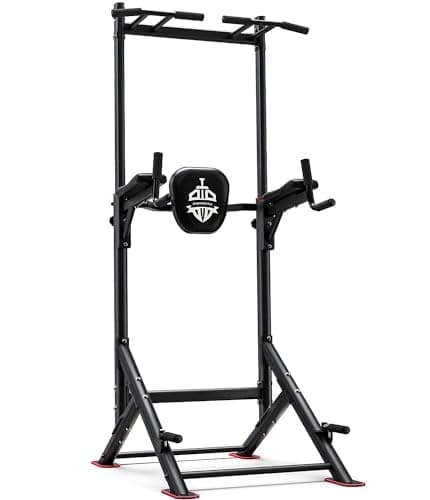
A power tower is the cheapest way to add three or four genuinely useful exercises to a home gym without drilling anything into a wall. The Sportsroyals is one of the most established options on Amazon UK, and at around £220 it sits in the awkward middle: more than a doorway pull up bar, less than a proper squat rack with a pull-up bar built in. Whether it earns that money depends almost entirely on your floor space and your ceiling height.
What you get is four stations on one frame: a pull-up bar at the top with multiple grip positions, dip handles, a vertical knee raise station with a padded backrest and arm rests, and low push-up bars at the base. That covers most of the upper body pulling and pushing work you would otherwise need a gym for.
How we review
This review draws on the manufacturer's published specifications, dimensions pulled from the current Amazon UK listing, and consistent themes across long-term owner feedback. We have not run a multi-year durability test of this exact unit, so we report only what recurs reliably across sources, complaints included.
People training bodyweight strength at home who want more than a bar over a doorway. If pull-ups, chin-ups and dips are the backbone of your upper body training, this frame handles all of them properly, and the knee raise station covers core work that most home setups ignore entirely. It suits garages, spare rooms and anywhere with a hard floor and headroom.
It is the wrong buy in two situations. If your ceiling is standard height and you are tall, the maths does not work. And if you already own a squat rack with an integrated pull-up bar, you are buying a second pull-up bar with dip handles attached; a set of dip bars would be cheaper.
The frame is thickened steel tubing with a powder-coated finish, and the base uses what Sportsroyals describes as a bracket-shaped design to maximise the support area. In practice that means a wider footprint at floor level than the narrow four-leg towers sold at lower prices, and it is the main reason this one feels more planted than its weight suggests. The adjustable foot covers matter more than they sound if you are putting it on a garage floor that slopes towards a drain.
At around 28kg assembled, the frame is not heavy. That is a genuine advantage when you want to move it and a genuine limitation when you want to attack a set of dips. Controlled reps produce nothing worth mentioning; explosive work produces a noticeable rock at the top of the frame. The standard fix, weighting the base with a couple of spare plates or a sandbag, works well and costs nothing if you already own plates.
| Height | Approx 235 cm (92.7 in) at full extension, adjustable |
|---|---|
| Footprint | Approx 107 x 81 cm (42.3 x 32 in) |
| Frame weight | Approx 28 kg (61.7 lb) |
| Stated load capacity | 450 lb in listing title, 400 lb in description |
| Stations | Pull-up bar, dip handles, vertical knee raise, push-up bars |
| Base | Wide bracket-style with adjustable foot covers |
| Frame material | Thickened powder-coated steel tubing |
| Assembly | Self-assembly, roughly 60 to 90 minutes |
This deserves its own section because the listing genuinely contradicts itself. The title claims 450 lb, about 204kg. The manufacturer's own bullet point on the same page claims 400 lb, about 181kg. That is a 23kg gap, and no explanation is given for it anywhere.
Neither number is likely to be a problem for the vast majority of buyers, since 181kg covers a heavy user plus a weight vest with room to spare. But sloppy specification writing on a piece of equipment you hang your bodyweight from is not a great look, and the honest advice is to plan around 400 lb and to treat that as a static rating rather than a dynamic one. Controlled reps, not swinging.
The pull-up bar offers several grip positions, so wide, neutral and narrow are all available without moving anything. Grips are foam-covered, which is comfortable enough at first and compresses with time; a pair of gloves or lifting straps solves that permanently if it bothers you. Bar height adjusts, which is more useful than it sounds, because a bar you have to jump for makes every set start badly.
Dip handles are set at a fixed width. That suits most people and will feel narrow if you are broad through the shoulders. The knee raise station with backrest and arm pads is the part that surprises people: hanging leg raises are hard on the grip and the padded version lets you actually train the core to fatigue. Our hanging leg raise guide covers the technique that makes the difference.
Padding is the weak point across the whole frame. It is firm, fairly thin, and it compresses noticeably over months of use. Replacement pads are not sold separately, though a folded towel does the job.
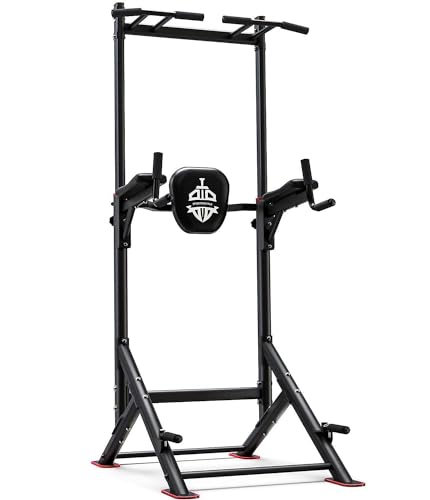
Bodyweight training on a frame like this covers the muscle-strengthening side of the standard activity guidance neatly. Both the NHS and ACSM recommend strengthening activities working all the major muscle groups on at least two days a week (NHS strength exercise guidance, ACSM physical activity guidelines). Pull-ups, dips and knee raises hit the back, chest, shoulders, arms and trunk between them, which is most of the upper body in one frame.
What it will not do is train your legs, and it will not replace a barbell for progressive loading once bodyweight becomes easy. The usual progression from here is a weight vest or a dip belt so you can add load to pull-ups and dips rather than chasing rep counts forever.
Compared with the alternatives: a doorway bar is a fifth of the price and does a fifth of the job; a wall mounted bar is more stable and permanent but needs solid brick and a drill; a full power cage does everything this does plus squats and bench, for two to three times the money and considerably more space.
Check price on AmazonThe listing is inconsistent, which is worth knowing before you buy. The product title says 450 lb while the manufacturer's own feature description says 400 lb, roughly 204kg and 181kg respectively. Either figure is comfortable headroom for most users doing controlled reps, but treat the lower one as the real number and do not use it for kipping pull-ups or explosive work near the ceiling of that range.
This frame is listed at 92.7 inches, around 235cm, at its full height. A standard UK ceiling is about 240cm, which leaves roughly five centimetres of clearance before your head is in the plasterboard at the top of a pull-up. Measure your ceiling before ordering. A garage or a room with a higher ceiling is the safer home for it, and the height is adjustable downwards if needed.
For most people, yes, if you have the floor space. A power tower adds dips, knee raises and elevated push-ups that no doorway bar can do, it does not mark your door frame, and it is far more stable for anything other than strict pull-ups. A doorway bar wins on price, storage and the fact that it takes up no permanent space at all.
Less than most at this price, thanks to a wide base and adjustable foot covers that level it on uneven floors. It is not immovable: at around 28kg the frame is light for its footprint, so aggressive swinging or explosive dips will produce some rock. Owners who load the base with a couple of weight plates report it settles down completely.
Expect 60 to 90 minutes with the supplied tools, and it is considerably easier with a second pair of hands for the upright sections. The instructions are diagram-led and adequate rather than good. The most common assembly complaint is bolt holes that need a little persuasion to line up, which is normal for powder-coated steel in this bracket.
No, and you should not try. The frame is designed for controlled vertical loading, not for the dynamic swing a muscle-up generates. That kind of work needs a bolted wall mount or a floor-anchored rig.
Are vibration plates worth it? Yes for balance, bone health support and low-impact warm-ups; no for weight loss or replacing strength training. The evidence.
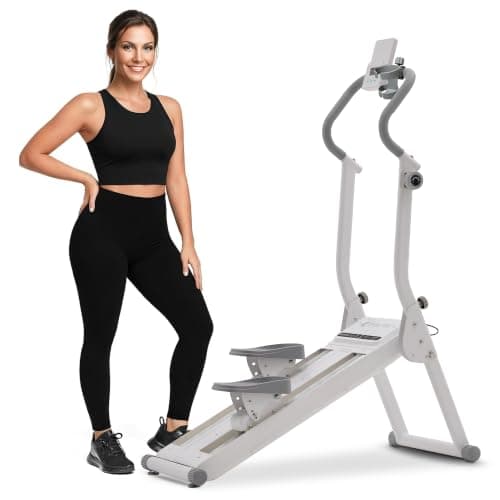
Our ExacMe magnetic stair climber review covers its 16 magnetic resistance levels, 48cm stride, 158kg user limit, app and noise claims, and who should buy it.
What a cambered bar is, the three main types (cambered squat bar, bowed bench bar, cambered Swiss bar), what each one does, how much they weigh and how to buy one.
What a landmine attachment is, the rack-mounted, plate-post and floor platform types, how to check bar and rack fit, safety tips, and the best exercises to do.
Best Exercise is a participant in the Amazon EU Associates Programme, an affiliate advertising programme designed to provide a means for sites to earn advertising fees by advertising and linking to Amazon.co.uk. As an Amazon Associate we earn from qualifying purchases. This comes at no extra cost to you and never influences our independent reviews or rankings.