Home Gym
Dumbbell Set With Rack: Sizes, Real Costs and What to Buy
Buying a dumbbell set with rack in the UK: what 2.5 to 10kg, 2.5 to 25kg and 5 to 30kg bundles actually weigh, cost per kg, rack styles and delivery.

By Jack Atkins, Home Gym Equipment Specialist · Updated 1 November 2026
A free standing pull up bar is a steel frame that holds a pull-up bar above head height without drilling into walls, ceilings or door frames; it stands on its own base and you can move it. It beats a wall-mounted or doorway bar when you rent, when your walls are plasterboard or your door frames are too weak or too wide, or when you also want a dip station in the same footprint. The trade-off is that you swap drilling for floor space, and a frame that only rests on the floor will never feel as solid as a bar bolted into brick.
Most of what Amazon UK sells under this name is really a power tower, which means a pull-up bar plus dip handles and a knee-raise station. That's not a bad thing. It just means the questions that matter are about height, base width and how much the frame moves, and the product photos rarely answer them.
The case for one is strongest if any of these describe you:
And here's when it's the wrong choice: low ceilings combined with a tall user, a tiny room where 90 x 70cm of permanent floor space hurts, or training that involves kipping, muscle-ups or anything explosive. A bolted bar wins all three.
This is the common one. A tall upright frame on an H-shaped or bracket-shaped base, with the pull-up bar on top, dip handles at waist height and a padded back rest so you can do vertical knee raises. Prices on Amazon UK run from about £65 to £220. The Sportsroyals Power Tower we've reviewed is a typical example: four stations on roughly 107 x 81cm of floor.
Because it's all one frame, the dip station and back pad add useful weight and rigidity low down, but the pull-up bar sits at the very top of a tall, fairly light structure. That's why towers rock.
A simpler frame with no dip station: two uprights, a top bar and splayed legs or a wide flat base. Fewer of these exist at the budget end, and they're often marketed as portable or foldable. Some fold flat against a wall, which is handy if the room has to double as something else.
They can be more stable than a tower for pull-ups specifically, because the legs splay wider. Check the base dimensions though, since "portable" sometimes means a narrow stance.
A pair of squat stands joined by a pull-up crossbar, or a half rack with a bar on top. You get a real barbell station plus somewhere to hang from. They're heavier, often 40kg and more, and loading plates on the storage pegs makes them very planted.
The catch is height. Many squat stands top out around 210 to 230cm, and the pull-up bar is usually the highest point, so the same ceiling maths applies. This route makes sense if you were going to buy a squat stand anyway.
Two numbers matter: the lowest and highest bar setting. For a dead hang with your arms straight and feet off the floor, the bar needs to sit above your standing reach. For the top of a rep, your head ends up roughly 25 to 30cm above the bar. Add that to the bar height you'll use and compare it with your ceiling.
A typical UK room is about 240cm floor to ceiling. That means a tower with a 235cm maximum is often unusable at full height indoors, and if you're over about 185cm you may find you can't dead hang with straight legs at the height your ceiling allows. Bending your knees works fine for pull-ups, so this is less of a dealbreaker than it sounds. It's the reason to measure before you order, not after.
Listings quote a single static figure, usually 150kg to 230kg. That's the load the frame can hold still. A pull-up isn't still: you accelerate up, and a sloppy rep or a dropped hang loads the bar well beyond bodyweight for a moment.
Our rule is simple. Buy a frame rated at least 50kg above your bodyweight, more if you'll add a dip belt. And don't trust a listing that gives two different figures. The Sportsroyals listing quotes both 400 lb and 450 lb, so we treat the lower one as real.
The base matters more than the weight rating for how the thing feels. A wider base resists front-to-back tipping, which is the direction your body swings during a pull-up. Look for a footprint of at least 90 x 65cm on a tower, and check which way round it goes: the longer side should run front to back, the way you swing.
Then mark the footprint on your floor with tape. Add space in front for your legs during dips and knee raises, and enough clearance behind that a swing won't put your heels into a radiator.
Every free standing bar moves a bit. These fixes are cheap:
How we researched this guide
We haven't put every tower on our own bathroom scales. This guide draws on manufacturer specifications and dimensions, the Amazon UK listings themselves, owner reviews and the products we've already covered in depth, including our Sportsroyals Power Tower review.
Power towers rock. Most weigh 20 to 30kg, and you're hanging 70kg or more off the highest, narrowest point of the structure. Strict reps are fine; kipping, fast negatives and anything with a swing will make the frame walk or tip on its back legs. If you want to kip, bolt a bar to something solid.
Maximum heights are low. To keep the frame stable and shippable, most towers top out between 210 and 235cm, which works for many users but means taller lifters bend their knees on every rep. That's a nuisance for pull-ups and a real limit for toes-to-bar.
They also take permanent floor space. A tower doesn't fold away, and at around 90 x 70cm minimum it's a piece of furniture.
None of that makes them a bad buy. For most home trainers doing controlled sets of pull-ups and dips, they're the cheapest way to get both without drilling anything.
Search "free standing pull up bar" on Amazon UK and you'll mostly see products titled "power tower" or "pull up and dip station". The names overlap. In practice:
If you only want to hang and pull, a standalone frame is enough. If dips matter, a tower gives you a far taller and more stable dip position than parallel bars on the floor. For dips alone, a cheaper option from our best dip station guide does the job.
The pull-up is one of the most efficient upper-body exercises you can do at home. EMG research from the Mayo Clinic found that the latissimus dorsi worked at 117 to 130% of maximal voluntary contraction across pull-up and chin-up variations, with the chin-up recruiting the biceps and chest a bit more (Youdas et al., 2010). A later study comparing pronated, supinated, neutral and rope grips found overall muscle activation was broadly similar across grips (Dickie et al., 2017), so the bar shape matters less than whether you use it.
A power tower makes the build-up easier too. You can loop a band over the bar for assisted pull-ups, or use the dip handles to practise lowering yourself slowly before you have a full rep.
The Panana tower is the budget pick that ticks the boxes. It adjusts across nine bar heights from 149.6cm to 223.5cm, carries a 200kg rating and sits on a 90.6 x 66.5cm H-shaped base, according to the listing. The lower range is useful for shorter users and band work, though in a standard 240cm room you will probably run it a notch or two below the top.
Check the Panana power tower price on AmazonThe Roygym tower suits heavier users or taller ceilings. Roygym lists a 230kg capacity, eight height positions from 165cm to 235cm and four back pad positions, again on an H-shaped base. Check your ceiling before choosing it: at 235cm you'll need a garage or a high-ceilinged room to use the top setting.
Check the Roygym power tower price on AmazonThey're stable enough for strict pull-ups, chin-ups and dips if the frame is assembled square, sits on a level floor and has a wide base. Most budget towers weigh only 20 to 25kg, so they rock when you swing or kip. A rubber mat under the feet and a couple of weight plates on the base fix most of the movement.
Take the bar height you'll actually use and add roughly 25 to 30cm, which is about where the top of your head ends up when your chin clears the bar. A standard UK ceiling is around 240cm, so in most living rooms you can't run a tower at its highest setting. Measure first, then check the listing's minimum and maximum bar heights.
We wouldn't. Kipping throws your weight forwards and backwards, and a light frame with a small base will tip or walk across the floor long before it reaches its rated load. If kipping or muscle-ups matter to you, a properly anchored wall-mounted bar or a rig bolted to the floor is the safer choice.
Mostly, yes. Retailers use the names interchangeably. A power tower is a free standing pull up bar with extra stations bolted on, usually dip handles, a back pad and arm rests for knee raises, and sometimes push-up handles. A plain free standing pull up bar may be just the frame and the bar.
Look for a rating of at least 150kg, and ideally 200kg or more if you're over 90kg or plan to add a dip belt later. The rated figure is a static load. Dynamic movement multiplies the force through the frame, so treat the number as a ceiling for controlled reps, not a target.
Buying a dumbbell set with rack in the UK: what 2.5 to 10kg, 2.5 to 25kg and 5 to 30kg bundles actually weigh, cost per kg, rack styles and delivery.
Should you buy a folding weight bench or a fixed FID bench? How folding benches work, what you give up, and the specs to check before you buy one in the UK.
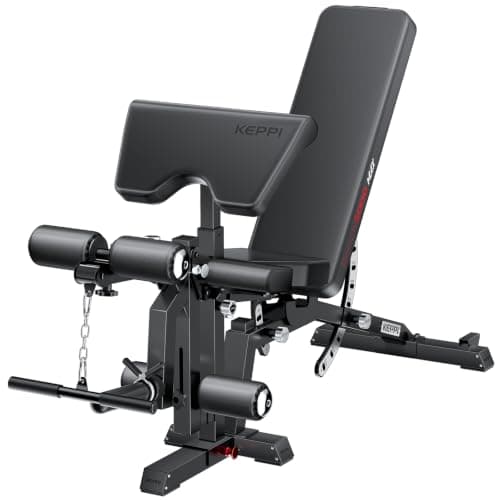
Our Keppi 3000 V2 weight bench review: 600kg rating, 12 backrest angles with decline, leg extension and preacher attachments, the catches and who should buy it.
How to set up an outdoor pull up bar in a UK garden: galvanised vs powder coat, concreting posts in, tree and wall mounts, ground cover and wet-weather grip.
Best Exercise is a participant in the Amazon EU Associates Programme, an affiliate advertising programme designed to provide a means for sites to earn advertising fees by advertising and linking to Amazon.co.uk. As an Amazon Associate we earn from qualifying purchases. This comes at no extra cost to you and never influences our independent reviews or rankings.