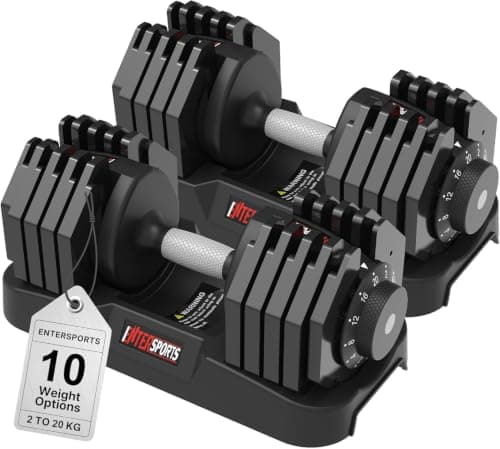
Home Gym
EnterSports Adjustable Dumbbells Review: A 20kg Pair for About £200
EnterSports 20kg adjustable dumbbells review: ten 2kg steps, twist-handle selector, what the 20kg ceiling means and how it compares with Bowflex and Strongway.

By Nadia Popescu, Strength & Conditioning Writer · Updated 8 August 2026
We may earn a commission from qualifying purchases made through links on this page, at no extra cost to you. This never affects our ratings.
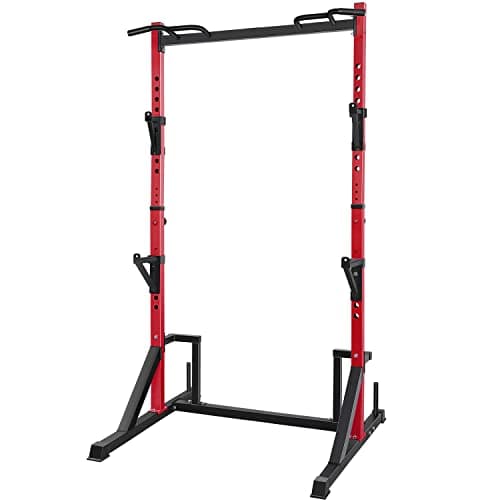
There is a point in every home gym where you stop buying gadgets and buy a cage. The CANPA Multifunction Power Rack is a decent place for that to happen: around £477, an 800lb rating, 2 inch square steel, a multi-grip pull up bar across the top and plate storage at the back. It is not a Rogue rack and it does not pretend to be. It is a competent, heavily specified home cage from a brand that has sold a great many of them, and for most people in a garage that is exactly the right purchase.
How we review
This review is built on CANPA's published specifications and the recurring themes across a large volume of verified owner reviews, alongside our experience of what separates a usable home rack from a frustrating one. We have not run a multi-year hands-on test of this exact unit, so we report consistent, repeated findings rather than one-off opinions, and we are direct about where it is beaten.
The main frame is 2 inch square steel with front and rear uprights, which is the specification that matters most and the thing cheap racks skimp on. Thin-walled 50mm tube flexes visibly under a heavy squat; 2 inch square section does not. CANPA rates the frame to 800lb, around 363kg, which is well beyond what nearly any home lifter will put on it.
The barbell support arms adjust across 17 holes per side, with 1 inch spacing on standard holes so most aftermarket accessories fit. The main frame itself has six height positions. That combination is what makes a cage safe to train alone in: you set the arms just under your bottom squat position, and a failed rep lands on steel rather than on you. Anyone training without a spotter should treat that as the whole point of the purchase rather than a feature on a list.
Across the top sits a multi-grip pull up bar, and at the back is an Olympic plate storage bar, which does double duty as ballast to stop the rack shifting.
Budget an afternoon. Racks in this class arrive as a heap of steel sections and a very large bag of bolts, and the order you tighten them in decides whether the finished cage is rigid or rattly. Bolt everything loosely first, square the frame against the floor, then torque down. Nearly every owner complaint about wobble traces back to skipping that step rather than to a manufacturing fault.
Once it is up, stability comes down to what is on it. Empty, the rack is light enough to rock a little if you dump a heavy bar into the J-hooks. Loaded with plates on the rear storage bar, it plants. If your floor is smooth concrete, put rubber gym flooring underneath, both to stop it walking and to save the slab when you drop something.
| Frame | 2 inch square steel, front and rear uprights |
|---|---|
| Rated capacity | 800 lb / approx 363 kg (manufacturer stated) |
| Barbell arm adjustment | 17 holes per side |
| Frame height positions | 6 |
| Hole spacing | 1 inch standard, fits most accessories |
| Pull up bar | Multi-grip, across the top |
| Storage | Olympic plate storage bar at rear |
| Cable system | None on this model |
| Warranty | 1 year |
| Colour | Red |
Everything that matters, provided you buy a bar and plates. Squats, front squats, overhead press, bench press with your own bench, rack pulls at any height the 17 holes allow, plus pull ups and inverted rows from the top bar. That covers the compound lifts that drive most of the strength adaptation people are actually after.
The case for barbells over machines is often overstated by both camps, and the research is calmer than the arguing. A 2023 systematic review and meta-analysis of 13 studies covering 1,016 participants found no difference between free-weight and machine-based training for hypertrophy or jump performance, with strength gains simply specific to whichever modality was trained (BMC Sports Sci Med Rehabil, 2023). What the rack genuinely gives you is progression without a ceiling and the freedom to train the back squat and deadlift properly at home, which the NHS's request for muscle-strengthening work across all major muscle groups on at least two days a week is far easier to satisfy with than with a bag of resistance bands.
Squat depth is worth a note while you are setting the catch bars. Done with sensible loads and decent technique, a deep squat is safe for healthy knees, and full-range work tends to produce greater strength gains than partial reps (scoping review on the deep squat and the knee joint). Set your safeties for where you actually squat, not where you wish you did.
No cable system. That is the single biggest gap, and it is the reason to think carefully before ordering. Racks at a similar price from Gym Master and Strongway offer an optional or included dual pulley, which adds lat pulldowns, tricep pushdowns and cable rows to the same footprint. Our Gym Master GM1 power rack review covers the obvious alternative, and the best power cage UK guide ranks the field.
The counter-argument is honest enough: the pulleys on cages in this price bracket are usually the first thing to develop play, and a rack that does one job well beats one that does two adequately. If you want cables, a separate cable machine will be better than any bolted-on pulley at this money.
You will also need a weight bench, a bar and weight plates before a single rep happens. Add roughly £250 to £400 for those, and cost the whole setup rather than the rack alone.
CANPA rates it at 800lb, roughly 363kg, on a 2 inch square steel main frame with front and rear supports. For a home lifter that is a large margin: a 150kg squat plus bodyweight is well inside it. What matters more in practice is bolting or loading the base properly, because an unanchored rack of any brand can shift when you rack a bar hard.
It has adjustable barbell support arms with 17 holes per side, which act as both J-hooks and catch positions. That is the main reason to own a cage rather than a pair of squat stands, because it means you can bail out of a failed squat or bench press without a spotter. Set them a couple of centimetres below your bottom position every session.
Squats, bench press with your own bench, overhead press, rack pulls, pull ups on the top bar and inverted rows. It has an Olympic plate storage bar at the back, which doubles as ballast. What it does not do is lat pulldowns or cable work, because there is no pulley system on this model.
Allow three to four hours and a second person. Racks in this class ship as a large number of steel sections with a lot of bolts, and the frame needs to be squared before anything is tightened fully. Owners who report wobble almost always tightened in the wrong order rather than receiving a faulty unit.
A power rack if you want to get genuinely strong, a multi gym if you want convenience and variety. The rack demands you learn barbell technique and buy a bar, plates and a bench separately, which is more money and more skill. In return it progresses with you for decades, which almost no multi gym does.
Not necessarily, but you should either bolt it down or keep plates loaded on the rear storage bar so the base is weighted. An empty rack is light enough to rock when you re-rack a heavy bar carelessly. Rubber matting underneath also stops it walking on a smooth garage floor.
EnterSports 20kg adjustable dumbbells review: ten 2kg steps, twist-handle selector, what the 20kg ceiling means and how it compares with Bowflex and Strongway.
How much does an EZ bar weigh? Olympic EZ bars are usually 7kg to 10kg and standard 1 inch bars around 5kg. UK bar weights and how to count your curl load.
A men's Olympic barbell weighs 20kg and a women's 15kg. See what standard, technique, Smith, EZ and trap bars weigh, and how to weigh your own bar at home.
How much does a trap bar weigh? Most Olympic hex bars weigh 20kg to 27kg, but budget bars can be under 15kg. Real UK bar weights and how to count your lift.
Best Exercise is a participant in the Amazon EU Associates Programme, an affiliate advertising programme designed to provide a means for sites to earn advertising fees by advertising and linking to Amazon.co.uk. As an Amazon Associate we earn from qualifying purchases. This comes at no extra cost to you and never influences our independent reviews or rankings.