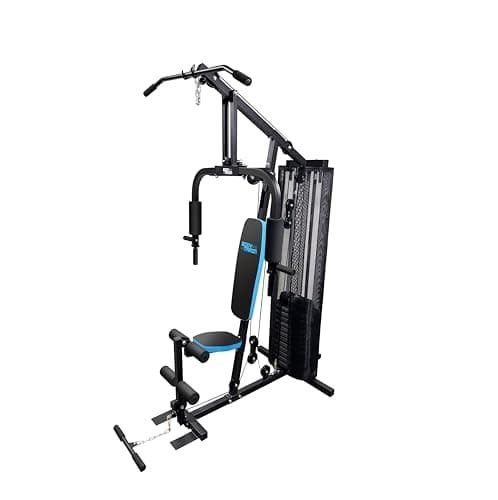
Home Gym
BodyTrain Advanced Single Station Multi Gym Review: 72kg for Under £300
Our BodyTrain multi gym review: the 72kg shrouded stack, 12.5lb jumps, stations, 213cm height, lifetime frame warranty and £283.99 price against rivals.

By Nadia Popescu, Strength & Conditioning Writer · Updated 3 November 2026
Most beginners should start with roughly 3 to 5kg dumbbells (women) or 6 to 10kg (men) for curls and shoulder work, about double that for rows and presses, and a single 8 to 20kg dumbbell for goblet squats. The exact number matters less than how the set feels: you want to finish 8 to 12 reps knowing you had about two more good ones left. That two-rep test is what you use to correct the chart below for your own body, and it's the same test you'll keep using to decide when to go up.
One dumbbell weight won't cover every exercise. Your quads can handle four or five times what your side delts can, which is why a single pair of 5kg dumbbells feels too heavy for lateral raises and almost pointless for squats.
Dumbbell exercises split into three rough groups, and each tolerates a very different load.
Small-muscle isolation work (lateral raises, front raises, curls, triceps extensions, rear-delt flyes) uses one joint and a small muscle working at a long lever. These are the lightest lifts you'll do. A 2kg dumbbell held out at arm's length for a lateral raise is harder than it sounds, and swinging a 6kg one up with your hips doesn't train your shoulders any better.
Upper-body compound lifts (presses and rows) use several muscles together, so they go heavier. Rows are usually the strongest of these because your lats and upper back are big muscles. Overhead presses sit at the bottom of the group, since your shoulders are working against gravity at full stretch.
Lower-body lifts (goblet squats, Romanian deadlifts, lunges, step-ups) involve your glutes, quads and hamstrings, the largest muscles you have. These need the heaviest dumbbells, and for a lot of beginners the limit is grip or how awkward the weight is to hold, not the legs.
Weights are per dumbbell. "Pair" means one in each hand; the goblet squat uses a single dumbbell held at the chest. Treat these as starting guesses for a healthy adult with no injuries, then adjust with the two-rep test. If you're older, returning after a long break or have no strength training behind you at all, start at the bottom of the range.
| Exercise | Beginner women | Beginner men |
|---|---|---|
| Lateral raise (pair) | 1 to 3kg | 2 to 5kg |
| Bicep curl / triceps extension (pair) | 3 to 5kg | 6 to 10kg |
| Shoulder press (pair) | 4 to 6kg | 8 to 12kg |
| Bench or floor press (pair) | 5 to 8kg | 10 to 16kg |
| One-arm row | 6 to 10kg | 12 to 18kg |
| Lunges or split squats (pair) | 4 to 8kg | 8 to 14kg |
| Romanian deadlift (pair) | 6 to 10kg | 12 to 18kg |
| Goblet squat (one dumbbell) | 8 to 12kg | 12 to 20kg |
Notice the spread. A beginner man might use 3kg for raises and 16kg for a goblet squat in the same session, more than five times the weight, and that gap is the main reason buying dumbbells is harder than it looks. Our kettlebell weight guide covers the same problem for bells, where the 4kg size jumps make it worse.
A chart can only get you close. To find your real working weight, use reps in reserve (RIR): how many more clean reps you think you could have done when you stopped. Researchers developed a lifting-specific effort scale built on exactly this idea, and found it a practical way to judge daily training load, in novices as well as experienced lifters (Zourdos et al., J Strength Cond Res, 2016).
Here's how to use it with a new dumbbell:
Beginners are bad at guessing RIR at first, and they nearly always underestimate what's left. If you're unsure, take one set to the point where you genuinely can't do another clean rep, count it, and you'll calibrate fast.
Why not just lift as light as feels comfortable? Because effort matters more than the number on the dumbbell. A meta-analysis of 21 studies found light loads (60% of your max or less) built about as much muscle as heavy loads when sets went to failure, though heavier weights still won for maximal strength (Schoenfeld et al., J Strength Cond Res, 2017). Light dumbbells work, but only if the set gets genuinely hard by the end. Sixty easy curls with a 2kg dumbbell won't do much.
Use a simple rule: once you can do two more reps than your target on every set, increase the weight. If your plan says 3 sets of 8 to 12 and you hit 12, 12, 12 with good form, go up and accept dropping back to 8 or 9 reps. That's close to what the American College of Sports Medicine recommends for novices: train in the 8 to 12 rep range and add 2 to 10% load when you can do one or two reps beyond your target (ACSM position stand, Med Sci Sports Exerc, 2009).
The practical catch is that 2 to 10% of a 4kg dumbbell is 0.1 to 0.4kg, and nobody sells those. Moving from 4kg to 6kg is a 50% jump, which is why lateral raises and curls stall so often. Before you make that jump, squeeze more from the current weight: add reps up to 15, slow the lowering phase to three seconds, or pause at the top. Then move up and start back at 8.
How often? The NHS recommends strengthening activities that work all the major muscle groups on at least two days a week. Two or three full-body sessions is plenty to make steady progress for the first six months or so, and our full-body dumbbell workout is a good template.
This is where the chart above earns its keep. Look at the range you'll need across all your exercises, then buy to cover it.
Upper body only, lighter goals. A few fixed pairs are cheapest. For most women, 4kg, 6kg and 8kg pairs cover raises, curls, presses and rows for the first few months; for men, 6kg, 10kg and 14kg is a sensible trio. Hex or rubber dumbbells in these sizes are inexpensive, and a dumbbell set with rack bundles them if you want somewhere to keep them.
Full body, including legs. Here fixed pairs get expensive and bulky, because you'd need everything from 2kg to 20kg+. A pair of adjustable dumbbells that runs from about 2kg to 24kg covers the whole chart for women and almost all of it for men, and for many people it lasts years before the top weight becomes the limit. We've done the cost and space sums in are adjustable dumbbells worth it; the short version is that once you'd otherwise buy more than four or five fixed pairs, adjustable usually wins.
Already lifting, or a bigger man. Consider a set that goes to 30kg or more per hand, since rows and Romanian deadlifts outgrow 24kg within a year for a lot of men.
Two dial-type pairs fit the 2 to 24kg brief well. The ATIVAFIT pair adjusts from 2kg to 25kg per dumbbell across ten settings with a quick dial, and was around £246.49 at the time of writing. Our ATIVAFIT adjustable dumbbells review covers the details.
Check ATIVAFIT 2 to 25kg dumbbells on AmazonIf you'll mostly train upper body and want to spend a little less, the EnterSports 20kg pair covers 2kg to 20kg in ten levels and was around £212.47 at the time of writing. That top weight suits most women and beginner men; see our EnterSports adjustable dumbbells review for where it falls short.
Check EnterSports 20kg dumbbells on AmazonFor more options across price points, our best adjustable dumbbells UK guide compares the field.
Using one pair for everything. It's either too heavy for your shoulders or too light for your legs. Most people's home routine needs at least two different weights, often three.
Swinging the weight up. If your hips or lower back jolt to start a curl or raise, the dumbbell is too heavy. You're training momentum, not the muscle you meant to.
Staying light for too long. Lots of women in particular sit on 2kg dumbbells for months out of worry about getting bulky. Building noticeable size takes years of hard, deliberate training and eating for it; adding a couple of kilos to your rows won't change that.
Chasing heavier weight with shrinking range. Half-rep shoulder presses with 12kg aren't better than full reps with 8kg. If the range shortens when you go up, go back down.
Ignoring grip. On Romanian deadlifts and lunges, many beginners hit grip fatigue well before their legs tire. That doesn't mean the weight is too heavy for your legs; it means you need a few weeks for your grip to catch up, or a goblet hold for squats in the meantime.
Pick a starting weight from the chart for each exercise, adjust it until a set of 10 leaves you two reps in reserve, and add weight when you beat your target reps by two on every set. If you're buying, check the full range your exercises need first; for full-body training at home, that range almost always points to an adjustable pair rather than a pile of fixed dumbbells. Then work through the best dumbbell exercises with it.
It depends on the exercise. As a rough start, beginner women use about 3 to 5kg for curls, 4 to 6kg for shoulder presses and 8 to 12kg for a goblet squat; beginner men use about 6 to 10kg, 8 to 12kg and 12 to 20kg for the same lifts. Then check the number with the two-reps-in-reserve test: finish your set of 8 to 12 feeling you could have done two more good reps, no more and no fewer.
Most women new to lifting do well with 1 to 3kg for lateral raises, 3 to 5kg for curls and triceps work, 5 to 8kg for presses and rows, and 8 to 12kg for goblet squats and Romanian deadlifts. Many women underestimate their legs, so expect lower-body weights to climb fastest. If you're buying a home set, a pair of 4kg, 6kg and 8kg covers the first few months; an adjustable pair that reaches 20 to 25kg covers years.
For small muscles like the shoulders and biceps, yes, at least for a while. Research comparing light and heavy loads found similar muscle growth as long as sets are taken close to failure. For legs, back and chest, 5kg runs out quickly for most adults, because you'd need very high reps to get close to failure.
When you can do two more reps than your target on every set with clean form, move up. If your plan is 3 sets of 10 and you hit 12 on all three, increase the weight and drop back to 8 to 10 reps. On small lifts that usually means a 1 to 2kg jump per dumbbell; on squats and deadlifts you can take 2 to 4kg.
Fixed pairs are cheaper if you only need two or three weights, for example 4kg, 6kg and 8kg for an upper-body routine. Once you want both light weights for raises and heavy weights for squats and rows, an adjustable pair covering roughly 2 to 24kg works out cheaper per kilo and takes up a fraction of the floor space.
Our BodyTrain multi gym review: the 72kg shrouded stack, 12.5lb jumps, stations, 213cm height, lifetime frame warranty and £283.99 price against rivals.
What a cable crossover machine is, how it differs from a functional trainer, what 177kg stacks really mean, the ceiling height you need and UK price bands.
Every common cable machine attachment explained: D-handles, rope, straight and EZ bars, V-bar, ankle straps and more, with exercises, the 4 to buy first and prices.
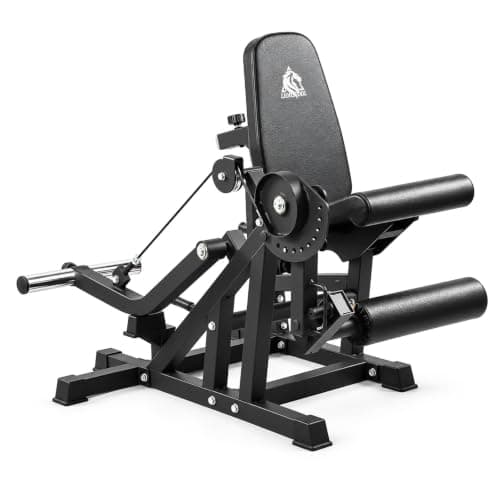
LIONSCOOL leg extension machine review: the V4.0's cable system, 400lb capacity, lying leg curl, 1.65m footprint and what the £429.99 price really buys you.
Best Exercise is a participant in the Amazon EU Associates Programme, an affiliate advertising programme designed to provide a means for sites to earn advertising fees by advertising and linking to Amazon.co.uk. As an Amazon Associate we earn from qualifying purchases. This comes at no extra cost to you and never influences our independent reviews or rankings.