Home Gym
Folding Weight Bench: Is One Right for Your Home Gym?
Should you buy a folding weight bench or a fixed FID bench? How folding benches work, what you give up, and the specs to check before you buy one in the UK.

By Jack Atkins, Home Gym Equipment Specialist · Updated 1 November 2026
A dumbbell set with rack is a bundle of fixed-weight pairs plus the stand that holds them, and for most UK buyers the sensible starting point is a rubber hex set running from 2.5kg to somewhere between 15kg and 25kg. Expect to pay roughly £2.25 to £3 for every kilo of total iron, rack included. The real decisions are which weight range, how big the jumps between pairs are, and whether the rack it ships with will actually suit your room. This guide covers the set as a whole; if you only need somewhere to put dumbbells you already own, our dumbbell rack guide goes through rack types, load ratings and floor protection in detail.
How we put this guide together
We haven't tested these sets in person. Prices, weights and pair counts come from current Amazon UK listings checked on 1 November 2026, alongside manufacturer specs and owner feedback. Prices move, so treat every figure as a snapshot.
Listing titles tell you the lightest and heaviest pair. They rarely tell you the total, and the total is what sets the price, the delivery weight and whether your rack copes. Here's the arithmetic for the bundles you'll see most often, assuming 2.5kg steps unless stated.
| Bundle | Pairs | Total weight | Notes |
|---|---|---|---|
| 2.5 to 10kg | 4 | 50kg | Starter range, outgrown quickly for legs |
| 2.5 to 12.5kg | 5 | 75kg | Common A-frame bundle |
| 2.5 to 25kg (7 pairs, skips 12.5, 17.5, 22.5) | 7 | 170kg | 5kg gaps above 10kg |
| 2.5 to 25kg (every 2.5kg) | 10 | 275kg | Needs a 3-tier rack |
| 5 to 30kg (every 5kg) | 6 | 210kg | Big jumps, fewer pairs |
| 5 to 30kg (every 2.5kg) | 11 | 385kg | Close to a commercial rack |
That last row surprises people. A full 5 to 30kg run in 2.5kg steps is nearly 400kg of iron, heavier than most home racks are rated for and far more than a typical bedroom floor should hold in one small patch without some thought.
Divide the price by the total weight and the bundles start to make sense. Three in-stock examples on Amazon UK when we checked:
The pattern holds across most listings. Small sets look cheap but cost the most per kilo, because a rack costs about the same to make whether it holds 30kg or 150kg. Mid-sized sets usually give the best value. Very large sets climb again as brands move to heavier-gauge racks and better rubber.
As a rough budget, a 2.5 to 25kg set in every 2.5kg step (275kg) works out at somewhere around £620 to £810 at those per-kilo rates. That's an estimate from the per-kilo range, not a quoted price.
Your legs get there first. Goblet squats, split squats and Romanian deadlifts use big muscles, and someone who trains them twice a week will often find the top bell of a 12.5kg set too light within a few months. Rows and chest presses follow. The light pairs, oddly, never become useless: 2.5kg to 7.5kg dumbbells stay in use for lateral raises, rear-delt work and rotator cuff exercises for years.
The bigger issue is the size of the jumps. The ACSM position stand on resistance training progression suggests adding roughly 2 to 10% to the load once you can beat your target reps by one or two (American College of Sports Medicine, 2009). Going from 10kg to 12.5kg is a 25% jump. Going from 10kg to 15kg, which is what the seven-pair sets ask of you, is 50%. You can bridge that with extra reps, slower tempo or pauses, but a set with no gaps in the middle of your working range will serve you better than one with an extra heavy pair you can't lift yet.
So when comparing two sets at similar prices, look at the pairs between 7.5kg and 20kg. That's where most adults do most of their work, and that's where skipped weights hurt.
The rack in a bundle is chosen to fit that set, which is fine on day one and a problem when you want to add a pair. Briefly:
A-frame (tree) racks come with sets of five or six pairs, usually up to 10kg or 12.5kg. They need about 60 x 35cm of floor and hold one pair per tier, so there's no room to grow. Add a 15kg pair and it lives on the floor.
2-tier racks suit six to ten pairs of light to mid-weight bells. They're often low, which means bending down for the heaviest ones on the bottom shelf.
3-tier racks ship with the bigger sets and typically measure about 90 to 100cm wide by 45 to 50cm deep. They're the only realistic option for anything above about 200kg in total, and the heavy pairs sit at a sensible height.
If you think you'll buy heavier pairs within a year, it can be cheaper to buy the dumbbells without a rack and choose a rack separately. Our rack guide covers how to size one, so we won't repeat it here.
Almost every UK set with rack under £700 uses rubber-coated hex dumbbells, and for good reason. The hex heads don't roll, the rubber protects floors and the cost per kilo is the lowest of the coated options. The trade-off is smell: new rubber off-gasses for a few weeks, which matters more in a spare bedroom than a garage. Our rubber dumbbells guide covers that in more depth, and the best hex dumbbells page compares individual sets.
Urethane costs noticeably more and rarely appears in rack bundles aimed at home users, but it barely smells and resists chipping. Chrome dumbbells mostly appear in small 1 to 10kg sets with a stand. They look tidy in a living room; they're also slippery when your hands sweat and clatter loudly on a hard floor, so they're best kept to light accessory work.
A decent 24kg pair of adjustable dumbbells starts around £150 to £200, and a 40kg pair runs about £270 to £370. A fixed set covering 2.5 to 25kg in full 2.5kg steps would cost several times that and take up a metre of wall. On money and space alone, adjustables win easily, which is why our adjustable dumbbells explainer recommends them for most single-person home gyms.
A fixed set earns its price in a few specific cases. Supersets and drop sets are instant because there's no dial to turn. Two people can train at once. And there's no mechanism to wear out, so a rubber hex set bought now will likely still work in 20 years and resell easily. If any of those matter to you, the extra outlay starts to look reasonable.
A 170kg set arrives as 170kg. Couriers typically leave heavy parcels at the front door or kerbside, and you carry them in. Sets often ship in several boxes, sometimes with the rack separate, so check how many parcels the listing mentions and plan for the heaviest one to be awkward for one person. If your gym is upstairs, that's a lot of trips.
Check the floor too. Spreading a few hundred kilos across a 1m rack on a suspended timber floor is generally fine in a normal house, but put the rack against a wall and over a joist run where you can, and put a rubber mat underneath to stop the rack feet marking boards.
Both were in stock on Amazon UK when we checked on 1 November 2026. We picked them on range, gaps between pairs and price per kilo, not hands-on testing.
NORTHERN 2.5 to 12.5kg hex set with 5-tier A-frame rack. Five pairs, 75kg in total, at about £2.27 per kilo. It suits beginners and anyone training mostly upper body. Expect to outgrow the top pair for leg work fairly quickly, and remember the A-frame has no spare tier.
Check the NORTHERN dumbbell set with rack on Amazon£169.99Extreme Fitness seven-pair hex set with storage rack. Pairs of 2.5, 5, 7.5, 10, 15, 20 and 25kg, 170kg in total, at roughly £2.94 per kilo. The top end is heavy enough for most people's lower-body work for a long time. The 5kg gaps above 10kg are the catch, as covered above, so you may want to add 12.5kg and 17.5kg pairs later.
Check the Extreme Fitness dumbbell set with rack on Amazon£499.99The NHS recommends strength work covering all the major muscle groups on at least two days a week (NHS physical activity guidelines), and either of these covers that comfortably. For more options, including sets sold without a rack, see our best dumbbell sets roundup, and for planning the rest of the room, how to build a home gym.
Most rubber hex sets with a rack land somewhere around £2.25 to £3 per kilo of total weight, rack included, going by Amazon UK listings in November 2026. A 2.5 to 12.5kg set (75kg in total) was £169.99, and a seven-pair 2.5 to 25kg set (170kg) was £499.99. Very small sets cost more per kilo because the rack makes up a bigger share of the price.
For most beginners, a set running from 2.5kg to at least 15kg covers the first year of training. Lighter pairs handle shoulder and arm work, while the heavier ones cover rows, presses and goblet squats. If you already squat or deadlift, start the range higher or plan to add heavier pairs within months.
A fixed set is better if you train with a partner, like supersets or circuits, or want something that never breaks. Adjustable dumbbells are better if space and budget are tight, because a 24kg pair costs around £150 to £200 and fits in a corner, while a fixed set covering the same range runs to several hundred pounds and needs a rack.
An A-frame rack holding five or six pairs needs roughly 60 x 35cm of floor. A 3-tier horizontal rack for eight to ten pairs is usually around 90 to 100cm wide and 45 to 50cm deep. Leave at least the same depth again in front of the rack so you can lift bells out without twisting.
Usually to the front door or kerbside, not into the room. Heavy sets often ship as several boxes, and a 170kg set means carrying that whole weight in yourself. Check the listing for the number of parcels and whether the courier offers a two-person service before ordering.
Should you buy a folding weight bench or a fixed FID bench? How folding benches work, what you give up, and the specs to check before you buy one in the UK.
What a free standing pull up bar is, when it beats a wall or doorway bar, the three main types, and how to check height, footprint and wobble before you buy.
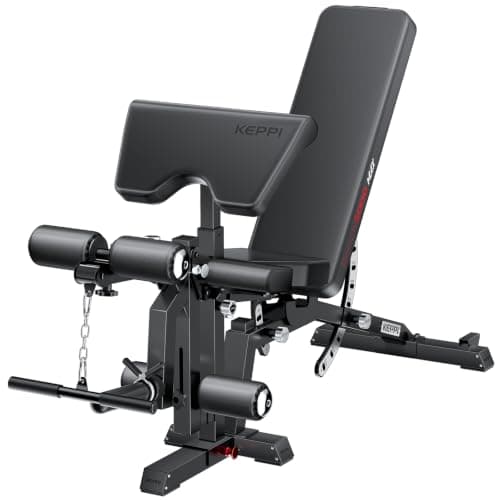
Our Keppi 3000 V2 weight bench review: 600kg rating, 12 backrest angles with decline, leg extension and preacher attachments, the catches and who should buy it.
How to set up an outdoor pull up bar in a UK garden: galvanised vs powder coat, concreting posts in, tree and wall mounts, ground cover and wet-weather grip.
Best Exercise is a participant in the Amazon EU Associates Programme, an affiliate advertising programme designed to provide a means for sites to earn advertising fees by advertising and linking to Amazon.co.uk. As an Amazon Associate we earn from qualifying purchases. This comes at no extra cost to you and never influences our independent reviews or rankings.