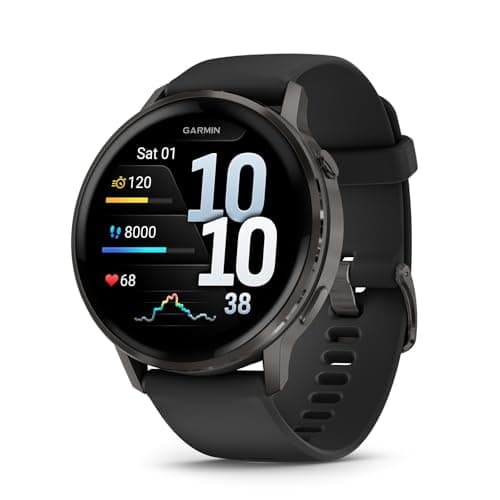
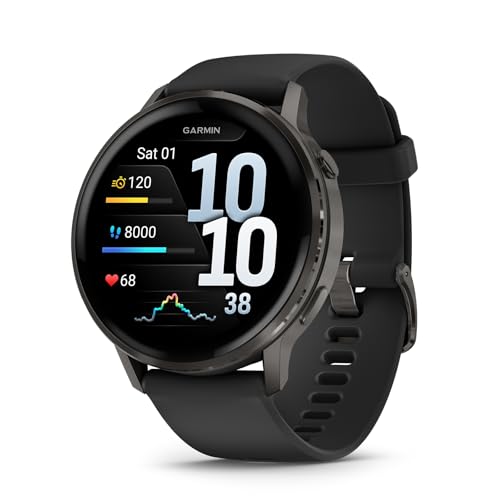
Garmin's Venu line has always been the range you buy when you want a Garmin that doesn't announce itself as sports equipment. The Venu 4 keeps that brief and then quietly annexes most of what used to justify buying a Forerunner: on-wrist running dynamics, a full training metrics suite, multi-band GNSS, ECG, an LED flashlight. At roughly £345 on Amazon UK it costs less than half of a Forerunner 970 and does about eighty percent of what most people would ever ask of one.
The remaining twenty percent is maps, and whether that matters is basically the whole buying decision.
How we review
This review draws on Garmin's published specifications and support documentation, the consistent findings across long-term reviews from established running and wearables outlets, and the recurring themes in verified owner feedback. We have not run our own six month endurance test of this exact unit, so we report findings that show up repeatedly rather than one reviewer's impression. Specs and prices were correct at the time of writing.
What Garmin actually changed
The Venu 3 was a good watch with a metal bezel bolted to a polymer case. The Venu 4 uses a full metal case, and the difference in the hand is more obvious than a spec sheet suggests: it feels like a watch you'd wear to something formal rather than a fitness tracker with aspirations. It also weighs more, which is the trade.
The display is brighter than the Venu 3's, and on the 45mm it's a 1.4 inch AMOLED panel. In direct summer sun the older watch needed a squint; this one doesn't. Positioning moves to multi-band GNSS across GPS, GLONASS, Beidou and Galileo, which is the meaningful upgrade for anyone running in a city where tall buildings used to turn a 5K into 5.4K.
Then there's the pile of smaller things that add up: an LED flashlight with white and red modes, a speaker and microphone for calls and voice control, and, for the first time on a Venu, running dynamics measured from the wrist alongside a genuine training metrics suite (Garmin).
ECG app, wrist heart rate, sleep coaching, Body Battery
Extras
LED flashlight with red mode, speaker and microphone, music
Amazon UK price
Around £345 at the time of writing
Battery life in practice
Garmin's own figures put the 45mm at up to 12 days in smartwatch mode against 10 for the 41mm, and roughly 19 hours of GPS recording at full accuracy against 13. Those numbers come with the usual assumptions about display settings and sensor use, which Garmin publishes rather than hides (Garmin support).
Switch the always-on display on and the picture changes sharply: around 4 days on the 45mm, 3 on the 41mm. That's the single biggest lever you control. Most people who report disappointing Venu battery life have always-on enabled and don't realise how expensive it is.
For a typical week of four or five hours of GPS activity plus continuous heart rate and sleep tracking, the 45mm lands somewhere in the 8 to 10 day range. You charge it on a Sunday and forget about it, which is the entire point of buying a Garmin over an Apple Watch.
The mapping problem
There's no way to soften this: the Venu 4 has no onboard maps. Navigation is breadcrumb style, so you get a line representing your route on an otherwise empty screen, with back-to-start, course following and saved locations. No contours, no street names, no trails.
In a city, following a planned route as a breadcrumb works fine and I've done it for years. On an unfamiliar hill in poor visibility, a line on a blank screen tells you where you should be and nothing about what's around you, and that's a materially worse experience than the Forerunner 970 or a Fenix gives you. There are Connect IQ workarounds that pipe turn-by-turn directions from your phone, but they need the phone, which defeats a chunk of the reason to own the watch.
Garmin has clearly decided mapping is what separates the Venu line from the Forerunner and Fenix ranges. That's a product decision, not an oversight, and it means the Venu 4 is the wrong watch for anyone whose training regularly takes them somewhere they don't know.
Health tracking and the ECG
The health side is where the Venu 4 justifies itself. Sleep coaching, Body Battery, stress tracking and the wrist heart rate sensor all work as well here as anywhere in Garmin's range, and the sleep reporting in particular has become genuinely useful rather than decorative.
The ECG app records a single-lead reading and checks for signs of atrial fibrillation, subject to regional availability. Treat it for what it is: an on-demand spot check. It cannot see an episode that starts at 3am, and it doesn't replace a proper cardiology assessment. If you have symptoms such as palpitations, breathlessness or dizziness, the NHS guidance on atrial fibrillation is the place to start, not a watch.
For the ordinary job of tracking whether you're actually hitting the muscle-strengthening and aerobic activity targets in the UK physical activity guidelines, it does that better than almost anything at the price.
Pros
Full metal case makes it feel like a watch rather than a tracker
Up to 12 days of battery on the 45mm with always-on switched off
Multi-band GNSS fixes the urban accuracy problems of older Venu models
First Venu with wrist-based running dynamics and a real training suite
LED flashlight with a red mode is more useful than it sounds
ECG, sleep coaching and Body Battery are the best in class at this price
Cons
No onboard maps at all, only breadcrumb navigation
Always-on display cuts battery life from around 12 days to around 4
45mm with a metal case is heavy on a smaller wrist
The 41mm gives up meaningful battery and GPS endurance to look better
Sits awkwardly close to Forerunner pricing, where you get mapping
Who should buy it
Buy the Venu 4 if you train four or five times a week, care about sleep and recovery data, want a watch that passes as jewellery in an office, and do your running and cycling on roads you already know. For that person it's close to the ideal Garmin, and it's the one I'd recommend over a Venu 3 without hesitating.
Skip it if you run trails, race ultras, or ever find yourself navigating somewhere unfamiliar. The Forerunner 265 is better value if running is the whole point, and the Forerunner 970 is the one to buy if you want maps on your wrist.
Is the Garmin Venu 4 worth upgrading to from the Venu 3?
If you own a Venu 3 and it works, the case for upgrading is thin. The Venu 4 gives you a full metal case rather than just a metal bezel, a brighter display, multi-band GNSS, an LED flashlight with a red mode, and the first proper training metrics suite the Venu line has had. Coming from a Venu 2 or a Vivoactive, the jump is far more worthwhile.
How long does the Garmin Venu 4 battery last?
Garmin quotes up to 12 days in smartwatch mode for the 45mm and 10 days for the 41mm, dropping to about 4 days and 3 days with the always-on display enabled. GPS recording at full accuracy is rated at roughly 19 hours on the 45mm and 13 hours on the 41mm. Real use with always-on off, background heart rate and a few hours of GPS a week tends to land around 8 to 10 days on the larger size.
Does the Garmin Venu 4 have maps?
No, and this is the watch's biggest limitation. There are no onboard topographic or street maps. Navigation is breadcrumb only: a line on a blank screen, plus back-to-start, course following and saved locations. That is fine for city running and gym work and genuinely poor on an unfamiliar trail. If you want maps at this kind of money, look at the Forerunner range instead.
Does the Garmin Venu 4 have ECG?
Yes, it supports Garmin's ECG app for recording a single-lead reading and checking for signs of atrial fibrillation, subject to regional availability and the current versions of the watch software and Garmin Connect. It is an on-demand spot check rather than continuous monitoring, so it will not catch an episode that happens while you are asleep, and it is not a substitute for a clinical assessment.
Venu 4 or Forerunner 265?
Pick the Venu 4 if you want a watch that looks like a watch, takes calls, tracks sleep and health properly, and does structured training as a strong secondary job. Pick the Forerunner 265 if running is the main event and you want a lighter case, running-first menus and better value. The Forerunner 970 is the one to buy if you want maps.
Which Venu 4 size should I buy?
The 45mm if your wrist can carry it, because you get 12 days of battery instead of 10 and about 19 hours of full-accuracy GPS instead of 13. The 41mm is the better-looking watch on a smaller wrist and gives up meaningful endurance to get there. Try both on if you can, since 45mm with a full metal case is a substantial object.
Are adjustable dumbbells worth it? We run the UK numbers on cost and floor space against a fixed hex set, then cover dial, twist and spin-lock types, drop risk and who should skip them.
The best barbell row alternatives for a tired lower back, no barbell, no equipment or a cable stack. Chest-supported rows, dumbbell and landmine options, inverted rows and more, with form cues.
How to do the Cuban press step by step, the light dumbbell or bar weights to use, the rotator cuff and shoulder muscles it trains, common mistakes and easy variations.
How to do the kettlebell gorilla row with good form. Muscles worked, step-by-step cues, what weight to use, common mistakes, variations and a simple sets and reps plan.
Best Exercise is a participant in the Amazon EU Associates Programme, an affiliate advertising programme designed to provide a means for sites to earn advertising fees by advertising and linking to Amazon.co.uk. As an Amazon Associate we earn from qualifying purchases. This comes at no extra cost to you and never influences our independent reviews or rankings.