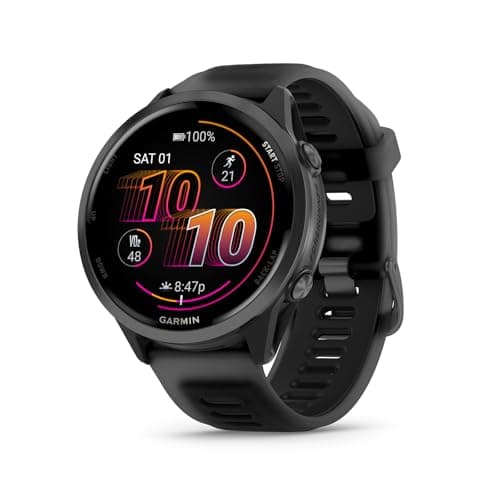
Garmin gave the Forerunner 570 a screen that outclasses its price, a speaker you will actually use, and two case sizes so that people with normal wrists are not forced into a 47mm slab. Then it priced the thing at roughly £440 and removed maps and ECG so nobody would cannibalise the 970. That decision is the whole story of this watch.
Judged on its own, it is excellent. Judged on the shelf next to a discounted Forerunner 265 below and a Forerunner 970 above, it occupies an awkward middle where you can feel the marketing department's fingerprints. Whether that bothers you depends entirely on how much you care about navigation.
How we review
This is a research-led review built from Garmin's published specifications, the recurring findings in long-term testing by established running publications, and patterns across verified owner reviews. We have not run our own multi-month test of this specific unit, so we stick to what shows up consistently rather than one reviewer's opinion. Prices and specs were accurate at the time of writing.
Who it is for
Road runners and triathletes who want a premium-feeling watch with modern training metrics and do not navigate unfamiliar routes. It suits smaller wrists particularly well, since the 42mm version loses nothing but screen area. Anyone who trains for a marathon on known routes, does structured sessions, and wants their pace visible in bright sun will get on with it immediately.
The people who should look elsewhere are trail and ultra runners, who need maps, and budget-conscious buyers who can find a 265 at a discount and will not miss the voice features.
Pros
Bright, sharp AMOLED display that is easy to read in direct sunlight
Two case sizes, 42mm and 47mm, with no feature difference between them
Built-in speaker and microphone for calls and voice commands
Multi-band GNSS for accurate tracking in cities and woodland
Triathlon Coach plans and full multisport support
Evening Report and the usual excellent Garmin training load tools
Cons
No offline maps, only breadcrumb course following
No ECG and no skin temperature sensor
Battery life is modest at 18 hours GPS and around 10 to 11 days smartwatch
Priced close enough to the 970 that the missing features sting
Aluminium bezel and standard lens rather than titanium and sapphire
The screen and the build
The AMOLED panel is the best thing here. Colours are punchy, the touchscreen responds without lag, and glancing at your pace mid-interval takes no effort at all. Garmin has also finally made the always-on mode look good rather than dim and grey, though leaving it on will cost you battery.
Build quality sits a clear step below the 970. You get an aluminium bezel instead of titanium and a standard lens instead of sapphire, which in practice means it will pick up scratches faster if you are the sort of runner who clips doorframes. The upside is weight and comfort, and the strap design is a genuine improvement over the older Forerunners, with a softer silicone that stops the sweaty suction effect on long runs.
What Garmin left out
No maps. That is the headline omission and it is deliberate. You can load a course and follow a breadcrumb trail, which works fine on a route you already know or a marked race route, and it is useless when you take a wrong turn in an unfamiliar town and need to find your way back. Garmin quotes the 47mm at up to 11 days in smartwatch mode and 18 hours of GPS, so battery was not the reason for cutting maps.
No ECG either, and no skin temperature sensor. Neither is a training feature, and plenty of runners will shrug. If you bought a watch partly for health monitoring, though, this is where the 570 quietly stops competing with watches costing not much more.
Garmin Forerunner 570 key specs
Case sizes
42mm and 47mm, aluminium bezel
Display
AMOLED touchscreen, 1.2in or 1.4in
Battery, smartwatch
Up to 10 days (42mm), 11 days (47mm)
Battery, GPS
Up to 18 hours
GNSS
Multi-band with SatIQ
Maps
No offline maps, breadcrumb course following only
Health sensors
Elevate optical HR, pulse ox. No ECG, no skin temperature
Audio
Built-in speaker and microphone, voice commands
Water rating
5 ATM, pool and open water swim profiles
Extras
Garmin Pay, music storage, Triathlon Coach, Evening Report
Training features and accuracy
Everything that makes Garmin watches worth owning is present. Training Readiness, acute and chronic load, HRV status, race predictions, daily suggested workouts and structured multisport sessions all behave exactly as they do on the pricier models. Triathlon Coach is the notable addition, giving adaptive plans for sprint through to half distance racing, and it is a proper feature rather than a menu item.
Multi-band GPS tracking is accurate enough that comparing traces with a training partner on a cheaper watch is mildly embarrassing for them. Optical heart rate is good in steady state and less reliable in short intervals, which is the standard limitation of wrist sensors rather than a Garmin failing. Validation research consistently finds wrist devices tracking chest straps well during running while losing accuracy at lower intensities and during erratic movement. Pair a strap for interval and gym sessions if the numbers matter to you. Our heart rate monitor guide has the options.
The voice features
The speaker and microphone are better than they sound on a spec sheet. Saying "start run" while your hands are cold and gloved works, taking a phone call from your wrist on a recovery jog is oddly practical, and the audio prompts for interval sessions come through your watch rather than needing headphones. None of this makes you faster. It does make the watch pleasant to live with.
Value
Here is the uncomfortable arithmetic. At around £440, the 570 sits roughly £150 below the 970, and that £150 buys maps, ECG, a flashlight, titanium and sapphire. Meanwhile the 265 does the core training work for meaningfully less. The 570 is the right buy for a specific person: someone who wants a modern, bright, well-built running watch in a smaller case, who will never need offline navigation, and who does not want to spend £600. That person exists in large numbers. Just be honest about whether you are them, and check our best Garmin watch guide before you commit.
No, and that is the single biggest thing separating it from the Forerunner 970. You get breadcrumb navigation along a course you have loaded, which shows a line to follow, but there are no full colour offline maps and no turn by turn directions through streets you do not know. If navigation matters, the 970 is the watch.
Forerunner 570 or Forerunner 265?
The 570 adds a speaker and microphone, voice commands, a brighter aluminium-bezelled build, Triathlon Coach and the Evening Report. The 265 gives you the same core training metrics and multi-band GPS for substantially less money. Unless you specifically want the voice features or the newer design, the 265 is the better value buy.
How long does the Forerunner 570 battery last?
Garmin quotes about 10 days in smartwatch mode for the 42mm and 11 days for the 47mm, with up to 18 hours of GPS tracking. That covers any marathon comfortably and most long training weeks, but it is less than the 265 managed and well short of the 970.
Does the Forerunner 570 have ECG?
No. Garmin reserved the ECG app for the 970 in this generation, so the 570 covers optical heart rate, pulse ox and the standard sleep and stress tracking without the single-lead ECG recording. Skin temperature sensing is also absent.
What sizes does the Forerunner 570 come in?
Two, 42mm and 47mm, which is a real advantage over the 970's single 47mm option. Anyone with smaller wrists gets a watch that actually fits without losing any features, and the only difference between the sizes is screen area and roughly a day of battery life.
Is the Forerunner 570 waterproof for swimming?
Yes, it carries a 5 ATM rating and has pool and open water swim profiles, so lane swimming and sea swims are both fine. It is not built for scuba or high pressure water sports, which is standard across the Forerunner line.
Are adjustable dumbbells worth it? We run the UK numbers on cost and floor space against a fixed hex set, then cover dial, twist and spin-lock types, drop risk and who should skip them.
The best barbell row alternatives for a tired lower back, no barbell, no equipment or a cable stack. Chest-supported rows, dumbbell and landmine options, inverted rows and more, with form cues.
How to do the Cuban press step by step, the light dumbbell or bar weights to use, the rotator cuff and shoulder muscles it trains, common mistakes and easy variations.
How to do the kettlebell gorilla row with good form. Muscles worked, step-by-step cues, what weight to use, common mistakes, variations and a simple sets and reps plan.
Best Exercise is a participant in the Amazon EU Associates Programme, an affiliate advertising programme designed to provide a means for sites to earn advertising fees by advertising and linking to Amazon.co.uk. As an Amazon Associate we earn from qualifying purchases. This comes at no extra cost to you and never influences our independent reviews or rankings.