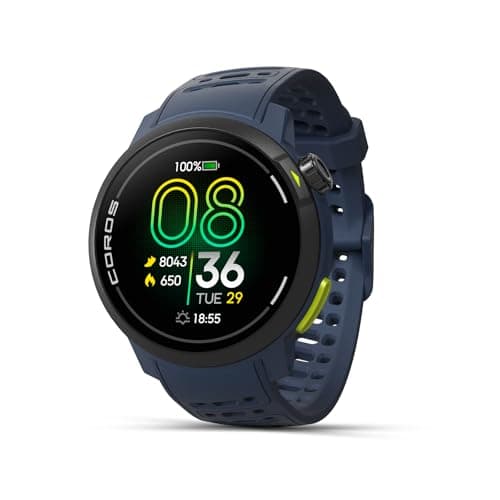
COROS has spent five years quietly building running watches that embarrass Garmin on price, and the PACE Pro is the sharpest example yet. Around £299 buys a 1.3 inch AMOLED panel running at 1500 nits, 38 hours of GPS recording, 32GB of storage and free global offline maps. Garmin charges considerably more for that combination, and in some cases does not offer it at all.
The catch is not the hardware. It is everything around the hardware, because COROS is a much smaller company and it shows in the ecosystem rather than the engineering.
How we review
This review is based on COROS's published specifications, the consistent findings across long-form testing by established endurance and wearables publications, and recurring themes in verified owner reviews. We have not run our own six month test of this unit, so we report only what shows up repeatedly rather than one reviewer's impression. Specs and prices were correct at the time of writing.
Who it is for
Runners, cyclists and triathletes who want training data and battery life without paying flagship money, and who are happy for a watch to be a watch. It suits people frustrated by Garmin Connect's sprawl, since the COROS app is noticeably calmer to navigate. Ultra runners get particular value, because 38 hours of GPS at this price is unusual.
It is the wrong watch if you tap your wrist to pay for things, if your music lives in Spotify, or if you rely on turn by turn navigation in unfamiliar cities. Those are not small omissions and no amount of screen brightness compensates.
Pros
1.3in AMOLED at 1500 nits, one of the brightest screens on any running watch
38 hours of GPS with all systems, 31 hours in dual frequency
Roughly 20 days of daily use battery, exceptional for an AMOLED watch
Free global offline topographic maps with no subscription
32GB of storage and a fast processor that makes the interface feel instant
Light at around 37g with the nylon strap
Around £299, which undercuts comparable Garmins by a wide margin
Cons
No NFC, so no contactless payment of any kind
Music is MP3 files only, with no Spotify or podcast support
Maps are viewable and downloadable but not routable for turn by turn navigation
Almost no third-party app ecosystem compared with Garmin or Suunto
Screen has drawn durability complaints from owners in rough outdoor use
The screen and the build
At 1500 nits the display is brighter than most phones, and in direct summer sun you read your splits without breaking stride. COROS also gets the interface right, pairing the touchscreen with a physical digital dial that works with wet hands and gloves, which is the single most practical design decision on the watch.
Weight is the other pleasant surprise. Roughly 37g with the nylon strap, or about 49g with silicone, puts it among the lightest AMOLED watches you can buy, and after a couple of hours you stop noticing it is there. The one recurring complaint from owners is screen durability: the lens picks up marks more readily than a sapphire-lensed Garmin, so if you scrape doorframes and rock faces, take that seriously.
COROS PACE Pro key specs
Display
1.3in AMOLED touchscreen, 1500 nits
Weight
Approx 37g with nylon strap, 49g with silicone
Battery, daily use
Around 20 days
Battery, all systems GPS
Up to 38 hours
Battery, dual frequency
Up to 31 hours
GNSS
Dual frequency, five satellite systems
Storage
32GB, MP3 playback only
Maps
Free global offline topo maps, breadcrumb navigation, not routable
Controls
Touchscreen plus digital dial
Payments
None, no NFC
Price
Around £299 at the time of writing
Battery life is the headline
Around 20 days of daily use and 38 hours of all-systems GPS from a bright AMOLED watch is the specification that makes people switch brands. Garmin's equivalent AMOLED models generally trade brightness against endurance, and COROS has somehow avoided the compromise. A marathon takes maybe 8% of the charge. A hundred mile ultra fits inside one charge with room left over, which is the sort of claim that used to require an ugly memory-in-pixel screen.
Real world figures land close to the published ones, which is not always true of watch marketing. Leave the always-on display running and expect the daily use number to halve, though even then you are charging fortnightly.
Maps, navigation and the honest limits
COROS publishes the full specification list on its official PACE Pro specs page, and the mapping entry needs reading carefully. You get free global offline topographic maps that download to the watch, and they are genuinely useful for seeing terrain and checking where a path goes. What you do not get is routable navigation, so the watch cannot generate turn by turn directions to somewhere you point at. Load a route and follow the breadcrumb, and it works. Get lost improvising, and it will show you a map but not a way home.
Route syncing is the other rough edge owners raise, with Wi-Fi transfers to the watch being more temperamental than Garmin's. It is a minor irritation on a Sunday morning and a real one if you plan routes the night before a race.
Training data and heart rate
The COROS training platform is deliberately less busy than Garmin's, giving you effort pace, training load, recovery timing and a running fitness estimate without burying you in scores. Runners who found Garmin Connect overwhelming tend to prefer it. Runners who love data dashboards will find it thin.
Wrist heart rate is solid at steady effort and, like every optical sensor, less trustworthy during short intervals. Validation work on wrist devices consistently shows close agreement with chest straps during running while accuracy falls away at lower intensities and with erratic wrist movement. Pair a strap for track sessions and gym work. The heart rate monitor guide covers what to buy.
COROS versus Garmin, plainly
Buy the COROS if the watch is for training and racing, if battery life matters, and if you would rather spend £300 than £600. Buy a Garmin Forerunner if you want contactless payment, streaming music, real navigation and a mature app ecosystem, and accept that you are paying for the ecosystem rather than better running hardware.
There is no wrong answer, and anyone weighing it up should also read our best Garmin watch guide to see what the extra money actually buys. If your training is mostly indoors on a bike or a treadmill, the watch matters far less than the machine, and our exercise bike and treadmill guides are the better place to spend.
Is the COROS PACE Pro better than a Garmin Forerunner?
On raw specification per pound, comfortably. At around £299 it offers a brighter screen and longer GPS battery than Garmin watches costing considerably more. Garmin wins on ecosystem: contactless payment, a large third-party app store, streaming music support and routable navigation. Which matters more depends on whether you want a running watch or a smartwatch that runs.
How long does the COROS PACE Pro battery last?
COROS quotes around 20 days in daily use, 38 hours with all satellite systems on, and 31 hours in dual frequency mode. Those figures hold up well in practice and they are far ahead of most AMOLED watches at this price. A marathon costs you a small fraction of a charge.
Does the COROS PACE Pro have maps?
Yes, free global offline topographic maps that you download to the watch, plus breadcrumb navigation along a loaded route. What you do not get is routable turn by turn navigation through streets, which is what Garmin's mapping does. For following a planned route it works well, for improvising a way home it is limited.
Can you pay with the COROS PACE Pro?
No. There is no NFC and no contactless payment on any COROS watch, so you still need a card or phone for a mid-run coffee. It is the most commonly cited omission from owners coming across from Garmin or Apple.
Can you play music on the COROS PACE Pro?
Only MP3 files you own and load onto the 32GB of internal storage. Spotify, Apple Music and other streaming services are not supported, and neither are podcast apps. If your running playlist lives in a streaming app, you will be carrying your phone.
Is the COROS PACE Pro good for beginners?
Yes, though it is arguably more watch than a new runner needs. The COROS app is clean and less overwhelming than Garmin Connect, the training metrics are sensible rather than exhausting, and the battery means charging is a fortnightly job. The cheaper COROS PACE 3 covers the basics for £100 less.
Are adjustable dumbbells worth it? We run the UK numbers on cost and floor space against a fixed hex set, then cover dial, twist and spin-lock types, drop risk and who should skip them.
The best barbell row alternatives for a tired lower back, no barbell, no equipment or a cable stack. Chest-supported rows, dumbbell and landmine options, inverted rows and more, with form cues.
How to do the Cuban press step by step, the light dumbbell or bar weights to use, the rotator cuff and shoulder muscles it trains, common mistakes and easy variations.
How to do the kettlebell gorilla row with good form. Muscles worked, step-by-step cues, what weight to use, common mistakes, variations and a simple sets and reps plan.
Best Exercise is a participant in the Amazon EU Associates Programme, an affiliate advertising programme designed to provide a means for sites to earn advertising fees by advertising and linking to Amazon.co.uk. As an Amazon Associate we earn from qualifying purchases. This comes at no extra cost to you and never influences our independent reviews or rankings.