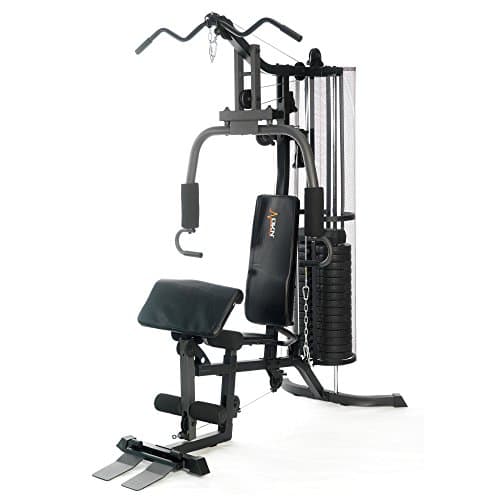
DKN is a French fitness brand that has quietly sold cardio and strength kit in the UK for years without ever making much noise about it. The Studio 7400 is its compact home multi gym: an 80kg stack, five stations, and a footprint of 165cm by 105cm that fits in a garage or a large spare room without a rebuild. It lists at £799 on DKN's own site and sells for around £499 on Amazon UK, which is the number that makes it interesting.
At that price it sits between the flimsy sub-£300 machines and the twin-stack units that cost four figures. What you get for the money is a well-built single-stack gym with a genuinely useful spread of stations, held back by an assembly experience that owners have been complaining about for years.
How we review
This review is based on DKN's published specification for the Studio 7400, the Amazon UK listing details, and the recurring themes across verified owner reviews rather than a long-term test of our own unit. Where the manufacturer and the retail listing disagree on a specification, we say so. Prices are correct at the time of writing.
Who it is for
Someone training alone at home who wants guided resistance work covering the whole body, with no spotter and no barbell. It suits general strength and conditioning, rehab-adjacent training, and anyone who wants to lift without the technical learning curve of free weights.
Experienced lifters chasing a heavy squat or deadlift should spend the money on a power cage and a barbell instead. An 80kg stack is a ceiling, and there's no upgrade path.
Pros
80kg weight stack, which is generous for a machine at this price
Five stations: high and low pulley, dual-action chest press and pec deck, butterfly, preacher pad, leg developer
Double pulley with micro cable adjustment for small resistance changes
Compact 165cm x 105cm footprint for what it does
Multi-position padded seat adjusts for different heights
Around £499 on Amazon against a £799 list price
144kg of machine, so it stays planted during heavy sets
Cons
Assembly commonly takes most of a day, and the manual is poor
Single stack, so only one person trains at a time
80kg ceiling with no stack upgrade available
Max user weight is listed as 150kg by DKN and 120kg on Amazon
Leg developer range suits average heights better than tall users
Two year warranty, shorter than the lifetime cover on premium machines
Stations and what they cover
The high pulley handles lat pulldowns, triceps pushdowns and straight-arm work. The low pulley covers rows, curls, upright rows and cable kicks. Between them you can build a complete pull session, and the lat pulldown alone justifies half the machine for anyone who can't yet do pull-ups.
The dual-action chest station is the clever part: it gives you a chest press and a pec deck from the same seated position without changing attachments, which saves the faff that makes people skip chest work on cheaper machines. The one-piece butterfly press handles the fly pattern.
An adjustable preacher pad bolts on for curls, and the leg developer at the bottom covers leg extensions and leg curls. That leg station is where taller users hit the limits first; the pad positions suit somewhere around average height best.
DKN Studio 7400 key specs
Weight stack
80kg (176lb)
Stations
High and low pulley, dual-action chest, butterfly press, preacher pad, leg developer
Pulley system
Double pulley with micro cable adjustment
Dimensions
165cm L x 105cm W x 210cm H
Machine weight
144kg
Max user weight
150kg per DKN, 120kg per the Amazon listing
Seat
Multi-position, padded
Warranty
2 years
Build quality
For £499, the frame is better than it needs to be. At 144kg the machine does not shift under a hard pulldown, the upholstery is thick enough to still be comfortable after a year, and the guide rods run smoothly once the cables have bedded in over the first few sessions. Owner reviews cluster around the same praise: it feels considerably more solid than the price suggests, and the pulleys stay quiet.
The double pulley with micro adjustment deserves a mention. Small increments matter more on a machine than they do with dumbbells, because you can't half-load a plate, and being able to make a 2 or 3kg change rather than a 5kg one keeps progression sensible on smaller movements like curls and lateral work.
The assembly problem
Every honest review of this machine lands here. Owners repeatedly describe the build as taking four to seven hours, and the instruction manual as the single worst part of the product. The parts themselves fit properly; the documentation just doesn't explain the order clearly enough.
Practical advice from people who have done it: get two people, sort and label every bag of fixings before you touch a bolt, work from the exploded diagrams rather than the text, and assemble the machine in its final position because 144kg is not something you slide across a garage afterwards. Set aside a Saturday and treat any earlier finish as a bonus.
Where it falls short
The 80kg stack is the honest limit. For most people it will take years to outgrow, but strong lifters will max out the pulldown and chest press within months, and DKN offers no stack upgrade.
Single-station design means one person trains at a time, which is fine for an individual and frustrating for a couple. And a multi gym, however good, cannot replicate the pattern of a loaded squat: research comparing closed chain training against machine-based open chain work found different regional growth patterns from the two, which is a technical way of saying they complement each other rather than substitute. Add a weight bench and some dumbbells if you have the space and the budget.
Value
Against the rest of the market it holds up well. The Marcy MWM-990 is the obvious rival at a similar price with a smaller stack, and the Senshi Japan multi gym undercuts both on cost while giving up build quality. Our multi gym guide puts the whole field side by side.
The Studio 7400's case rests on that £499 Amazon price against a £799 list. At £799 it would be a hard sell next to twin-stack machines. At £499 it is one of the better ways to get a complete guided strength setup into a UK garage, and it makes hitting the NHS target of strengthening work on at least two days a week genuinely convenient.
Frequently asked questions
Is the DKN Studio 7400 good value?
At around £499 on Amazon UK against a £799 list price on DKN's own site, it is one of the better value single-stack multi gyms sold here. You get 80kg of plates, a double pulley system with micro adjustment, and five workout stations in a 165cm by 105cm footprint. The build quality is a clear step above the sub-£300 machines.
How long does the DKN Studio 7400 take to assemble?
Owners consistently report most of a day, commonly four to seven hours with two people, and the instruction manual draws more criticism than any other part of the machine. Lay out and label the fixings before you start, and expect to reference the exploded diagrams more than the written steps.
What is the maximum user weight?
The specifications disagree, which is worth knowing before you buy. DKN's own product page states 150kg, while the Amazon UK listing states 120kg. Treat 120kg as the safe working figure unless DKN confirms otherwise for your unit.
Is 80kg enough weight for a multi gym?
For pulldowns, rows, chest press, curls and leg work it covers most people for a long time, particularly since the pulley routing means the effective resistance varies by station. Strong lifters will outgrow the lat pulldown and chest press first. There is no stack upgrade, so if you are already pulling more than 80kg, look at a plate-loaded machine or a power cage instead.
Can more than one person use it at a time?
No. The Studio 7400 is a single-stack, single-station design, so one person trains while the other waits. That is the trade-off for the compact footprint compared with the twin-stack machines that need twice the floor space.
Does it replace free weights?
Not entirely. A multi gym is excellent for controlled, guided movements and for training alone without a spotter, but it cannot give you barbell squats, deadlifts or any of the bracing and balance demand that comes with them. Most people who own one end up adding a bench and a pair of adjustable dumbbells.
EnterSports 27kg adjustable dumbbells review: 10 settings from 2 to 27kg, uneven 2.5 to 3kg jumps, dial lock, wobble and who should pick it over the 20kg pair.
What a glute ham developer is, how a GHD machine differs from a Roman chair, the exercises it's built for, how to set it up, UK price bands and cheaper substitutes.
Which lat pulldown attachment to use or buy: straight, angled, V-bar, neutral-grip, rope and D-handles explained, plus how to choose a rack-mounted pulldown unit.
What a Roman chair is, how it differs from a hyperextension bench, GHD and captain's chair, 45-degree vs horizontal, how to set the pad height, the best exercises and what to check before you buy.
Best Exercise is a participant in the Amazon EU Associates Programme, an affiliate advertising programme designed to provide a means for sites to earn advertising fees by advertising and linking to Amazon.co.uk. As an Amazon Associate we earn from qualifying purchases. This comes at no extra cost to you and never influences our independent reviews or rankings.