Nutrition
Active Calories vs Total Calories: What Your Watch Means
Active calories vs total calories explained: what Apple Watch, Garmin, Fitbit and Whoop count, how accurate they are, and how many to eat back for weight loss.

By Mike Shilling, Recovery & Training Editor · Updated 27 July 2026
We may earn a commission from qualifying purchases made through links on this page, at no extra cost to you. This never affects our ratings.
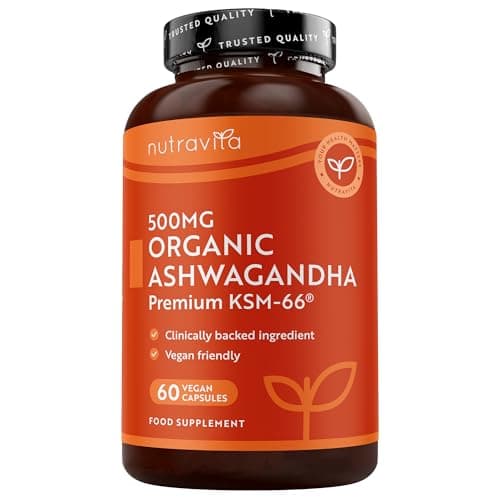
Ashwagandha is the supplement aisle's current favourite, and the UK shelves are now stacked with tubs promising 10,000mg of it. That number is almost never what it looks like. Most of the market runs on raw-root equivalent figures, unstandardised extracts and vague claims, so picking a good one means reading past the front of the label to what is actually in the capsule.
Below are five ashwagandha supplements worth buying on Amazon UK, ranked on extract quality, withanolide content and honest cost per day. There is also a safety section that most sellers would rather you skipped, and you should read it.
How we chose
We researched the best-reviewed ashwagandha products on Amazon UK against published trial protocols, not through our own testing. Picks were judged on whether the extract is standardised and named, the stated withanolide content, the real daily dose of extract (as opposed to raw-root equivalents), cost per day and label transparency. Prices are correct at the time of writing.
Two products can both say "6000mg ashwagandha" and contain wildly different amounts of active material. Here is why.
A 10:1 extract means 10kg of root was concentrated into 1kg of extract. A capsule containing 500mg of that extract can legally be marketed as "5000mg ashwagandha (equivalent to raw root)". The number on the tub is not what you swallow; it is what the manufacturer started with. So the questions worth asking are how many milligrams of extract you actually get, what the withanolide percentage is, and whether the extract is a named, standardised one.
Trials that reported an effect on stress mostly used 250mg to 600mg of standardised extract daily. Judge every product on this list against that number.
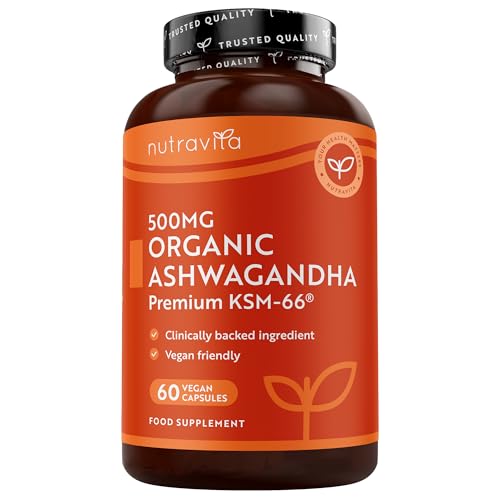
Nutravita's version gives you 500mg of KSM-66 root extract per capsule, standardised to at least 5% withanolides, which lands square in the middle of the dosing range used in the research. The tub is labelled 6000mg, which is the raw-root equivalent, and to Nutravita's credit the 500mg extract figure is stated plainly rather than buried.
KSM-66 matters because it is root-only and consistently standardised, which removes most of the batch-to-batch variability that plagues generic extracts. A systematic review and meta-analysis of randomised trials found significant reductions in perceived stress and serum cortisol against placebo across formulations in this dose range (Explore, 2024), with the caveat that the individual studies were small and often industry-funded.
Sixty capsules at around £14 works out at roughly 24p a day for a two-month supply. It is also certified organic and vegan, and the capsules are small enough to swallow without ceremony. The main gripe from owners is exactly the one you would expect from any effective adaptogen: some people find it makes them drowsy in the afternoon, which is a dosing-time problem rather than a product fault.
Check price on Amazon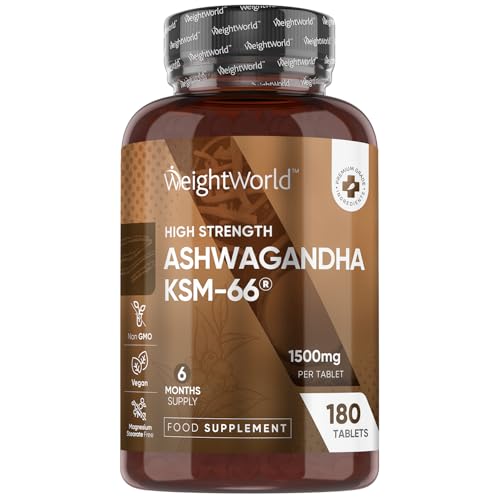
Six months of KSM-66 for under a tenner is a difficult offer to argue with. WeightWorld's tablets are labelled 1500mg, and as with every product in this category that headline figure is the raw-root equivalent rather than the extract weight, so the actual KSM-66 dose per tablet is a fraction of it. Take two a day if you want to sit in the range the trials used, which turns six months into three.
Even at two tablets daily this is the cheapest way to run a proper trial on yourself. Tablets rather than capsules means a firmer swallow and no vegetarian capsule shell to worry about, though a few owners find them slightly chalky.
Buy it if you want to test whether ashwagandha does anything for you before committing to a pricier tub. Do not buy it expecting the label number to be the dose.
Check price on Amazon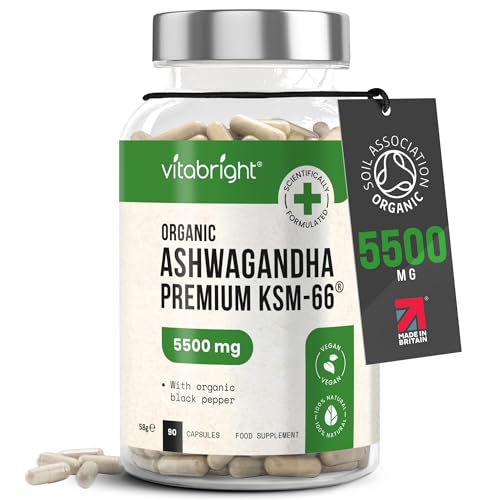
VitaBright markets this as 5500mg with a three-month supply, again a raw-root equivalent, and again built on KSM-66. What separates it from the Nutravita tub is the serving structure: it is designed around a higher daily extract dose, which suits anyone who has tried a modest dose and felt nothing.
That is a real use case. Response to ashwagandha varies enormously between people, and the trials that reported effects on sleep quality tended to sit at the upper end of the dose range. A review looking specifically at anxiety and insomnia outcomes found benefits alongside a reminder that safety data beyond three months is genuinely limited (review, 2024).
At around £18 for three months, the cost per day is still under 20p. The caution here is straightforward: more is not automatically better with a herb that has a liver injury signal attached to it. Start low, and do not run it indefinitely.
Check price on Amazon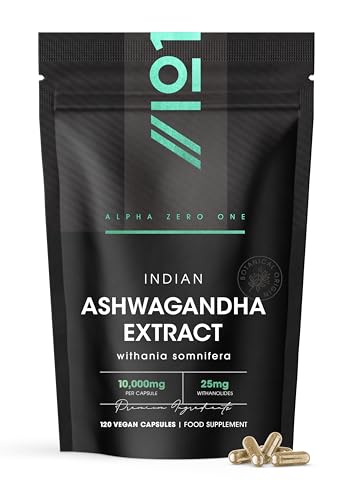
This is the pick for anyone who wants the withanolide number stated outright rather than inferred. ALPHA01 lists 25mg of withanolides per serving from a 5% standardised extract, and adds BioPerine, a branded black pepper extract used to improve absorption of certain compounds.
The BioPerine addition is worth a raised eyebrow. It has decent evidence for improving the bioavailability of curcumin; the case for it doing much for withanolides is far weaker. Treat it as a neutral inclusion rather than a selling point.
What you are really buying is transparency: 120 vegan capsules at around £13, with the active compound quantified on the label. It is not KSM-66, so you lose the direct link to the branded extract used in much of the published research, and that is the honest trade-off against the two picks above.
Check price on Amazon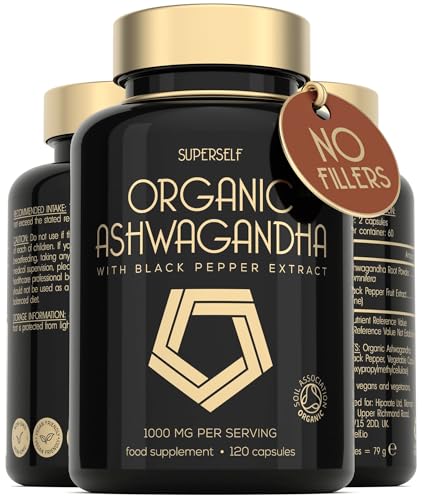
SuperSelf keeps it simple: organic ashwagandha root, 1000mg per serving, around £10. This is whole root powder rather than a concentrated standardised extract, which changes what you should expect from it. Whole root contains a much lower percentage of withanolides than a 5% standardised extract, so 1000mg of powder is not comparable to 500mg of KSM-66.
That is not automatically a mark against it. Whole root is the traditional preparation, it is certified organic here, and plenty of people prefer a less concentrated product for daily use. It is also the gentlest option if concentrated extracts have upset your stomach before.
Buy it if you want organic whole root at a low price and you are relaxed about the dose being less precise. If you want to match what the trials did, buy a standardised extract instead.
Check price on AmazonAshwagandha is generally well tolerated, and in clinical trials serious adverse events have been rare. But cases of clinically apparent liver injury have been reported in people taking commercial ashwagandha products, typically showing up between two and twelve weeks after starting, and the NIH LiverTox database now classifies it as a probable cause (LiverTox, National Institute of Diabetes and Digestive and Kidney Diseases). Jaundice, dark urine, pale stools or persistent itching mean stop taking it and see a doctor.
Beyond that: avoid it entirely in pregnancy, because traditional use includes abortifacient properties. Speak to your GP first if you have thyroid disease, since ashwagandha can raise thyroid hormone levels, or if you take sedatives, benzodiazepines or immunosuppressants. And do not treat it as an alternative to proper care for anxiety or depression.
None of that means you should not take it. It means you should take it deliberately, for a defined period, and pay attention to how you feel.
If your actual problem is poor sleep or a stressful few months, ashwagandha is worth a controlled eight-week try alongside the boring fundamentals. Magnesium, a consistent bedtime and enough training volume to tire you out do more for most people than any capsule, and our magnesium guide covers the forms that are actually absorbed. Omega 3 belongs on that same list of boring fundamentals, and our guide to the best cod liver oil capsules and fish oils ranks them on EPA and DHA per serving instead of the headline milligrams on the tub.
Nutravita's certified organic KSM-66 capsules are the best all-round pick. KSM-66 is a root-only extract standardised to at least 5% withanolides, it is the form used in a large share of the published trials, and Nutravita states the actual extract dose on the label rather than hiding behind a raw-root equivalent number.
KSM-66 is a branded ashwagandha extract made only from the root, standardised to at least 5% withanolides, which are the compounds thought to do the work. Sensoril is the other common branded extract, made from root and leaf, with a higher withanolide percentage and a more sedating reputation. Anything sold as generic ashwagandha extract may vary a lot batch to batch.
The evidence is moderately encouraging rather than conclusive. Meta-analyses of randomised trials report reductions in perceived stress scores and in serum cortisol against placebo, but the trials are mostly small, mostly short, and a good number were funded by the ingredient manufacturers. It is not a substitute for treating anxiety properly.
Most trials used between 250mg and 600mg of a standardised extract per day, usually split into one or two doses, for 30 to 90 days. That is extract, not raw root powder. If a label says 6000mg or 10,000mg, check whether that is the extract dose or a raw-root equivalent figure, because it is almost always the latter.
Most people tolerate it, with drowsiness and mild stomach upset the usual complaints. The serious concern is liver injury: the NIH LiverTox database lists ashwagandha as a probable cause of clinically apparent liver injury, typically appearing 2 to 12 weeks after starting. Stop and see a doctor if you develop jaundice, dark urine or itchy skin. Avoid it in pregnancy, and talk to your GP first if you have thyroid disease or take sedatives.
If you are taking it for sleep, take it in the evening about an hour before bed. If you are taking it for daytime stress, take it with breakfast, since taking it on an empty stomach makes nausea more likely. Splitting the dose across both is what several trials did.
Active calories vs total calories explained: what Apple Watch, Garmin, Fitbit and Whoop count, how accurate they are, and how many to eat back for weight loss.
The best multivitamin UK buyers can get right now, compared on nutrient forms, dose and price, plus what changes for seniors and over 50s and the honest evidence on who benefits.
How much water should you drink with creatine? The honest answer: mix each 3 to 5g dose in 250 to 350ml, then drink to normal needs. Loading, cramps and dehydration myths explained.
Creatine gummies vs powder, with real UK prices per 5g dose. Gummies cost 4 to 10 times more and some fail lab tests. Here's when each one actually makes sense.
Best Exercise is a participant in the Amazon EU Associates Programme, an affiliate advertising programme designed to provide a means for sites to earn advertising fees by advertising and linking to Amazon.co.uk. As an Amazon Associate we earn from qualifying purchases. This comes at no extra cost to you and never influences our independent reviews or rankings.